Regeneron Pharmaceuticals stands out among large-cap biotech companies for its combination of steady commercial cash flows and a robust, internally funded research pipeline. The company's position rests on two main pillars: Dupixent (dupilumab), an immunology therapy developed in partnership with Sanofi, and the Eylea family of treatments for eye diseases, which it shares with Bayer. Dupixent delivered roughly $17.8 billion in global sales in 2025, reflecting about 32% year-over-year growth, and it continues to expand into areas such as chronic obstructive pulmonary disease (COPD) and chronic spontaneous urticaria (CSU).
In ophthalmology the picture is more layered, as Eylea HD gains traction while the original Eylea contends with biosimilar pressure. Regeneron's approach of shifting patients toward the higher-dose, longer-acting version—backed by the broadest label in its class and an expected prefilled syringe—supports revenue stability over the medium term. A pipeline of approximately 45 clinical candidates across oncology, immunology, rare diseases, and metabolic conditions adds flexibility that many competitors do not share. I also checked this using Tickeron’s AI Screener to see how the stock compares to others in the industry.
Regeneron heads into 2026 with a notably active catalyst schedule. The standout event is the Phase 3 readout for fianlimab, a LAG-3 antibody, paired with Libtayo (cemiplimab) in first-line advanced melanoma, anticipated in the first half of the year. A strong progression-free survival outcome could establish the combination as a meaningful alternative to current standards.
Additional items include a potential mid-2026 approval for the Eylea HD prefilled syringe, an FDA target action date in August 2026 for garetosmab in fibrodysplasia ossificans progressiva, and complement-inhibitor data for pozelimab and cemdisiran in geographic atrophy and PNH during the second half. Early commercial progress for Lynozyfic (linvoseltamab) in relapsed or refractory multiple myeloma is also drawing attention as a possible entry point into earlier treatment lines.
Analyst views remain generally positive yet show some variation. Consensus points to a "Moderate Buy" rating and an average 12-month price target around $840–$852, with highs near $1,030 and lows near $640. Recent moves include target increases from Guggenheim and J.P. Morgan alongside more measured stances from Morgan Stanley and RBC Capital. Bank of America's early-2026 upgrade from Underperform to Buy, highlighting Eylea HD momentum and 2026 events, reflects a modestly brighter sentiment overall.
Regeneron's path is closely tied to policy and economic factors. Drug-pricing reforms and Most Favored Nation negotiations rank among the largest variables; a favorable outcome could ease a persistent concern, whereas tighter controls might compress margins industry-wide. Interest rates affect valuations by altering the discount applied to long-term pipeline cash flows, with lower rates generally supportive of biotech multiples.
At the sector level, the rise of obesity and metabolic treatments centered on GLP-1 agents is redirecting investment. Regeneron's licensed olatorepatide program, which has shown competitive weight-loss results and a differentiated side-effect profile, offers a way to participate in this space even though commercialization remains years away. Biosimilar competition in ophthalmology and immunology further emphasizes the need for ongoing innovation and effective lifecycle management.
Looking ahead, Regeneron's trajectory depends on converting its pipeline optionality into additional commercial franchises. Consensus estimates anticipate faster earnings growth over the next two to three years, driven by Eylea HD, Dupixent, and early oncology launches, together with margin improvement as collaboration payments to Sanofi decline.
Structural drivers include further moves into obesity and cardiometabolic disease, advancement of complement and Factor XI programs, and potential from gene-writing and genetic-medicine work with Tessera Therapeutics and Alnylam. The company has also outlined sizable U.S. manufacturing investments, including roughly $1.1 billion to $1.3 billion in facility expansions during 2026. Principal risks involve clinical setbacks, increased biosimilar pressure, policy shifts on pricing, and concentration in a limited number of products. How these elements play out will influence whether the stock's valuation, which some view as under-appreciating pipeline potential, receives an upward re-rating.
In my own monitoring of names like REGN, I find Tickeron's Trend Prediction Engine helpful for gauging whether a stock may trend higher, lower, or sideways over the next week or month. The tool supplies searchable forecasts, historical context, and alerts that complement traditional analysis when evaluating potential breakouts or shifts in momentum.
The information on this webpage is provided for general informational and educational purposes only and is not intended as investment advice, a recommendation to purchase or sell any security, or an offer or solicitation related to investments. It does not consider your personal financial situation, goals, or risk profile, and all investing carries inherent risks, including the possibility of losing your entire investment. For more details, please review our full disclaimer.
Serhii Bondarenko is an AI-focused trading strategist and financial markets analyst specializing in the development and application of AI trading bots and autonomous trading agents. His work combines technical analysis, fundamental analysis, and quantitative research to identify market patterns, forecast price movements, and analyze liquidity, volatility, and correlations across global stock markets. Serhii actively publishes market insights, forecasts, and trading frameworks on platforms such as Investing.com and Finextra, with a strong focus on AI-driven decision-making and next-generation algorithmic trading. His research aims to bridge the gap between traditional trading methodologies and advanced artificial intelligence, helping traders and investors navigate complex and rapidly evolving market conditions.
The Aroon Indicator for REGN entered a downward trend on October 02, 2026. Tickeron's A.I.dvisor identified a pattern where the AroonDown red line was above 70 while the AroonUp green line was below 30 for three straight days. This could indicate a strong downward move is ahead for the stock. Traders may want to consider selling the stock or buying put options. A.I.dvisor looked at 158 similar instances where the Aroon Indicator formed such a pattern. In 113 of the 158 cases the stock moved lower. This puts the odds of a downward move at 72%.
The Momentum Indicator moved below the 0 level on September 28, 2026. You may want to consider selling the stock, shorting the stock, or exploring put options on REGN as a result. In 52 of 92 cases where the Momentum Indicator fell below 0, the stock fell further within the subsequent month. The odds of a continued downward trend are 57%.
The Moving Average Convergence Divergence Histogram (MACD) for REGN turned negative on August 26, 2026. This could be a sign that the stock is set to turn lower in the coming weeks. Traders may want to sell the stock or buy put options. Tickeron's A.I.dvisor looked at 49 similar instances when the indicator turned negative. In 27 of the 49 cases the stock turned lower in the days that followed. This puts the odds of success at 55%.
REGN moved below its 50-day moving average on September 28, 2026 date and that indicates a change from an upward trend to a downward trend.
The 10-day moving average for REGN crossed bearishly below the 50-day moving average on October 01, 2026. This indicates that the trend has shifted lower and could be considered a sell signal. In 9 of 15 past instances when the 10-day crossed below the 50-day, the stock continued to move higher over the following month. The odds of a continued downward trend are 60%.
Following a 3-day decline, the stock is projected to fall further. Considering past instances where REGN declined for three days, the price rose further in 50 of 62 cases within the following month. The odds of a continued downward trend are 54%.
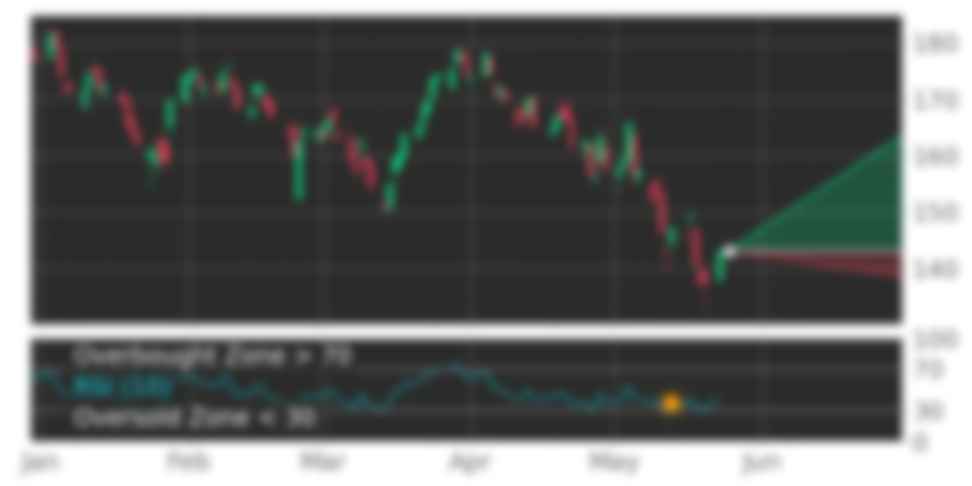
The RSI Indicator demonstrates that the ticker has stayed in the oversold zone for 1 day, which means it's wise to expect a price bounce in the near future.
The Stochastic Oscillator shows that the ticker has stayed in the oversold zone for 3 days. The price of this ticker is presumed to bounce back soon, since the longer the ticker stays in the oversold zone, the more promptly an upward trend is expected.
The 50-day moving average for REGN moved above the 200-day moving average on September 03, 2026. This could be a long-term bullish signal for the stock as the stock shifts to an upward trend.
Following a +2.45% 3-day Advance, the price is estimated to grow further. Considering data from situations where REGN advanced for three days, in 207 of 317 cases, the price rose further within the following month. The odds of a continued upward trend are 65%.
REGN may jump back above the lower band and head toward the middle band. Traders may consider buying the stock or exploring call options.
The Tickeron Valuation Rating of 2 (best 1 - 100 worst) indicates that the company is seriously undervalued in the industry. This rating compares market capitalization estimated by our proprietary formula with the current market capitalization. This rating is based on the following metrics, as compared to industry averages: P/B Ratio (2.442) is normal, around the industry mean (26.780). P/E Ratio (18.615) is within average values for comparable stocks, (43.395). Projected Growth (PEG Ratio) (1.238) is also within normal values, averaging (9.059). REGN has a moderately high Dividend Yield (0.005) as compared to the industry average of (0.000). P/S Ratio (5.339) is also within normal values, averaging (438.009).
The Tickeron PE Growth Rating for this company is 17 (best 1 - 100 worst), pointing to outstanding earnings growth. The PE Growth rating is based on a comparative analysis of stock PE ratio increase over the last 12 months compared against S&P 500 index constituents.
The Tickeron Seasonality Score of 50 (best 1 - 100 worst) indicates that the company is fair valued in the industry. The Tickeron Seasonality score describes the variance of predictable price changes around the same period every calendar year. These changes can be tied to a specific month, quarter, holiday or vacation period, as well as a meteorological or growing season.
The Tickeron Price Growth Rating for this company is 54 (best 1 - 100 worst), indicating steady price growth. REGN’s price grows at a higher rate over the last 12 months as compared to S&P 500 index constituents.
The Tickeron SMR rating for this company is 59 (best 1 - 100 worst), indicating strong sales and a profitable business model. SMR (Sales, Margin, Return on Equity) rating is based on comparative analysis of weighted Sales, Income Margin and Return on Equity values compared against S&P 500 index constituents. The weighted SMR value is a proprietary formula developed by Tickeron and represents an overall profitability measure for a stock.
The Tickeron Profit vs. Risk Rating rating for this company is 92 (best 1 - 100 worst), indicating that the returns do not compensate for the risks. REGN’s unstable profits reported over time resulted in significant Drawdowns within these last five years. A stable profit reduces stock drawdown and volatility. The average Profit vs. Risk Rating rating for the industry is 94, placing this stock better than average.
The average fundamental analysis ratings, where 1 is best and 100 is worst, are as follows
a developer of medicines for the treatment of serious medical conditions
Industry Biotechnology