MENU
Go to the list of all blogs
Arthur Evans's Avatar
published in Blogs
Oct 01, 2026
Axon Enterprise (AXON) Declines -25% on Convertible Notes and Valuation Concerns

Axon Enterprise (AXON) Declines -25% on Convertible Notes and Valuation Concerns

Key Takeaways

  • Axon Enterprise shares fell roughly 25% over the past 30 days, sliding from about $567 to near $423 on a closing basis.
  • A $1 billion convertible note offering announced in mid-September sparked concerns over dilution and pressured the stock sharply.
  • The decline extended a broader drawdown: AXON is down roughly 25% over the trailing three-month period as well.
  • Longer-term demand remains strong, with fiscal Q2 revenue up 35% year over year and future contracted bookings up 41% to $15.1 billion.
  • Investor focus has shifted toward valuation, margin durability, and cash-position concerns despite a consensus "Buy" rating.

Company Background and Market Position

Axon Enterprise, Inc. (AXON) is a public safety technology company headquartered in Scottsdale, Arizona. Formerly known as TASER International, the company rebranded in 2017 and has since evolved from a hardware manufacturer into a connected software and data platform serving law enforcement, first responders, government agencies, and enterprise customers.

The business operates across two reporting segments. Its Connected Devices segment includes TASER conducted energy weapons, body-worn and in-car cameras, and drone and counter-drone technologies acquired through Dedrone. Its Software and Services segment includes cloud offerings such as Axon Evidence, Axon Records, Draft One, Axon Fusus, and Axon Assistant, which capture, store, manage, and analyze digital evidence.

Axon is widely regarded as a category leader in the public safety technology market, benefiting from a large recurring revenue base, high customer switching costs, and an expanding total addressable market driven by artificial intelligence and drone adoption. These characteristics make the stock closely followed by growth-oriented investors. I also checked this using Tickeron’s AI Screener to see how the stock compares to others in the industry.

Stock Price Performance Over the Past 30 Days and Quarter

Over the last 30 days, AXON declined approximately 25%. The shares closed near $567 on August 31 and fell to about $423 by September 30, marking a sustained downward move punctuated by several high-volume selling sessions.

The pullback is part of a longer slide. Measured from the end of June, when the stock closed near $561, AXON is down roughly 25% over the trailing quarter. The shares touched intraday highs above $640 in early-to-mid August before the momentum reversed, underscoring how quickly sentiment shifted from record territory to a corrective phase.

Factors Behind the Recent 30-Day Move

The sharpest single-day move came in mid-September, when Axon announced plans for a $1 billion offering of 0% convertible senior notes due 2031. While the zero coupon limits cash interest costs, convertible notes allow bondholders to exchange debt for equity, raising dilution concerns that weighed heavily on the share price. Analysts also noted the offering highlighted a declining cash position, which had fallen from roughly $1.7 billion in late 2025 to below $700 million by mid-2026.

Beyond the offering, valuation and sentiment played a central role. After a strong run, Axon traded at a premium multiple that left the stock vulnerable to multiple compression. Analysts trimmed price targets during the period — Goldman Sachs, for example, lowered its target from $715 to $675 while maintaining a Buy rating — reflecting a combination of sector-wide multiple pressure and caution around near-term margins.

Fundamental results remained robust even as the stock fell. In its fiscal second quarter, Axon reported revenue growth of about 35% year over year and raised its full-year growth guidance to a range of 32% to 34%. Future contracted bookings grew 41% to $15.1 billion, and the Dedrone platform surpassed $100 million in quarterly revenue. However, management cautioned that third-quarter adjusted EBITDA margin would face headwinds from higher memory costs, and some of the Q2 gross margin improvement was attributed to tariff refunds rather than underlying efficiency. From what I see, the AI software momentum continues to stand out here.

Drivers of the Broader Quarterly Decline

The broader three-month decline reflects a transition from momentum-driven gains to a more defensive stance on valuation. After rallying through July and into early August, Axon shares were hit by a combination of sector rotation away from high-multiple software and AI names, margin and cash-flow scrutiny, and the eventual dilutive capital raise.

Several large banks and asset managers disclosed changes to their Axon positions during the quarter, and most sell-side firms trimmed price targets even while reiterating constructive long-term views on the business model. The common theme across research was confidence in Axon's recurring revenue and AI opportunity, offset by concerns about valuation and execution. That tension — strong fundamentals against a premium multiple — defined the stock's quarterly performance.

Key Areas to Monitor Going Forward

Investors will be watching Axon's next earnings report for confirmation that revenue growth, bookings momentum, and margin trajectories remain intact. Guidance updates will be especially important given management's comments about third-quarter margin pressure from higher memory costs and the absence of the prior tariff-refund benefit.

Beyond earnings, key factors include the execution of the Dedrone counter-drone business, continued adoption of Axon's AI software tools, and the company's ability to convert its $15.1 billion contracted bookings backlog into revenue. Macroeconomic conditions, interest-rate expectations, and broader sentiment toward high-valuation technology stocks are also likely to influence price action. Finally, competitive developments in the public safety technology market and any further capital-raising or dilution-related announcements will remain in focus. As with any equity, outcomes depend on a range of factors, and past performance does not guarantee future results. I’m watching this closely as the next quarter unfolds.

Integrating AI Tools Into My Research Process

In my own analysis, I occasionally turn to Tickeron’s AI Trading Bots to cross-check patterns and sentiment signals across volatile names. These tools provide a data-driven layer that complements traditional fundamental review, helping me stay objective when valuations shift quickly. It’s one way I add systematic perspective without replacing my own judgment on long-term business quality.

Disclaimer

The information on this webpage is provided for general informational and educational purposes only and is not intended as investment advice, a recommendation to purchase or sell any security, or an offer or solicitation related to investments. It does not consider your personal financial situation, goals, or risk profile, and all investing carries inherent risks, including the possibility of losing your entire investment. For more details, please review our full disclaimer.

Disclaimers and Limitations

Related Ticker: AXON

Contributor

Financial writer and active order flow futures trader with a focus on fundamental analysis, macroeconomic factors, and equity research. I make in-depth blogs on stocks and ETFs, bridging the gap between raw market data and real-world trading decisions.


Momentum Indicator for AXON turns negative, indicating new downward trend

AXON saw its Momentum Indicator move below the 0 level on August 27, 2026. This is an indication that the stock could be shifting in to a new downward move. Traders may want to consider selling the stock or exploring put options. Tickeron's A.I.dvisor looked at 77 similar instances where the indicator turned negative. In 54 of the 77 cases, the stock moved further down in the following days. The odds of a decline are at 70%.

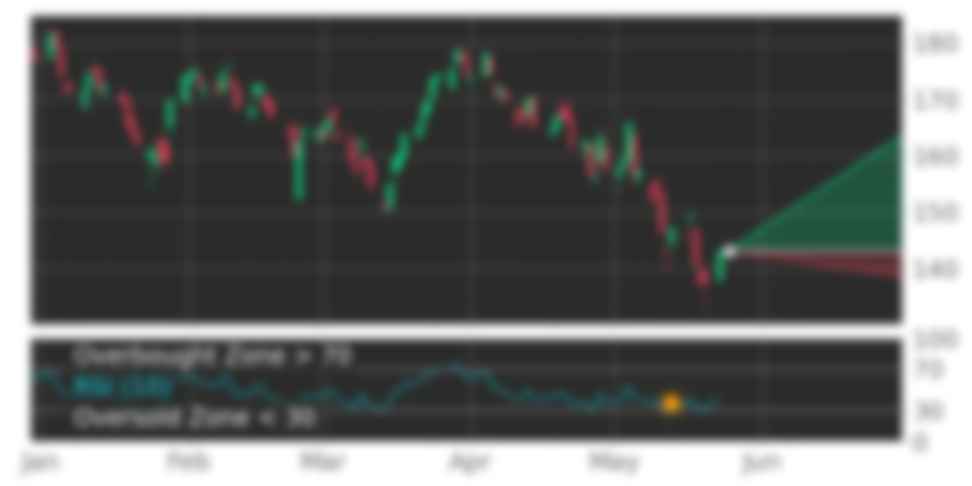
Price Prediction Chart

Technical Analysis (Indicators)

Bearish Trend Analysis

AXON moved below its 50-day moving average on September 01, 2026 date and that indicates a change from an upward trend to a downward trend.

The 10-day moving average for AXON crossed bearishly below the 50-day moving average on September 08, 2026. This indicates that the trend has shifted lower and could be considered a sell signal. In 9 of 15 past instances when the 10-day crossed below the 50-day, the stock continued to move higher over the following month. The odds of a continued downward trend are 60%.

Following a 3-day decline, the stock is projected to fall further. Considering past instances where AXON declined for three days, the price rose further in 50 of 62 cases within the following month. The odds of a continued downward trend are 69%.

The Aroon Indicator for AXON entered a downward trend on October 02, 2026. This could indicate a strong downward move is ahead for the stock. Traders may want to consider selling the stock or buying put options.

Bullish Trend Analysis

The RSI Indicator shows that the ticker has stayed in the oversold zone for 4 days. The price of this ticker is presumed to bounce back soon, since the longer the ticker stays in the oversold zone, the more promptly an Uptrend is expected.

The Stochastic Oscillator shows that the ticker has stayed in the oversold zone for 22 days. The price of this ticker is presumed to bounce back soon, since the longer the ticker stays in the oversold zone, the more promptly an upward trend is expected.

Following a +2.58% 3-day Advance, the price is estimated to grow further. Considering data from situations where AXON advanced for three days, in 279 of 374 cases, the price rose further within the following month. The odds of a continued upward trend are 75%.

AXON may jump back above the lower band and head toward the middle band. Traders may consider buying the stock or exploring call options.

Fundamental Analysis (Ratings)

The Tickeron PE Growth Rating for this company is 37 (best 1 - 100 worst), pointing to consistent earnings growth. The PE Growth rating is based on a comparative analysis of stock PE ratio increase over the last 12 months compared against S&P 500 index constituents.

The Tickeron Price Growth Rating for this company is 65 (best 1 - 100 worst), indicating fairly steady price growth. AXON’s price grows at a lower rate over the last 12 months as compared to S&P 500 index constituents.

The Tickeron Profit vs. Risk Rating rating for this company is 71 (best 1 - 100 worst), indicating that the returns do not compensate for the risks. AXON’s unstable profits reported over time resulted in significant Drawdowns within these last five years. A stable profit reduces stock drawdown and volatility. The average Profit vs. Risk Rating rating for the industry is 76, placing this stock better than average.

The Tickeron SMR rating for this company is 81 (best 1 - 100 worst), indicating weak sales and an unprofitable business model. SMR (Sales, Margin, Return on Equity) rating is based on comparative analysis of weighted Sales, Income Margin and Return on Equity values compared against S&P 500 index constituents. The weighted SMR value is a proprietary formula developed by Tickeron and represents an overall profitability measure for a stock.

The Tickeron Valuation Rating of 87 (best 1 - 100 worst) indicates that the company is significantly overvalued in the industry. This rating compares market capitalization estimated by our proprietary formula with the current market capitalization. This rating is based on the following metrics, as compared to industry averages: P/B Ratio (9.390) is normal, around the industry mean (6.305). AXON has a moderately high P/E Ratio (176.979) as compared to the industry average of (58.116). Projected Growth (PEG Ratio) (1.949) is also within normal values, averaging (2.564). Dividend Yield (0.000) settles around the average of (0.009) among similar stocks. P/S Ratio (12.034) is also within normal values, averaging (18.330).

The Tickeron Seasonality Score of 95 (best 1 - 100 worst) indicates that the company is significantly overvalued in the industry. The Tickeron Seasonality score describes the variance of predictable price changes around the same period every calendar year. These changes can be tied to a specific month, quarter, holiday or vacation period, as well as a meteorological or growing season.

Notable companies

The most notable companies in this group are GE Aerospace (NYSE:GE), Boeing Company (NYSE:BA), Lockheed Martin Corp (NYSE:LMT), Northrop Grumman Corp (NYSE:NOC), Virgin Galactic Holdings (NYSE:SPCE).

Industry description

Aerospace & Defense is one of largest industries in the U.S., mainly comprising the following areas: commercial airliners, military aircraft, missiles, space, and general aviation. Focused heavily on research & development, it is also one of the fastest growing industries. Military aircraft has the largest market share in the industry’s sales, followed by space systems, civil aircraft, and missiles. Aerospace exports, directly and indirectly, support more jobs than the export of any other commodity, according to a study by the U.S. Department of Commerce. Boeing Company, Lockheed Martin Corporation and General Electric Company are some of the most prominent players in this space.

Market Cap

The average market capitalization across the Aerospace & Defense Industry is 38.94B. The market cap for tickers in the group ranges from 4.49 to 1.92T. SPCX holds the highest valuation in this group at 1.92T. The lowest valued company is BDRPF at 4.49.

High and low price notable news

The average weekly price growth across all stocks in the Aerospace & Defense Industry was -3%. For the same Industry, the average monthly price growth was -9%, and the average quarterly price growth was -12%. ELMT experienced the highest price growth at 13%, while KITT experienced the biggest fall at -34%.

Volume

The average weekly volume growth across all stocks in the Aerospace & Defense Industry was 26%. For the same stocks of the Industry, the average monthly volume growth was 47% and the average quarterly volume growth was -32%

Fundamental Analysis Ratings

The average fundamental analysis ratings, where 1 is best and 100 is worst, are as follows

Valuation Rating: 45
P/E Growth Rating: 70
Price Growth Rating: 62
SMR Rating: 77
Profit Risk Rating: 76
Seasonality Score: 13 (-100 ... +100)
View a ticker or compare two or three
AXON
Daily Signal:
Gain/Loss:
Interact to see
Advertisement
A.I.Advisor
published price charts
A.I. Advisor
published General Information

General Information

a clinical-stage biopharmaceutical company

Industry AerospaceDefense

Industry
Biotechnology
Address
17800 North 85th Street
Phone
+1 480 991-0797
Employees
6300
Web
https://www.axon.com