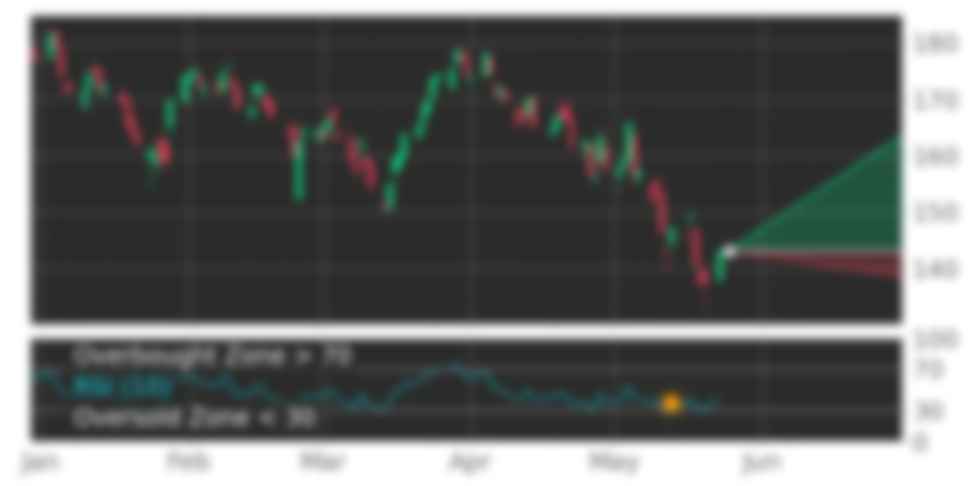
This is a Bearish indicator signaling IYF's price could decline from here. Traders may explore shorting the stock or put options. A.I. dvisor identified 46 similar cases where IYF's MACD histogram became negative, and of them led to successful outcomes. Odds of Success:
IYF saw its Momentum Indicator move below the 0 level on November 17, 2026. This is an indication that the stock could be shifting in to a new downward move. Traders may want to consider selling the stock or exploring put options. Tickeron's A.I.dvisor looked at 80 similar instances where the indicator turned negative. In 66 of the 80 cases, the stock moved further down in the following days. The odds of a decline are at 82%.
The 10-day RSI Indicator for IYF moved out of overbought territory on November 05, 2026. This could be a bearish sign for the stock. Traders may want to consider selling the stock or buying put options. Tickeron's A.I.dvisor looked at 42 similar instances where the indicator moved out of overbought territory. In 33 of the 42 cases, the stock moved lower in the following days. This puts the odds of a move lower at 79%.
The Moving Average Convergence Divergence Histogram (MACD) for IYF turned negative on November 18, 2026. This could be a sign that the stock is set to turn lower in the coming weeks. Traders may want to sell the stock or buy put options. Tickeron's A.I.dvisor looked at 46 similar instances when the indicator turned negative. In 37 of the 46 cases the stock turned lower in the days that followed. This puts the odds of success at 80%.
IYF moved below its 50-day moving average on November 18, 2026 date and that indicates a change from an upward trend to a downward trend.
Following a 3-day decline, the stock is projected to fall further. Considering past instances where IYF declined for three days, the price rose further in 50 of 62 cases within the following month. The odds of a continued downward trend are 82%.
The Stochastic Oscillator demonstrated that the ticker has stayed in the oversold zone for 1 day, which means it's wise to expect a price bounce in the near future.
The 10-day moving average for IYF crossed bullishly above the 50-day moving average on November 04, 2026. This indicates that the trend has shifted higher and could be considered a buy signal. In 13 of 14 past instances when the 10-day crossed above the 50-day, the stock continued to move higher over the following month. The odds of a continued upward trend are 90%.
Following a +1.09% 3-day Advance, the price is estimated to grow further. Considering data from situations where IYF advanced for three days, in 310 of 357 cases, the price rose further within the following month. The odds of a continued upward trend are 87%.
IYF may jump back above the lower band and head toward the middle band. Traders may consider buying the stock or exploring call options.
The Aroon Indicator entered an Uptrend today. In 252 of 315 cases where IYF Aroon's Indicator entered an Uptrend, the price rose further within the following month. The odds of a continued Uptrend are 80%.
The iShares U.S. Financials ETF seeks to track an index composed of U.S. equities in the financials sector, providing diversified exposure to banks, insurers, capital-markets firms, and diversified financial services companies. The fund is passively managed and uses a capping methodology that limits individual issuer weights and the aggregate weight of large issuers to improve diversification, with the index rebalanced quarterly.
With roughly 147 holdings and a net expense ratio near 0.37%, the portfolio is concentrated in the largest U.S. financial institutions. Berkshire Hathaway (BRK.B) and JPMorgan Chase (JPM) each represent roughly 11% of assets, followed by Bank of America (BAC), Goldman Sachs (GS), Wells Fargo (WFC), Morgan Stanley (MS), and Citigroup (C). Asset managers and insurers including Charles Schwab (SCHW), BlackRock (BLK), and Progressive (PGR) round out the top holdings. This heavy large-cap bank and diversified-financials tilt means the fund's performance closely tracks the interest-rate environment and credit cycle.
The financials sector sits at the intersection of monetary policy, economic growth, and credit conditions. Banks generate a meaningful portion of earnings from net interest income, making them sensitive to short- and long-term rate expectations and the shape of the yield curve. Capital-markets and asset-management firms, by contrast, depend more on trading volumes, M&A (mergers and acquisitions) activity, underwriting fees, and equity-market levels. Insurers are driven by underwriting discipline, pricing power, and the returns earned on their investment portfolios.
The broader backdrop remains shaped by inflation trends, the path of Federal Reserve policy, and the strength of consumer and corporate balance sheets. Financial stocks have historically benefited from steeper yield curves and steady loan growth, while rising credit costs or an economic slowdown can pressure earnings. Regulatory and capital-requirements developments also remain recurring influences across the sector.
IYF's recent behavior reflects a financials sector that has traded in a well-defined range rather than a sustained trend. After climbing toward the upper $130s in early September, the fund pulled back through the month and reached a local trough near the mid-$120s in late September before recovering. Over the trailing 30 days, the ETF rebounded roughly 5% from those late-September lows, while the trailing three-month period has been largely flat to modestly lower.
This pattern mirrors sector rotation within the broader market. Financial shares have been caught between competing forces: on one hand, resilient bank earnings and strong capital-markets activity have supported large-cap names such as JPMorgan Chase and Goldman Sachs; on the other, shifting interest-rate expectations and periodic concerns about credit quality have tempered upside. The fund's concentration in a handful of mega-cap institutions amplifies the influence of those bellwether stocks, while its insurance sleeve has provided ballast as insurers benefit from firm pricing across personal and commercial lines.
Tickeron's AI Screener is an AI-powered stock and ETF discovery platform that helps investors scan thousands of securities using technical indicators, fundamentals, volatility measures, AI-generated signals, market trends, price patterns, and customizable filters. The tool is designed to surface trending securities, breakout candidates, and new trading opportunities far more efficiently than manual screening, while supporting industry-level and performance-based filters that suit both retail and institutional workflows. For investors monitoring the financials sector, the AI Screener offers a structured way to compare funds, identify momentum shifts, and track sector leadership as market conditions evolve.
Several structural factors are likely to shape IYF through 2026. The trajectory of interest rates and the shape of the yield curve will remain central, directly influencing bank net interest margins and the earnings power of the fund's largest holdings. Inflation readings and their effect on Federal Reserve policy will set the tone for the entire sector, while the pace of loan growth and any deterioration in credit quality bear close watching.
Capital-markets conditions—including IPO and M&A volumes, trading activity, and asset-management fee trends—will be key for firms such as Goldman Sachs, Morgan Stanley, BlackRock, and Charles Schwab. Insurance pricing cycles and catastrophe-loss experience will guide the insurer sleeve. Regulatory and capital policy developments, along with potential changes to financial-sector oversight, represent an additional swing factor. ETF competition and relative valuation versus the broader market also matter for flows. None of these factors point to a single predetermined outcome, but together they define the environment investors should monitor when assessing the fund's positioning.
The information on this webpage is provided for general informational and educational purposes only and is not intended as investment advice, a recommendation to purchase or sell any security, or an offer or solicitation related to investments. It does not consider your personal financial situation, goals, or risk profile, and all investing carries inherent risks, including the possibility of losing your entire investment. For more details, please review our full disclaimer.