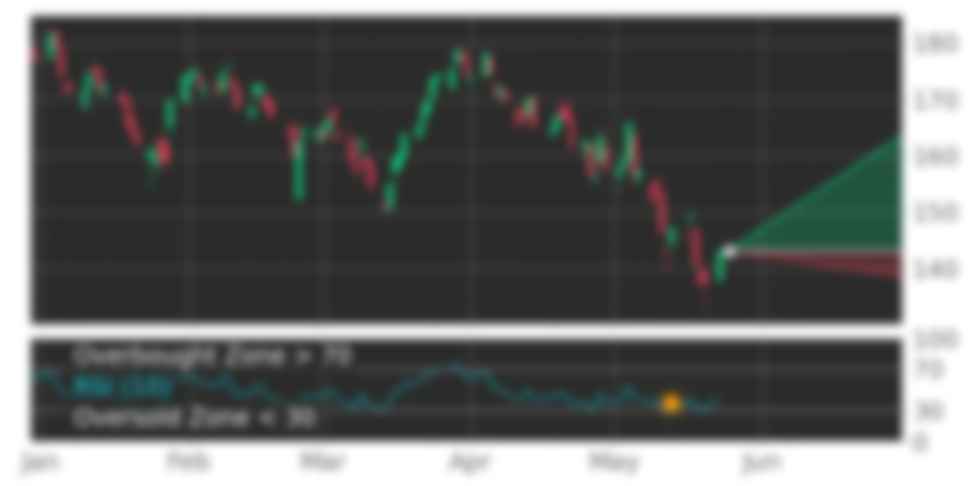
This price move could indicate a change in the trend, and may be a sell signal for investors. A.I.dvisor found 47 similar cases, and were successful. Based on this data, the odds of success are
The 10-day RSI Oscillator for ONLN moved out of overbought territory on November 05, 2026. This could be a sign that the stock is shifting from an upward trend to a downward trend. Traders may want to look at selling the stock or buying put options. Tickeron's A.I.dvisor looked at 36 instances where the indicator moved out of the overbought zone. In 33 of the 36 cases the stock moved lower in the days that followed. This puts the odds of a move down at 90%.
The Momentum Indicator moved below the 0 level on November 16, 2026. You may want to consider selling the stock, shorting the stock, or exploring put options on ONLN as a result. In 65 of 74 cases where the Momentum Indicator fell below 0, the stock fell further within the subsequent month. The odds of a continued downward trend are 88%.
The Moving Average Convergence Divergence Histogram (MACD) for ONLN turned negative on November 16, 2026. This could be a sign that the stock is set to turn lower in the coming weeks. Traders may want to sell the stock or buy put options. Tickeron's A.I.dvisor looked at 51 similar instances when the indicator turned negative. In 40 of the 51 cases the stock turned lower in the days that followed. This puts the odds of success at 78%.
ONLN moved below its 50-day moving average on November 19, 2026 date and that indicates a change from an upward trend to a downward trend.
Following a 3-day decline, the stock is projected to fall further. Considering past instances where ONLN declined for three days, the price rose further in 50 of 62 cases within the following month. The odds of a continued downward trend are 84%.
The Stochastic Oscillator shows that the ticker has stayed in the oversold zone for 4 days. The price of this ticker is presumed to bounce back soon, since the longer the ticker stays in the oversold zone, the more promptly an upward trend is expected.
The 10-day moving average for ONLN crossed bullishly above the 50-day moving average on October 20, 2026. This indicates that the trend has shifted higher and could be considered a buy signal. In 15 of 17 past instances when the 10-day crossed above the 50-day, the stock continued to move higher over the following month. The odds of a continued upward trend are 88%.
The 50-day moving average for ONLN moved above the 200-day moving average on November 13, 2026. This could be a long-term bullish signal for the stock as the stock shifts to an upward trend.
Following a +2.23% 3-day Advance, the price is estimated to grow further. Considering data from situations where ONLN advanced for three days, in 264 of 308 cases, the price rose further within the following month. The odds of a continued upward trend are 86%.
ONLN may jump back above the lower band and head toward the middle band. Traders may consider buying the stock or exploring call options.
The Aroon Indicator entered an Uptrend today. In 184 of 223 cases where ONLN Aroon's Indicator entered an Uptrend, the price rose further within the following month. The odds of a continued Uptrend are 83%.
The ProShares Online Retail ETF (ONLN) is a passively managed, rules-based exchange-traded fund (ETF) launched in July 2018. It seeks to track the ProShares Online Retail Index, a global, modified market-capitalization-weighted index of companies classified as online retailers, spanning both established e-commerce leaders and smaller, faster-growing platforms.
The portfolio holds approximately 20 securities and is notably concentrated. Amazon.com (AMZN) is the largest position at roughly 24% of assets, followed by Alibaba Group (BABA) near 10% and eBay (EBAY) near 9%. Additional holdings include Carvana (CVNA), Coupang (CPNG), Chewy (CHWY), Wayfair (W), FIGS (FIGS), GigaCloud Technology (GCT), and Buckle (BKE).
Sector exposure is dominated by consumer cyclical names at about 96% of the portfolio, with a small technology allocation of roughly 3%. Geographically, the fund is about three-quarters U.S.-listed, with the remainder spread across China, South Korea, Argentina, Singapore, and Israel. The net expense ratio is 0.58%, and assets under management (AUM) remain modest at roughly $56–58 million, a relatively small fund within the thematic ETF space.
ONLN sits at the intersection of two durable investment themes: the structural shift of retail spending online and the growing role of global e-commerce platforms in consumer markets. While the early pandemic-era surge in digital shopping has normalized, e-commerce continues to capture a larger share of overall retail activity across most developed and emerging economies, supporting long-term revenue growth for the fund's core holdings.
The macro backdrop adds complexity. Interest-rate expectations and inflation trends directly influence consumer discretionary demand and the valuations of high-growth, often richly priced online retailers. Several of the fund's holdings trade at elevated price-to-earnings (P/E) multiples, leaving them sensitive to shifts in the discount rate. Meanwhile, the fund's China-linked exposure, particularly through Alibaba, ties part of its performance to policy, regulatory, and consumer-confidence developments in that market. Competitive intensity, logistics costs, and platform economics also remain key structural variables across the online retail industry.
Over the most recent 30-day period, ONLN advanced by roughly 6% as measured from adjusted closing prices, reflecting a modest rebound rather than a decisive trend. This move followed a softer stretch earlier in the quarter, and over the trailing three-month window the fund remains modestly lower by roughly 6–7%, underscoring the volatility that characterizes this concentrated, high-beta strategy.
The recent recovery has been led disproportionately by the fund's largest holding, Amazon.com, whose weighting gives it outsized influence on daily returns. A stabilization in large-cap e-commerce sentiment, combined with selective strength in marketplace and platform names, has helped offset weakness in some China-linked and smaller-cap positions. Because the portfolio's beta is above 1.0 relative to the broad market, ONLN tends to exaggerate both risk-on and risk-off moves, a dynamic investors should weigh against its narrow thematic focus and limited diversification across roughly 20 holdings.
Tickeron's AI Screener is an AI-powered stock and ETF discovery platform that helps investors search thousands of securities using technical indicators, fundamentals, volatility measures, AI-generated signals, market trends, price patterns, and customizable filters. It is designed to surface trending securities, breakout candidates, and new trading opportunities more efficiently than manual screening. For investors evaluating thematic funds such as ONLN, the platform offers a systematic way to monitor momentum, relative strength, and changing market conditions across industries. Exploring the AI Screener can help you build a more informed, data-driven view of the current opportunity set.
Several structural factors are likely to shape ONLN through 2026. The path of monetary policy and long-term interest rates will remain central, given the sensitivity of high-multiple consumer discretionary names to changes in the discount rate. Inflation trends and their effect on household purchasing power will likewise influence the revenue trajectory of the fund's e-commerce and marketplace holdings.
Earnings cycles among the largest positions, particularly Amazon.com, Alibaba, and eBay, will drive a substantial portion of fund performance given the portfolio's concentration. Developments in China—including consumer demand, platform regulation, and cross-border commerce—are a meaningful swing factor through the fund's Alibaba weighting. Capital flows into thematic ETFs, competitive dynamics within online retail, and any shifts in U.S. trade or tax policy also merit attention. Because ONLN is a small, high-beta fund with limited diversification, it may be more volatile than broad-market or large-cap index funds, and investors should weigh these structural risks against the long-term growth potential of global e-commerce.
The information on this webpage is provided for general informational and educational purposes only and is not intended as investment advice, a recommendation to purchase or sell any security, or an offer or solicitation related to investments. It does not consider your personal financial situation, goals, or risk profile, and all investing carries inherent risks, including the possibility of losing your entire investment. For more details, please review our full disclaimer.