


IonQ (IONQ) Stock Analysis: Wall Street Was Astonished by the Quantum Leap
From $17.88 to $45.56 in Four Months - How IonQ Engineered a 155% Rally Through Strategic Acquisitions and Billion-Dollar Deals
The quantum computing sector witnessed one of its most dramatic turnarounds in 2025, with IonQ Inc. (IONQ) delivering a spectacular 154.8% gain from its March 11 low of $17.88 to its July 9 closing price of $45.56. This remarkable recovery story showcases how strategic acquisitions, technological breakthroughs, and massive institutional investment can transform a company's trajectory in the rapidly evolving quantum computing landscape.
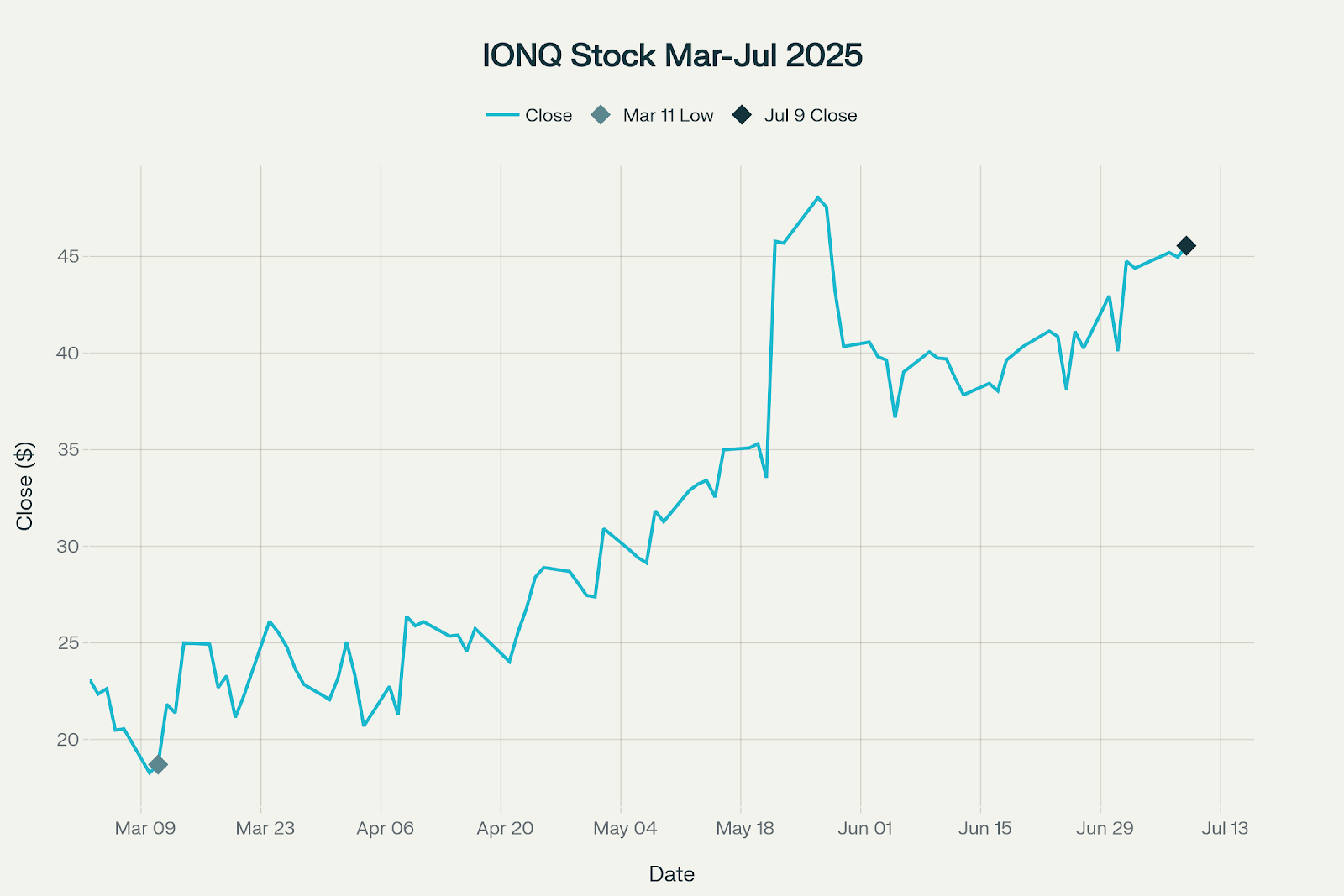
IonQ Stock Price Recovery: From March 11 Low ($17.88) to July 9 Close ($45.56) - 154.8% Gain
Understanding IonQ: The Quantum Computing Pioneer
IonQ stands as a leading commercial quantum computing and networking company, founded in 2015 by quantum physics experts Christopher Monroe and Jungsang Kim. The company specializes in trapped-ion quantum technology, which uses individual ions suspended in electromagnetic fields as quantum bits (qubits). This approach offers several key advantages over competing technologies:
- Higher coherence times for longer stability during quantum operations
- Lower error rates compared to superconducting qubits used by competitors like IBM and Google
- All-to-all connectivity allowing any qubit to interact with any other qubit
- Natural scalability since ions are naturally identical
IonQ operates on a Quantum-as-a-Service (QaaS) business model, providing access to its quantum computers through major cloud platforms including Amazon Web Services, Microsoft Azure, and Google Cloud. The company generates revenue from cloud computing services, enterprise collaborations, government contracts, and specialized quantum hardware sales.
The Perfect Storm: What Triggered the March Low
The stock's dramatic decline to $17.88 on March 11, 2025, reflected broader quantum sector volatility and specific company challenges. The quantum computing industry experienced significant turbulence in early 2025, with investors questioning the timeline for commercial viability and debating the technology's near-term prospects. However, this low would prove to be the launching pad for one of the most impressive recoveries in the sector's history.
The Transformation Begins: Strategic Acquisitions Drive Growth
ID Quantique Acquisition: Securing Quantum Networking Leadership
The turnaround began with IonQ's completion of its ID Quantique (IDQ) acquisition on April 30, 2025. This strategic move added nearly 300 patents to IonQ's portfolio, bringing the company's total to over 900 patents and cementing its leadership in quantum networking technologies. The acquisition included:
- Quantum Key Distribution (QKD) systems for ultra-secure communications
- Quantum Random Number Generators (QRNGs)
- Single-photon detectors for quantum networking applications
The deal, valued at approximately $172 million in IonQ stock, positioned the company as a "global powerhouse for secure compute and communications".
Q1 2025 Earnings: Steady Performance Amid Expansion
IonQ's Q1 2025 results, announced on May 7, demonstrated financial stability during its transformation period. Key highlights included:
- Revenue of $7.57 million, slightly down 0.2% year-over-year but beating analyst estimates of $7.51 million
- Net loss narrowed to $0.14 per share from $0.19 in Q4 2024, beating expectations by $0.14
- Cash position of nearly $700 million as of March 31, 2025
- Full-year revenue guidance maintained at $75-95 million
The EPB Partnership: First U.S. Quantum Computing Hub
Simultaneously with earnings, IonQ announced a groundbreaking $22 million partnership with EPB of Chattanooga to establish the first U.S. quantum computing and networking hub. This deal featured:
- Sale of a Forte Enterprise quantum computer to EPB
- Establishment of a permanent IonQ office in Tennessee
- Joint development of algorithms for energy grid optimization
- Creation of a quantum-ready workforce through specialized training programs
Lightsynq Acquisition: Quantum Memory Technology
On May 30, 2025, IonQ completed its acquisition of Lightsynq Technologies, a Boston-based startup specializing in photonic interconnects and quantum memory. Founded by Harvard quantum networking experts, Lightsynq brought:
- Over 20 patents related to quantum memory and interconnect technologies
- Universal photonic interconnect solutions for linking quantum processing units
- Technology to accelerate IonQ's fault-tolerant quantum computing roadmap
The Game Changer: Oxford Ionics Mega-Deal
The most significant catalyst came on June 9, 2025, when IonQ announced its agreement to acquire Oxford Ionics for $1.075 billion. This record-breaking transaction represents:
- $1.065 billion in IonQ stock plus $10 million in cash
- The largest acquisition in quantum computing history
- Oxford Ionics' world-record fidelity achievements in quantum operations
- Semiconductor-compatible ion-trap technology for scalable manufacturing
The combined company's ambitious roadmap includes:
- 256 physical qubits at 99.99% accuracy by 2026
- 10,000+ physical qubits with logical accuracies of 99.99999% by 2027
- 2 million physical qubits by 2030
The Billion-Dollar Vote of Confidence
The crescendo came on July 7, 2025, with IonQ's announcement of a $1.0 billion equity offering to Heights Capital Management at $55.49 per share - representing a 25% premium to the July 3 closing price. This massive investment included:
- 14.17 million shares of common stock
- 3.86 million pre-funded warrants
- 36.04 million seven-year warrants at $99.88 exercise price
- Pro-forma cash position of ~$1.68 billion
CEO Niccolo de Masi called it "the largest common-stock single-institutional investment in the history of the quantum industry".
International Expansion and Government Partnerships
IonQ's global reach expanded significantly during this period through strategic partnerships:
South Korea Quantum Center
On July 9, 2025, the Korea Institute of Science and Technology Information (KISTI) named IonQ as the primary quantum technology provider for South Korea's first National Quantum Computing Center of Excellence. The partnership includes:
- Delivery of an advanced 100-qubit quantum system
- Development of hybrid quantum-classical execution environments
- Integration with Megazone Cloud infrastructure
Air Force Research Lab Contracts
IonQ secured multiple significant government contracts, including:
- $54.5 million contract with the U.S. Air Force Research Lab announced in September 2024
- $21.1 million project for secure quantum networking infrastructure
- $5.7 million ARLIS contract for blind quantum computing systems
Financial Performance and Market Position
Metric
Value
Stock Price (March 11 Low)
$17.88
Stock Price (July 9 Close)
$45.56
Performance Gain
154.8%
Q1 2025 Revenue
$7.57 million
Full Year 2025 Guidance
$75-95 million
Pro-forma Cash (post equity offering)
~$1.68 billion
Total Patents (post acquisitions)
900+ patents
Market Cap (approx July 2025)
~$11.9 billion
Competitive Landscape and Market Position
The quantum computing market is expected to reach $53 billion by 2025, with trapped-ion technology gaining momentum for its precision and reliability. IonQ faces competition from established players like IBM, Google, and Rigetti Computing, but its unique approach offers distinct advantages:
IonQ's Competitive Advantages:
- Trapped-ion technology with superior fidelity and connectivity
- Cloud-first, asset-light business model
- Strong intellectual property portfolio with 900+ patents
- Diverse revenue streams from QaaS, partnerships, and hardware sales
Key Competitors:
- IBM Quantum: Superconducting qubits, strong enterprise relationships
- Google Quantum AI: Advanced research capabilities, cloud integration
- Rigetti Computing: Vertically integrated superconducting approach
- Quantinuum: Merged entity of Honeywell and Cambridge Quantum Computing
Technology Roadmap and Future Milestones
IonQ's ambitious technical roadmap targets several key milestones:
Near-term (2025-2026):
- Launch of IonQ Tempo systems with AQ 64 capabilities
- Deployment of Forte Enterprise systems globally
- Achievement of 256 physical qubits at 99.99% fidelity
Medium-term (2027-2030):
- 10,000+ physical qubits with fault-tolerant operation
- Quantum advantage for commercial applications
- 2 million physical qubits by 2030
Investment Outlook and Future Prospects
Several factors support continued growth momentum for IonQ:
Positive Catalysts
- Strong cash position of ~$1.68 billion enables sustained R&D investment
- Government support through defense and research contracts
- Strategic acquisitions building comprehensive quantum ecosystem
- Growing quantum market with increased enterprise adoption
- Technological leadership in trapped-ion quantum computing
Potential Risks
- Competitive pressure from well-funded rivals like IBM and Google
- Technology uncertainty regarding quantum advantage timelines
- Market volatility in emerging technology sectors
- Execution risk on ambitious technical roadmap
- Integration challenges from multiple acquisitions
Analyst Perspectives
Financial analysts project strong growth potential for IonQ, with 2025 revenue guidance suggesting 97% year-over-year growth. The company's expansion into quantum networking provides additional revenue opportunities in the estimated $15 billion quantum networking market.
Quantum Computing Market Dynamics
The broader quantum computing industry is experiencing unprecedented growth, with global investment reaching $1.25 billion in Q1 2025 alone - more than doubling the previous year. Key market drivers include:
- Enterprise adoption accelerating across finance, healthcare, and logistics
- Government investment in quantum technology for national security
- Technological maturity approaching commercial viability
- Geopolitical competition driving quantum leadership initiatives
Tickeron: AI-Powered Tools for Trading the Next Frontier
As companies like IonQ push the boundaries of technological innovation and redefine what's possible in computing, platforms like Tickeron are helping traders capitalize on the market moves that follow. Tickeron applies machine learning to real-time data to deliver intelligent trade ideas, short-term forecasts, and dynamic screeners—ideal for navigating high-growth sectors like quantum computing, semiconductors, and emerging tech.
Whether you're trading breakout opportunities or tracking innovation-driven momentum, Tickeron’s AI-driven platform offers a distinct analytical edge.
Key features include:
- AI Agents (60min / 15min / 5min): Short-term machine learning agents that surface intraday trade ideas based on evolving price action.
- AI Pattern Search Engine that identifies breakout setups with target prices and historical confidence levels.
- Trend Prediction Engine that forecasts entry and exit points shortly after the market opens.
- Real-Time Signal Screener for live buy/sell signals across thousands of stocks, ETFs, and crypto assets.
In a market where billion-dollar partnerships and technical breakthroughs can ignite dramatic rallies—like IonQ’s 154% surge—Tickeron equips traders with the tools to move quickly and intelligently.
Conclusion: A Quantum Leap Forward
IonQ's 154.8% rally from March to July 2025 represents more than just a stock recovery - it exemplifies the transformation of quantum computing from experimental technology to commercial reality. Through strategic acquisitions, technological breakthroughs, and billion-dollar institutional backing, IonQ has positioned itself at the forefront of the quantum revolution.
The company's comprehensive approach, combining hardware innovation, software development, and strategic partnerships, creates multiple pathways to growth in the emerging quantum economy. With nearly $1.7 billion in cash and a patent portfolio exceeding 900 applications, IonQ possesses the resources to execute its ambitious roadmap.
However, investors should remain cognizant of the inherent risks in emerging technology sectors. While IonQ has demonstrated remarkable progress, the timeline for achieving broad quantum advantage remains uncertain, and competition continues to intensify.
For those seeking exposure to the quantum computing revolution, IonQ's unique trapped-ion technology, strong financial position, and strategic market positioning make it a compelling consideration. The dramatic recovery from $17.88 to $45.56 may be just the beginning of a much larger quantum leap ahead.
The quantum age is no longer a distant future - it's happening now, and IonQ is leading the charge.
Contributor
Financial writer and active order flow futures trader with a focus on fundamental analysis, macroeconomic factors, and equity research. I make in-depth blogs on stocks and ETFs, bridging the gap between raw market data and real-world trading decisions.
IONQ sees MACD Histogram just turned negative
IONQ saw its Moving Average Convergence Divergence Histogram (MACD) turn negative on October 08, 2026. This is a bearish signal that suggests the stock could decline going forward. Tickeron's A.I.dvisor looked at 41 instances where the indicator turned negative. In 38 of the 41 cases the stock moved lower in the days that followed. This puts the odds of a downward move at 90%.

Technical Analysis (Indicators)
Bearish Trend Analysis
The Momentum Indicator moved below the 0 level on October 07, 2026. You may want to consider selling the stock, shorting the stock, or exploring put options on IONQ as a result. In 71 of 81 cases where the Momentum Indicator fell below 0, the stock fell further within the subsequent month. The odds of a continued downward trend are 88%.
IONQ moved below its 50-day moving average on October 08, 2026 date and that indicates a change from an upward trend to a downward trend.
Following a 3-day decline, the stock is projected to fall further. Considering past instances where IONQ declined for three days, the price rose further in 50 of 62 cases within the following month. The odds of a continued downward trend are 86%.
The Aroon Indicator for IONQ entered a downward trend on September 23, 2026. This could indicate a strong downward move is ahead for the stock. Traders may want to consider selling the stock or buying put options.
Bullish Trend Analysis
The Stochastic Oscillator demonstrated that the ticker has stayed in the oversold zone for 2 days, which means it's wise to expect a price bounce in the near future.
The 10-day moving average for IONQ crossed bullishly above the 50-day moving average on September 24, 2026. This indicates that the trend has shifted higher and could be considered a buy signal. In 11 of 15 past instances when the 10-day crossed above the 50-day, the stock continued to move higher over the following month. The odds of a continued upward trend are 73%.
Following a +6.91% 3-day Advance, the price is estimated to grow further. Considering data from situations where IONQ advanced for three days, in 239 of 279 cases, the price rose further within the following month. The odds of a continued upward trend are 86%.
IONQ may jump back above the lower band and head toward the middle band. Traders may consider buying the stock or exploring call options.
Fundamental Analysis (Ratings)
The Tickeron Price Growth Rating for this company is 50 (best 1 - 100 worst), indicating steady price growth. IONQ’s price grows at a higher rate over the last 12 months as compared to S&P 500 index constituents.
The Tickeron PE Growth Rating for this company is 59 (best 1 - 100 worst), pointing to consistent earnings growth. The PE Growth rating is based on a comparative analysis of stock PE ratio increase over the last 12 months compared against S&P 500 index constituents.
The Tickeron Profit vs. Risk Rating rating for this company is 66 (best 1 - 100 worst), indicating well-balanced risk and returns. The average Profit vs. Risk Rating rating for the industry is 87, placing this stock slightly better than average.
The Tickeron Valuation Rating of 73 (best 1 - 100 worst) indicates that the company is slightly overvalued in the industry. This rating compares market capitalization estimated by our proprietary formula with the current market capitalization. This rating is based on the following metrics, as compared to industry averages: P/B Ratio (5.429) is normal, around the industry mean (7.321). P/E Ratio (102.385) is within average values for comparable stocks, (51.117). Projected Growth (PEG Ratio) (0.000) is also within normal values, averaging (23.994). Dividend Yield (0.000) settles around the average of (0.004) among similar stocks. P/S Ratio (51.020) is also within normal values, averaging (51.774).
The Tickeron SMR rating for this company is 98 (best 1 - 100 worst), indicating weak sales and an unprofitable business model. SMR (Sales, Margin, Return on Equity) rating is based on comparative analysis of weighted Sales, Income Margin and Return on Equity values compared against S&P 500 index constituents. The weighted SMR value is a proprietary formula developed by Tickeron and represents an overall profitability measure for a stock.
Notable companies
Industry description
Market Cap
High and low price notable news
Volume
Fundamental Analysis Ratings
The average fundamental analysis ratings, where 1 is best and 100 is worst, are as follows

Advertisement
General Information
Industry ComputerProcessingHardware
Advertisement