
Zegna's Volume Increase: Examining the 296% Increase Despite a Flat Price Change
On June 16, 2025, Ermenegildo Zegna N.V. (NYSE: ZGN) experienced an extraordinary one-day trading volume spike, reaching a total volume of 4 million shares, a staggering 296% increase over its 65-day volume moving average. Despite this dramatic surge, the stock price remained nearly flat, with a modest +0.12% change, closing at $8.66. This article delves into the implications of this volume spike, examines broader market movements on the same day, compares ZGN’s performance with a stock highly correlated to NVIDIA (NASDAQ:NVDA), explores trading strategies involving inverse ETFs anti-correlated to NVDA, and highlights the role of AI-driven financial models in interpreting such market events.

This month, the stock gained +2.43% with an average daily volume of 896999 shares traded.
Understanding the Volume Surge
The 296% increase in ZGN’s trading volume compared to its 65-day moving average is a significant anomaly. Typically, such a spike suggests heightened investor interest, potentially driven by news, market sentiment, or speculative activity. However, the negligible price movement of +0.12% indicates that the surge was not accompanied by a strong directional push, which could imply a balance between buying and selling pressures or a lack of consensus on the stock’s valuation. According to AI-driven analysis, this volume pattern has occurred 18 times in similar cases, with 13 instances leading to positive price movements, suggesting a 72% probability of a bullish trend. This statistic positions the surge as a potential buy signal for investors, though caution is warranted given the stock’s recent performance and broader market context.
ZGN’s market capitalization stands at approximately $3.47 billion, with a price-to-earnings (P/E) ratio of 16.07 and a beta of 0.72, indicating lower volatility compared to the broader market. Over the past three months, ZGN’s stock has risen by 18%, driven by strong fundamentals, including a 44% net income growth over the last five years. However, its return on equity (ROE) lags behind the industry average of 14%, which may temper investor enthusiasm. The proposed dividend of €0.12 per share, to be approved at the Annual General Meeting (AGM) on June 26, 2025, further underscores the company’s commitment to returning value to shareholders, potentially contributing to the volume spike.
Market Context on June 16, 2025
The broader market on June 16, 2025, was influenced by several key developments. Technology stocks, particularly those tied to artificial intelligence, continued to drive market momentum. NVIDIA (NVDA), a leader in the AI and semiconductor space, saw its stock gain traction following CEO Jensen Huang’s European tour, which included announcements of telecom partnerships and supercomputer deals. This optimism spilled over into the semiconductor sector, with the Direxion Daily Semiconductor Bull 3X ETF (SOXL) showing positive momentum, driven by heavyweights like NVDA and Broadcom (NASDAQ:AVGO). Conversely, Tesla (NASDAQ:TSLA) faced volatility, with its stock dropping 12.6% amid concerns over EV tax risks and Full Self-Driving (FSD) challenges, highlighting the uneven performance within the tech sector.
Financial stocks displayed mixed performance, with the NYSE Financial Index up 0.1% and the Financial Select Sector SPDR Fund (NYSE:XLF) down 0.1%. The luxury goods sector, where ZGN operates, faced ongoing challenges, including a strategic shift toward direct-to-consumer (DTC) channels, which contributed to a 0.9% year-on-year revenue decline for ZGN in Q1 2025. Despite these headwinds, ZGN’s DTC channel grew by 5% year-on-year, particularly in the Americas, signaling resilience in key markets. The volume surge in ZGN may reflect investor speculation on its ability to navigate these challenges, especially as the company prepares for its Q2 2025 sales and revenue release on July 30.
Comparison with a Stock Correlated to NVDA
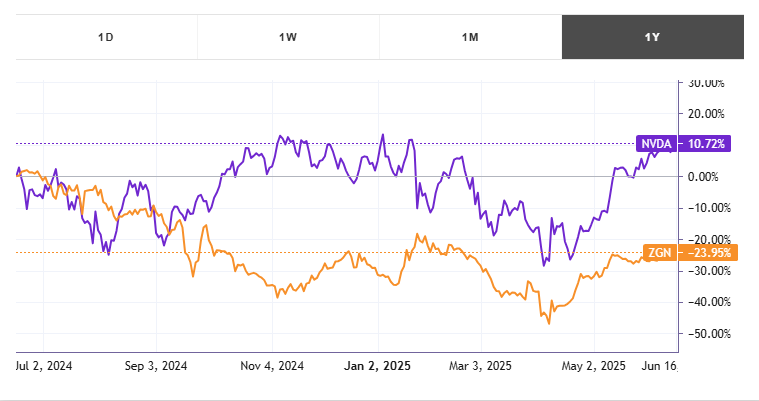
To contextualize ZGN’s performance, it’s useful to compare it with a stock highly correlated to NVIDIA, such as Arista Networks (NYSE:ANET). ANET, a provider of cloud networking solutions, has a correlation coefficient of approximately 0.70 with NVDA, driven by their shared exposure to AI infrastructure and data center growth. Since the start of 2023, ANET’s stock has surged 530%, significantly outpacing ZGN’s 18% gain over the past three months. On June 16, 2025, ANET’s trading volume remained within normal ranges, unlike ZGN’s spike, but its price stability suggests strong investor confidence in its AI-driven growth trajectory. While ZGN benefits from its luxury brand portfolio, its performance is less tied to the tech sector’s AI boom, making its volume surge more likely driven by company-specific factors, such as the upcoming dividend announcement or speculative trading ahead of the Q2 earnings.
Trading with Inverse ETFs Anti-Correlated to NVDA
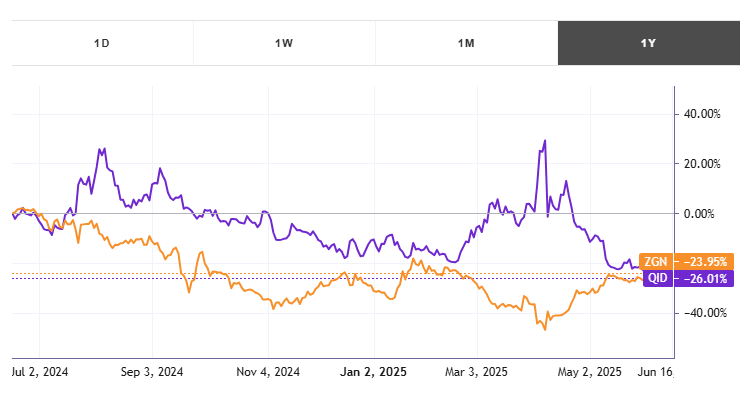
For traders looking to capitalize on market volatility, pairing ZGN with an inverse ETF anti-correlated to NVDA, such as the ProShares UltraShort QQQ (QID), offers a strategic hedging opportunity. QID aims to deliver twice the inverse daily performance of the NASDAQ-100 Index, which includes tech giants like NVDA, and has a correlation coefficient of approximately -0.65 with NVDA. When NVDA and correlated stocks rise, QID typically declines, making it an effective tool for traders anticipating a tech sector pullback. For instance, in May 2025, QID faced downward pressure as the NASDAQ-100 gained strength, but it remains a valuable hedge for short-term traders. By combining a long position in ZGN with a position in QID, traders can mitigate risks associated with tech sector volatility while capitalizing on ZGN’s potential upside, particularly if the volume surge signals a bullish trend.
The Role of AI in Trading Insights
AI-driven financial models are transforming how investors interpret market signals like ZGN’s volume surge. Tickeron, led by CEO Sergey Savastiouk, has developed Financial Learning Models (FLMs) that integrate advanced technical analysis with machine learning to identify patterns with high precision. AI Trading Robots, including the Double Trading Agent, combine long and hedged positions to achieve success rates as Ascendancy: up to 86.6% across leveraged and sector ETFs. For ZGN, these models identified the volume spike as a potential buy signal, with a 72% success rate based on 18 similar historical cases. By providing real-time insights and precise entry/exit signals, Tickeron’s tools empower traders to navigate volatile markets with greater confidence, aligning with the growing role of AI in financial decision-making.
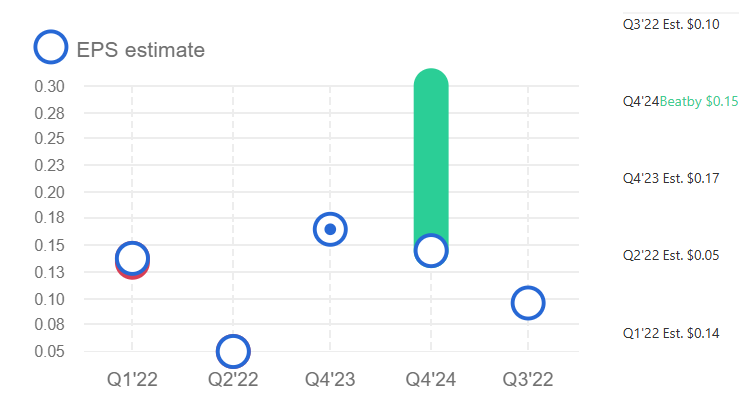
ZGN is expected to report earnings to fall 67.40% to 9 cents per share on October 27
The last earnings report on March 27 showed earnings per share of 30 cents, beating the estimate of 14 cents. With 3.95M shares outstanding, the current market capitalization sits at 3.67 B.
Conclusion
Ermenegildo Zegna’s record-breaking 296% volume surge on June 16, 2025, against a backdrop of minimal price movement, raises questions about its implications for investors. While the surge may signal a potential trend change, supported by a 72% historical success rate, broader market dynamics and ZGN’s fundamentals suggest a cautious approach. The luxury goods sector faces challenges, but ZGN’s strong DTC growth and upcoming dividend proposal provide reasons for optimism. By comparing ZGN to AI-driven performers like ANET and leveraging inverse ETFs like QID, traders can craft balanced strategies. With AI tools like FLMs offering precise insights, investors are better equipped to navigate such anomalies and make informed decisions.
Contributor
Serhii Bondarenko is an AI-focused trading strategist and financial markets analyst specializing in the development and application of AI trading bots and autonomous trading agents. His work combines technical analysis, fundamental analysis, and quantitative research to identify market patterns, forecast price movements, and analyze liquidity, volatility, and correlations across global stock markets. Serhii actively publishes market insights, forecasts, and trading frameworks on platforms such as Investing.com and Finextra, with a strong focus on AI-driven decision-making and next-generation algorithmic trading. His research aims to bridge the gap between traditional trading methodologies and advanced artificial intelligence, helping traders and investors navigate complex and rapidly evolving market conditions.

Advertisement