Advertisement
ALC or DHR or TMO


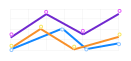
Which Stock Would AI Choose? Alcon Inc. (ALC) vs. Danaher Corporation (DHR) vs. Thermo Fisher Scientific Inc. (TMO) Stock Comparison
Key Takeaways
- DHR leads year-to-date performance at +23.33%, followed by TMO at +18.94% and ALC at +6.58%.
- ALC shows the strongest recent quarterly revenue growth at 8.60% year-over-year (yoy), ahead of TMO (6.20%) and DHR (3.70%).
- Valuation metrics highlight TMO's lowest forward price-to-earnings (P/E) ratio at 18.83, compared to DHR (20.66) and ALC (21.51).
- ALC maintains the lowest debt-to-equity (D/E) ratio at 23.81%, signaling lower leverage risk versus DHR (37.17%) and TMO (82.91%).
- All three stocks operate in healthcare but differ in focus: ALC in vision care, while DHR and TMO emphasize diagnostics and life sciences.
- Recent market activity reflects earnings pressures, with shares trading nearer 52-week lows amid sector volatility.
Introduction
Alcon Inc. (ALC), Danaher Corporation (DHR), and Thermo Fisher Scientific Inc. (TMO) represent key players in the healthcare sector, spanning medical devices, diagnostics, and life sciences tools. This comparison analyzes their business models, recent performance, and market positioning amid evolving sector dynamics like bioprocessing demand and acquisition activity. Traders seeking momentum plays and long-term investors evaluating valuation trade-offs will find insights into relative strengths, such as growth trajectories and risk profiles, in today's competitive landscape.
ALC Overview and Recent Performance
Alcon Inc. (ALC) specializes in eye care products, including surgical equipment, contact lenses, and pharmaceuticals within the medical instruments and supplies industry. In recent market activity, shares have hovered around $74, reflecting a year-to-date gain of 6.58% but trading closer to the 52-week low of $71.55 amid broader sector pressures. Key influences include quarterly revenue growth of 8.60% yoy, board changes, and collaborations like the one with PerZeption Inc. for vision research. Sentiment has been shaped by annual general meeting outcomes and steady volume around 1.3 million shares, with a forward P/E of 21.51 and return on equity (ROE) of 4.50% underscoring balanced growth potential.
DHR Overview and Recent Performance
Danaher Corporation (DHR) is a diversified diagnostics and research firm offering life sciences, diagnostics, and environmental solutions. Shares recently closed near $175, posting the strongest year-to-date return at +23.33% despite proximity to the 52-week low of $174.60. Recent weeks saw mixed earnings with Q1 revenue of $5.95 billion (3.70% yoy growth) slightly missing estimates, offset by euro debt issuance for the Masimo acquisition. Trading volume exceeds 3.8 million shares, supported by a forward P/E of 20.66, ROE of 7.08%, and analyst focus on profit forecasts amid a $908 million charge impacting results.
TMO Overview and Recent Performance
Thermo Fisher Scientific Inc. (TMO) leads in diagnostics and research, providing instruments, consumables, and services for life sciences applications. Trading around $469, the stock has delivered a year-to-date rise of 18.94%, though nearer the lower end of its 52-week range ($385-$644). Recent performance reflects Q1 earnings beats but a sharp post-report decline, alongside a $1.1 billion divestiture of its microbiology unit to Astorg and expansions like a new U.S. bioprocess design center. With quarterly revenue growth of 6.20% yoy, forward P/E at 18.83, and ROE of 13.52%, market sentiment weighs bioproduction strength against volume of 1.4 million shares.
Trending AI Robots
Tickeron’s Trending AI Robots page showcases a curated selection of 25 top-performing AI trading bots from over 351 available, each designed to trade thousands of tickers across diverse strategies, timeframes, and styles. These bots feature impressive stats, including annualized returns from +23.53% to +163.10%, win rates of 51.30% to 88.33%, profit factors up to 11.70, and profit-to-drawdown ratios reaching 17.02. Highlighted performers target sectors like semiconductors, AI infrastructure, and industrials, with average trade durations from 15 minutes to 49 days. Ideal for current market conditions, they adapt to volatility in stocks like ALC, DHR, and TMO. Investors can explore these bots to align with personalized trading approaches.
Head-to-Head Comparison
ALC, DHR, and TMO share healthcare exposure but diverge in focus: ALC’s niche in vision care contrasts with DHR and TMO’s broader diagnostics and life sciences platforms. Growth drivers include ALC’s surgical innovations, DHR’s M&A (mergers and acquisitions) like Masimo, and TMO’s bioprocessing expansions. Recent momentum favors DHR’s YTD lead, though all faced earnings-related dips; risk factors highlight TMO’s higher D/E ratio versus ALC’s conservative balance sheet. Valuation sensitivity shows TMO’s attractive forward P/E and ROE, while PEG ratios (price/earnings to growth) around 1.1-1.7 indicate fair pricing. Market sentiment tilts toward diversified giants amid sector consolidation trade-offs.
Tickeron AI Verdict
Tickeron’s AI models currently lean toward DHR based on superior year-to-date trend consistency, acquisition catalysts enhancing diagnostics positioning, and relative stability in revenue outlook. While TMO offers compelling valuation and ROE, and ALC low-debt appeal, DHR’s momentum and scale provide probabilistic edge in the near term.
Disclaimer
The information on this webpage is provided for general informational and educational purposes only and is not intended as investment advice, a recommendation to purchase or sell any security, or an offer or solicitation related to investments. It does not consider your personal financial situation, goals, or risk profile, and all investing carries inherent risks, including the possibility of losing your entire investment. For more details, please review our full disclaimer.
Long-Term Analysis
It is best to consider a long-term outlook for a ticker by using Fundamental Analysis (FA) ratings. The rating of 1 to 100, where 1 is best and 100 is worst, is divided into thirds. The first third (a green rating of 1-33) indicates that the ticker is undervalued; the second third (a grey number between 34 and 66) means that the ticker is valued fairly; and the last third (red number of 67 to 100) reflects that the ticker is undervalued. We use an FA Score to show how many ratings show the ticker to be undervalued (green) or overvalued (red).
ALC’s FA Score shows that 1 FA rating(s) are green whileDHR’s FA Score has 1 green FA rating(s), and TMO’s FA Score reflects 1 green FA rating(s).
- ALC’s FA Score: 1 green, 4 red.
- DHR’s FA Score: 1 green, 4 red.
- TMO’s FA Score: 1 green, 4 red.
Short-Term Analysis
It is best to consider a short-term outlook for a ticker by using Technical Analysis (TA) indicators. We use Odds of Success as the percentage of outcomes which confirm successful trade signals in the past.
If the Odds of Success (the likelihood of the continuation of a trend) for each indicator are greater than 50%, then the generated signal is confirmed. A green percentage from 90% to 51% indicates that the ticker is in a bullish trend. A red percentage from 90% - 51% indicates that the ticker is in a bearish trend. All grey percentages are below 50% and are considered not to confirm the trend signal.
ALC’s TA Score shows that 3 TA indicator(s) are bullish while DHR’s TA Score has 7 bullish TA indicator(s), and TMO’s TA Score reflects 5 bullish TA indicator(s).
- ALC’s TA Score: 3 bullish, 3 bearish.
- DHR’s TA Score: 7 bullish, 3 bearish.
- TMO’s TA Score: 5 bullish, 5 bearish.
Price Growth
ALC (@Pharmaceuticals: Other) experienced а +4.82% price change this week, while DHR (@Medical Specialties) price change was +10.97% , and TMO (@Medical Specialties) price fluctuated +10.42% for the same time period.
The average weekly price growth across all stocks in the @Pharmaceuticals: Other industry was +4.10%. For the same industry, the average monthly price growth was +5.64%, and the average quarterly price growth was -8.37%.
The average weekly price growth across all stocks in the @Medical Specialties industry was +8.88%. For the same industry, the average monthly price growth was +11.83%, and the average quarterly price growth was +6.31%.
Reported Earning Dates
ALC is expected to report earnings on Aug 10, 2026.
DHR is expected to report earnings on Jul 21, 2026.
TMO is expected to report earnings on Jul 29, 2026.
Industries' Descriptions
@Pharmaceuticals: Other (+4.10% weekly)Pharmaceuticals (Other) comprise companies that are involved in the discovery, development or manufacturing of therapeutic and preventative medicines. They often collaborate with or acquire other pharmaceutical/healthcare firms. Examples of companies in this segment include Bausch Health Companies Inc., Icon Plc and Perrigo Company Plc.
@Medical Specialties (+8.88% weekly)Medical specialties are companies that make equipment used by the health care industry. Equipment manufactured and distributed by these companies include dialysis machines, blood analysis equipment, surgical equipment, dental instruments, and diagnostic tools, among other items. Large companies typically aim to produce and distribute high-quality products across a broad market spectrum. Smaller firms are more likely to specialize in a particular market segment. Due to the industry’s close association with medical treatments, they typically have low sensitivity to macroeconomic fluctuations. Within this industry, Abbott Laboratories, Medtronic Plc and Thermo Fisher Scientific Inc. are some of the companies with multi-billion market capitalizations in the U.S. stock markets.
| ALC | DHR | TMO | |
| Capitalization | 33.1B | 139B | 191B |
| EBITDA | 2.54B | 7.08B | 11.7B |
| Gain YTD | -13.970 | -13.937 | -11.286 |
| P/E Ratio | 39.03 | 37.44 | 25.51 |
| Revenue | 10.6B | 24.8B | 45.2B |
| Total Cash | 1.66B | N/A | 1.12B |
| Total Debt | 5.25B | 18.5B | 43.2B |
ALC | DHR | TMO | ||
|---|---|---|---|---|
OUTLOOK RATING 1..100 | 10 | 32 | 87 | |
VALUATION overvalued / fair valued / undervalued 1..100 | 18 Undervalued | 10 Undervalued | 13 Undervalued | |
PROFIT vs RISK RATING 1..100 | 100 | 100 | 86 | |
SMR RATING 1..100 | 89 | 80 | 62 | |
PRICE GROWTH RATING 1..100 | 61 | 51 | 48 | |
P/E GROWTH RATING 1..100 | 49 | 56 | 43 | |
SEASONALITY SCORE 1..100 | 85 | 4 | 90 |
Tickeron ratings are formulated such that a rating of 1 designates the most successful stocks in a given industry, while a rating of 100 points to the least successful stocks for that industry.
DHR's Valuation (10) in the Medical Specialties industry is in the same range as TMO (13) in the Medical Specialties industry, and is in the same range as ALC (18) in the Hospital Or Nursing Management industry. This means that DHR's stock grew similarly to TMO’s and similarly to ALC’s over the last 12 months.
TMO's Profit vs Risk Rating (86) in the Medical Specialties industry is in the same range as DHR (100) in the Medical Specialties industry, and is in the same range as ALC (100) in the Hospital Or Nursing Management industry. This means that TMO's stock grew similarly to DHR’s and similarly to ALC’s over the last 12 months.
TMO's SMR Rating (62) in the Medical Specialties industry is in the same range as DHR (80) in the Medical Specialties industry, and is in the same range as ALC (89) in the Hospital Or Nursing Management industry. This means that TMO's stock grew similarly to DHR’s and similarly to ALC’s over the last 12 months.
TMO's Price Growth Rating (48) in the Medical Specialties industry is in the same range as DHR (51) in the Medical Specialties industry, and is in the same range as ALC (61) in the Hospital Or Nursing Management industry. This means that TMO's stock grew similarly to DHR’s and similarly to ALC’s over the last 12 months.
TMO's P/E Growth Rating (43) in the Medical Specialties industry is in the same range as ALC (49) in the Hospital Or Nursing Management industry, and is in the same range as DHR (56) in the Medical Specialties industry. This means that TMO's stock grew similarly to ALC’s and similarly to DHR’s over the last 12 months.
| ALC | DHR | TMO | |
|---|---|---|---|
| RSI ODDS (%) | N/A | 1 day ago 58% | 1 day ago 55% |
| Stochastic ODDS (%) | 1 day ago 64% | 1 day ago 65% | 1 day ago 60% |
| Momentum ODDS (%) | 1 day ago 65% | 1 day ago 59% | 1 day ago 59% |
| MACD ODDS (%) | 4 days ago 60% | 1 day ago 55% | 1 day ago 67% |
| TrendWeek ODDS (%) | 1 day ago 59% | 1 day ago 55% | 1 day ago 61% |
| TrendMonth ODDS (%) | 1 day ago 56% | 1 day ago 53% | 1 day ago 61% |
| Advances ODDS (%) | 2 days ago 57% | 1 day ago 54% | 1 day ago 61% |
| Declines ODDS (%) | 11 days ago 56% | 9 days ago 60% | 15 days ago 63% |
| BollingerBands ODDS (%) | N/A | 1 day ago 64% | 1 day ago 60% |
| Aroon ODDS (%) | 4 days ago 43% | 1 day ago 49% | 1 day ago 56% |


Advertisement
ALC and
Correlation & Price change
A.I.dvisor indicates that over the last year, ALC has been loosely correlated with SYK. These tickers have moved in lockstep 54% of the time. This A.I.-generated data suggests there is some statistical probability that if ALC jumps, then SYK could also see price increases.
DHR and
Correlation & Price change
A.I.dvisor indicates that over the last year, DHR has been closely correlated with TMO. These tickers have moved in lockstep 77% of the time. This A.I.-generated data suggests there is a high statistical probability that if DHR jumps, then TMO could also see price increases.
| Ticker / NAME | Correlation To DHR | 1D Price Change % | ||
|---|---|---|---|---|
| DHR | 100% | +1.75% | ||
| TMO - DHR | 77% Closely correlated | +1.44% | ||
| A - DHR | 73% Closely correlated | +0.37% | ||
| RGEN - DHR | 68% Closely correlated | +1.20% | ||
| RVTY - DHR | 64% Loosely correlated | -0.45% | ||
| BIO - DHR | 64% Loosely correlated | +0.84% | ||
More | ||||