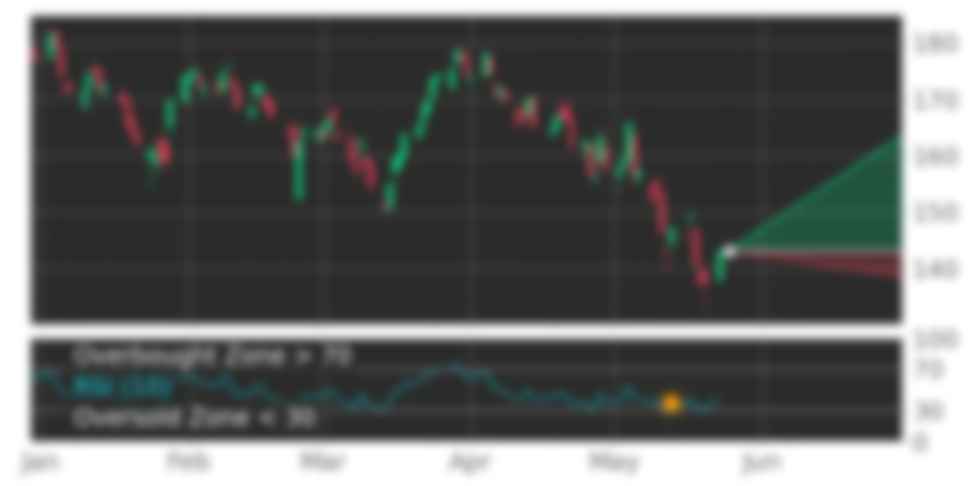
This indicator may be signaling that ITB's price has further to drop, since it fell below its price logged 14 days ago. Traders may consider selling the stock, shorting the stock, or exploring put options. A.I.dvisor backtested 76 similar cases where ITB's Momentum Indicator fell below the 0 level, and of them led to a successful outcome. Odds of Success:
ITB saw its Momentum Indicator move below the 0 level on November 16, 2026. This is an indication that the stock could be shifting in to a new downward move. Traders may want to consider selling the stock or exploring put options. Tickeron's A.I.dvisor looked at 76 similar instances where the indicator turned negative. In 71 of the 76 cases, the stock moved further down in the following days. The odds of a decline are at 90%.
The 10-day RSI Indicator for ITB moved out of overbought territory on November 05, 2026. This could be a bearish sign for the stock. Traders may want to consider selling the stock or buying put options. Tickeron's A.I.dvisor looked at 35 similar instances where the indicator moved out of overbought territory. In 27 of the 35 cases, the stock moved lower in the following days. This puts the odds of a move lower at 77%.
The Moving Average Convergence Divergence Histogram (MACD) for ITB turned negative on November 13, 2026. This could be a sign that the stock is set to turn lower in the coming weeks. Traders may want to sell the stock or buy put options. Tickeron's A.I.dvisor looked at 52 similar instances when the indicator turned negative. In 45 of the 52 cases the stock turned lower in the days that followed. This puts the odds of success at 87%.
Following a 3-day decline, the stock is projected to fall further. Considering past instances where ITB declined for three days, the price rose further in 50 of 62 cases within the following month. The odds of a continued downward trend are 89%.
ITB broke above its upper Bollinger Band on November 04, 2026. This could be a sign that the stock is set to drop as the stock moves back below the upper band and toward the middle band. You may want to consider selling the stock or exploring put options.
The Stochastic Oscillator shows that the ticker has stayed in the oversold zone for 5 days. The price of this ticker is presumed to bounce back soon, since the longer the ticker stays in the oversold zone, the more promptly an upward trend is expected.
ITB moved above its 50-day moving average on October 29, 2026 date and that indicates a change from a downward trend to an upward trend.
The 10-day moving average for ITB crossed bullishly above the 50-day moving average on October 30, 2026. This indicates that the trend has shifted higher and could be considered a buy signal. In 16 of 18 past instances when the 10-day crossed above the 50-day, the stock continued to move higher over the following month. The odds of a continued upward trend are 89%.
Following a +5.29% 3-day Advance, the price is estimated to grow further. Considering data from situations where ITB advanced for three days, in 264 of 306 cases, the price rose further within the following month. The odds of a continued upward trend are 86%.
The Aroon Indicator entered an Uptrend today. In 196 of 231 cases where ITB Aroon's Indicator entered an Uptrend, the price rose further within the following month. The odds of a continued Uptrend are 85%.
The iShares U.S. Home Construction ETF seeks to track the investment results of the Dow Jones U.S. Select Home Construction Index, which measures the performance of the home construction segment of the U.S. equity market. The fund is passively managed and non-diversified, generally investing at least 80% of its assets in the index's constituent securities.
ITB holds roughly 46 to 50 positions and is one of the largest home-construction ETFs, with more than $2 billion in assets under management (AUM). The portfolio is heavily concentrated at the top: DHI, PHM, LEN, and NVR together account for a large share of assets, followed by TOL, SHW, HD, and LOW. From a sector perspective, Consumer Discretionary dominates the exposure, with smaller Industrials and Materials weightings.
The home construction sector is navigating a difficult affordability environment. Thirty-year fixed mortgage rates have hovered near 7%—roughly a full percentage point above year-ago levels—while the 10-year Treasury yield briefly touched 5%. Against this backdrop, the National Association of Home Builders (NAHB) sentiment index fell to its lowest level since 2012, and a majority of builders reported cutting prices or offering sales incentives to sustain demand.
These pressures coexist with a powerful structural tailwind. The United States faces a persistent housing shortage, with independent estimates placing the deficit in the millions of units after years of underbuilding. Limited resale inventory and a "lock-in" effect—where existing homeowners with low-rate mortgages are reluctant to sell—have kept new construction central to the market. The result is an industry balanced between strong long-term demand and near-term margin compression as builders use rate buydowns and discounts to convert cautious buyers.
ITB's recent ETF performance reflects the tug-of-war between those forces. The fund declined through late summer and into mid-autumn, retreating from levels near the low-$100 range toward the mid-$80s as mortgage rates climbed and builder sentiment weakened. The shares then staged a sharp recovery, rising roughly 8% over the trailing 30 days as investors reassessed the sector's valuation and longer-term supply dynamics.
Despite that rebound, ITB remains about 7% below where it stood three months earlier, underscoring how sensitive this concentrated portfolio is to interest-rate movements. Large-cap homebuilders—led by DHI and LEN—have reported rising cancellation rates and softer margins, while PHM has held up comparatively well. Because the top holdings dominate the fund, their individual earnings results and order trends drive a substantial portion of ITB's sector exposure and fund performance.
Tickeron's AI Screener is an AI-powered stock and ETF discovery platform that helps investors scan thousands of securities using technical indicators, fundamentals, volatility measures, AI-generated signals, market trends, price patterns, and customizable filters. The tool is designed to surface trending securities, breakout candidates, and new trading opportunities more efficiently than manual screening, supporting both retail and professional workflows. Explore the AI Screener to apply these capabilities to your own market research.
Looking ahead, the home construction sector's trajectory will depend heavily on the path of interest rates and inflation. With inflation still running above the Federal Reserve's target and energy-related pressures lingering, the timing of any policy easing remains uncertain—and mortgage rates are unlikely to fall meaningfully without a durable shift in that dynamic. Affordability will remain the central variable for order growth, cancellation rates, and builder margins.
Investors should also watch the earnings cycle of the fund's largest holdings, particularly their gross margins and incentive spending, which reveal how much demand is being manufactured through discounts rather than underlying strength. Structural themes—the housing shortage, favorable demographics, and constrained resale supply—provide a longer-term foundation, while policy initiatives aimed at expanding supply and lowering financing costs could act as catalysts. Key risks include persistently high borrowing costs, tariff-related material inflation, labor shortages, and the competitive pressure among home-construction ETFs vying for the same investor capital.
The information on this webpage is provided for general informational and educational purposes only and is not intended as investment advice, a recommendation to purchase or sell any security, or an offer or solicitation related to investments. It does not consider your personal financial situation, goals, or risk profile, and all investing carries inherent risks, including the possibility of losing your entire investment. For more details, please review our full disclaimer.