RSI, the Chicago-based online casino and sports betting operator behind the BetRivers, PlaySugarHouse, and RushBet brands, saw its shares crater roughly 15.70% on Thursday, tumbling from a prior close of $30.77 to approximately $25.94 in intraday action. The dramatic reversal came less than 24 hours after the company posted what, on the surface, appeared to be a stellar second-quarter earnings report — record revenue, record net income, record adjusted EBITDA, and raised full-year guidance. The violent downside move underscores how elevated expectations and a premium valuation can turn even strong results into a selling event.
Rush Street Interactive reported Q2 2026 revenue of $393.8 million, up 46% year-over-year and comfortably above Wall Street's consensus estimate of approximately $367.7 million. Adjusted EBITDA hit $64.6 million, a 61% jump from the prior-year period, while net income edged to a record $29.3 million. Monthly active users surged 58% to roughly 949,000, driven by 64% growth in North American online casino markets and 62% growth in Latin America. Management raised full-year revenue guidance to a range of $1.56 billion to $1.60 billion — implying 38% to 41% growth — and lifted its adjusted EBITDA forecast to between $245 million and $265 million.
Yet beneath those impressive figures, several data points unsettled investors. Earnings per share of $0.15 merely met expectations rather than exceeded them. More critically, North American average revenue per monthly active user declined 18% year-over-year to $320, a metric that suggests newer customer cohorts are generating lower initial value. CFO Kyle Sauers attributed the decline to elevated player acquisition activity, which, while expanding the user base, dilutes near-term per-user economics.
A key catalyst for the selloff was management's disclosure that third-quarter marketing expense would increase by roughly $7 million to $10 million sequentially. While the company framed this as a reflection of attractive customer economics and improving marketing efficiency — not a reaction to competitive pressure — the market interpreted the announcement as a signal that margins may face near-term compression. The increased spend includes costs tied to the July 13 launch of online casino and sports betting operations in Alberta, Canada. Although early Alberta trends have been encouraging, the ramp-up introduces execution risk and near-term cost headwinds.
Another factor weighing on shares was the acknowledgment that approximately $10 million of second-quarter revenue stemmed from favorable sports-betting hold — essentially, outcomes that broke in the house's favor. The company posted its highest sports hold on record in both Colombia and North America during the quarter, boosted by World Cup results and NBA playoff activity. While strong hold is part of the business, analysts tend to discount earnings beats driven by luck rather than structural improvement, and the market appears to be marking down shares accordingly as it adjusts for less favorable hold normalization in future quarters.
The magnitude of Thursday's decline was amplified by the stock's extended positioning heading into the report. RSI had rallied roughly 58% year-to-date and was trading near its 52-week high of $34.53, which was reached on July 20. Its price-to-earnings multiple had stretched above 90 times trailing earnings, leaving virtually no room for anything short of a flawless quarter. Trading volume surged well above the average daily volume of roughly 2.5 million shares, signaling that institutional investors were actively reducing positions. The broader gaming and sports-betting sector has also faced periodic bouts of pressure as investors rotate away from high-multiple consumer-discretionary names.
Looking ahead, the focus shifts to whether RSI can sustain its growth trajectory while navigating higher marketing costs and the uncertain regulatory environment in Latin America — particularly in Colombia, where a temporary 16% gross gaming revenue tax remains in effect. The Alberta launch represents a meaningful growth opportunity, but it will take several quarters before its contribution can be accurately assessed. Additionally, the company's application for a CFTC Designated Contract Market license signals optionality around prediction markets, though management has emphasized it does not intend to focus on sports-oriented prediction products. While the fundamental story remains intact — a casino-first strategy, expanding user base, and zero debt — the sharp repricing suggests that the market is now demanding concrete evidence that growth can continue without sacrificing profitability before rewarding the stock again.
For traders seeking data-driven strategies to navigate volatile moves like the one in RSI, Tickeron's Trending AI Robots page offers a curated selection of AI-powered trading bots. Tickeron provides hundreds of automated trading bots that cover thousands of tickers across diverse strategies, timeframes, and performance metrics. Only the strongest performers under prevailing market conditions are featured in the Trending AI Robots section, giving traders a focused view of algorithms that are currently excelling. Each bot varies by trading style, holding period, and symbol coverage, allowing users to explore approaches aligned with their risk tolerance and objectives. Visit the Trending AI Robots page to discover which strategies are resonating in today's market.
The information on this webpage is provided for general informational and educational purposes only and is not intended as investment advice, a recommendation to purchase or sell any security, or an offer or solicitation related to investments. It does not consider your personal financial situation, goals, or risk profile, and all investing carries inherent risks, including the possibility of losing your entire investment. For more details, please review our full disclaimer.
RSI may jump back above the lower band and head toward the middle band. Traders may consider buying the stock or exploring call options. In of 32 cases where RSI's price broke its lower Bollinger Band, its price rose further in the following month. The odds of a continued upward trend are .
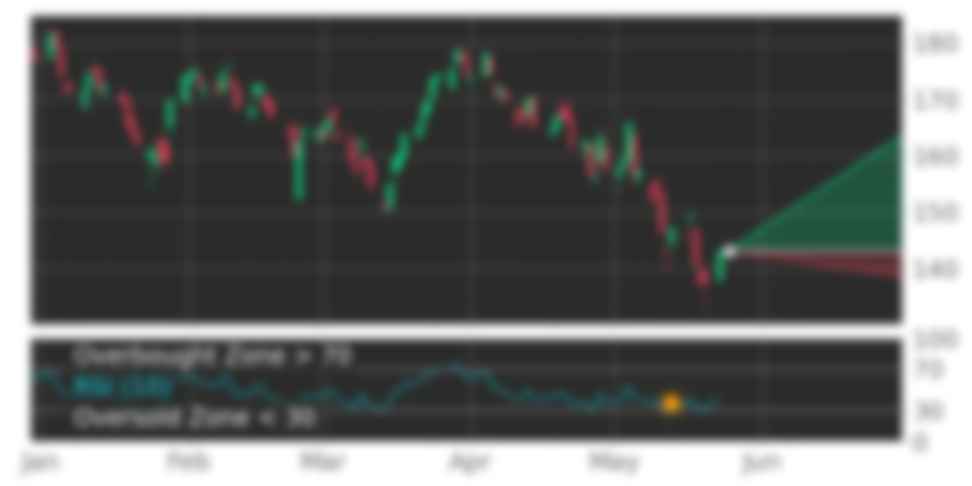
The RSI Indicator demonstrates that the ticker has stayed in the oversold zone for 1 day, which means it's wise to expect a price bounce in the near future.
The Stochastic Oscillator shows that the ticker has stayed in the oversold zone for 5 days. The price of this ticker is presumed to bounce back soon, since the longer the ticker stays in the oversold zone, the more promptly an upward trend is expected.
Following a 3-day Advance, the price is estimated to grow further. Considering data from situations where RSI advanced for three days, in of 305 cases, the price rose further within the following month. The odds of a continued upward trend are .
The Aroon Indicator entered an Uptrend today. In of 287 cases where RSI Aroon's Indicator entered an Uptrend, the price rose further within the following month. The odds of a continued Uptrend are .
The Momentum Indicator moved below the 0 level on July 22, 2026. You may want to consider selling the stock, shorting the stock, or exploring put options on RSI as a result. In of 86 cases where the Momentum Indicator fell below 0, the stock fell further within the subsequent month. The odds of a continued downward trend are .
The Moving Average Convergence Divergence Histogram (MACD) for RSI turned negative on July 17, 2026. This could be a sign that the stock is set to turn lower in the coming weeks. Traders may want to sell the stock or buy put options. Tickeron's A.I.dvisor looked at 45 similar instances when the indicator turned negative. In of the 45 cases the stock turned lower in the days that followed. This puts the odds of success at .
RSI moved below its 50-day moving average on July 30, 2026 date and that indicates a change from an upward trend to a downward trend.
Following a 3-day decline, the stock is projected to fall further. Considering past instances where RSI declined for three days, the price rose further in of 62 cases within the following month. The odds of a continued downward trend are .
The Tickeron SMR rating for this company is (best 1 - 100 worst), indicating strong sales and a profitable business model. SMR (Sales, Margin, Return on Equity) rating is based on comparative analysis of weighted Sales, Income Margin and Return on Equity values compared against S&P 500 index constituents. The weighted SMR value is a proprietary formula developed by Tickeron and represents an overall profitability measure for a stock.
The Tickeron Price Growth Rating for this company is (best 1 - 100 worst), indicating steady price growth. RSI’s price grows at a higher rate over the last 12 months as compared to S&P 500 index constituents.
The Tickeron Profit vs. Risk Rating rating for this company is (best 1 - 100 worst), indicating well-balanced risk and returns. The average Profit vs. Risk Rating rating for the industry is 97, placing this stock slightly better than average.
The Tickeron PE Growth Rating for this company is (best 1 - 100 worst), pointing to consistent earnings growth. The PE Growth rating is based on a comparative analysis of stock PE ratio increase over the last 12 months compared against S&P 500 index constituents.
The Tickeron Valuation Rating of (best 1 - 100 worst) indicates that the company is slightly overvalued in the industry. This rating compares market capitalization estimated by our proprietary formula with the current market capitalization. This rating is based on the following metrics, as compared to industry averages: RSI's P/B Ratio (14.970) is slightly higher than the industry average of (5.817). P/E Ratio (86.806) is within average values for comparable stocks, (85.574). RSI's Projected Growth (PEG Ratio) (0.000) is very low in comparison to the industry average of (0.139). Dividend Yield (0.000) settles around the average of (0.035) among similar stocks. RSI's P/S Ratio (3.435) is slightly higher than the industry average of (1.646).
The average fundamental analysis ratings, where 1 is best and 100 is worst, are as follows
a blank check company, which intends to focus on companies that have created compelling mobile app experiences with significant growth in segments such as gaming, entertainment, education, e-commerce, dating and health and wellness
Industry CasinosGaming