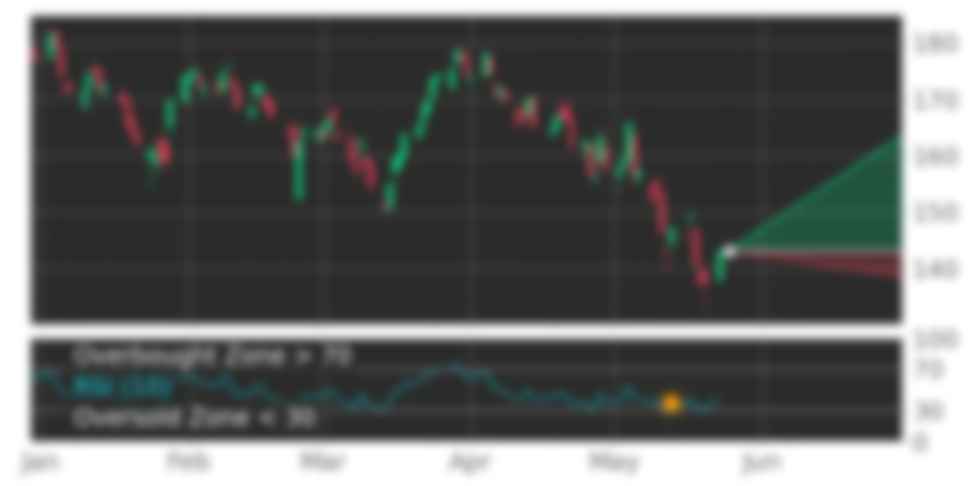
This is a signal that UDOW's price trend could be reversing, and it may be an opportunity to buy the stock or explore call options. A.I.dvisor identified 57 similar cases where UDOW's stochastic oscillator exited the oversold zone, and of them led to successful outcomes. Odds of Success:
The RSI Indicator for UDOW moved out of oversold territory on November 23, 2026. This could be a sign that the stock is shifting from a downward trend to an upward trend. Traders may want to buy the stock or call options. The A.I.dvisor looked at 28 similar instances when the indicator left oversold territory. In 26 of the 28 cases the stock moved higher. This puts the odds of a move higher at 90%.
The Stochastic Oscillator suggests the stock price trend may be in a reversal from a downward trend to an upward trend. 52 of 57 cases where UDOW's Stochastic Oscillator exited the oversold zone resulted in an increase in price. Tickeron's analysis proposes that the odds of a continued upward trend are 90%.
Following a +4.54% 3-day Advance, the price is estimated to grow further. Considering data from situations where UDOW advanced for three days, in 326 of 348 cases, the price rose further within the following month. The odds of a continued upward trend are 90%.
UDOW may jump back above the lower band and head toward the middle band. Traders may consider buying the stock or exploring call options.
The Aroon Indicator entered an Uptrend today. In 272 of 282 cases where UDOW Aroon's Indicator entered an Uptrend, the price rose further within the following month. The odds of a continued Uptrend are 90%.
The Momentum Indicator moved below the 0 level on November 16, 2026. You may want to consider selling the stock, shorting the stock, or exploring put options on UDOW as a result. In 74 of 84 cases where the Momentum Indicator fell below 0, the stock fell further within the subsequent month. The odds of a continued downward trend are 88%.
The Moving Average Convergence Divergence Histogram (MACD) for UDOW turned negative on November 16, 2026. This could be a sign that the stock is set to turn lower in the coming weeks. Traders may want to sell the stock or buy put options. Tickeron's A.I.dvisor looked at 52 similar instances when the indicator turned negative. In 44 of the 52 cases the stock turned lower in the days that followed. This puts the odds of success at 85%.
UDOW moved below its 50-day moving average on November 16, 2026 date and that indicates a change from an upward trend to a downward trend.
The 10-day moving average for UDOW crossed bearishly below the 50-day moving average on November 05, 2026. This indicates that the trend has shifted lower and could be considered a sell signal. In 12 of 14 past instances when the 10-day crossed below the 50-day, the stock continued to move higher over the following month. The odds of a continued downward trend are 86%.
Following a 3-day decline, the stock is projected to fall further. Considering past instances where UDOW declined for three days, the price rose further in 50 of 62 cases within the following month. The odds of a continued downward trend are 90%.
ProShares UltraPro Dow30 seeks daily investment results, before fees and expenses, that correspond to three times (300%) the daily performance of the Dow Jones Industrial Average (DJIA). Launched in February 2010, the fund is non-diversified and carries a net expense ratio of 0.95%. It holds roughly $850 million in assets under management (AUM).
The Dow is a price-weighted index of 30 large-cap, blue-chip U.S. companies, excluding utilities and transportation firms. Because weight is based on share price rather than market capitalization, the index tilts heavily toward its highest-priced members. The fund's largest single-stock exposures have recently included GS, CAT, MSFT, AMGN, and UNH. To achieve leverage, the portfolio layers on index swaps, futures, Treasury bills, and money-market instruments alongside the underlying equities.
This structure is designed for short-term tactical use. The daily reset means performance over periods longer than one day can diverge materially from a simple 3x multiple of the index's cumulative return, particularly in choppy, range-bound markets.
UDOW is ultimately a concentrated bet on U.S. large-cap cyclical and defensive blue chips. The Dow's sector composition skews toward financials, information technology, industrials, and health care, with meaningful representation from consumer discretionary and consumer staples. This blend makes the fund sensitive both to economic-growth expectations and to interest-rate policy.
Financials have been a recurring leadership theme, as large banks and payment processors benefit from a resilient economy and the shape of the yield curve. Industrials, including heavy-equipment and diversified manufacturers, remain tied to capital-spending and infrastructure cycles. Health care contributes defensiveness but carries its own policy and drug-pricing considerations. Because the Dow is price-weighted, a handful of high-priced names can dominate the index's day-to-day swings, concentrating both the opportunity set and the risk.
UDOW has moved in a choppy, range-bound fashion recently. Over the trailing month, the fund is up roughly 3%, with share-price action oscillating between the low-to-mid $60s and roughly $70. That modest net change masks substantial single-day swings amplified by the 3x leverage, including sharp one-day reversals that reflect the fund's daily-reset mechanics.
The broader three-month picture is more muted. After reaching a 52-week high near $79 in early summer, UDOW pulled back by roughly 10% through the autumn, settling into a lower trading band. This pattern reflects a rotation within large-cap leadership and periodic bouts of volatility in rate-sensitive and cyclical segments, rather than a single directional catalyst. The fund's 52-week range spans approximately $46 to $79, underscoring the wide amplitude that leveraged exposure introduces even to a relatively stable benchmark.
Tickeron's AI Screener is an AI-powered stock and ETF discovery platform that helps investors search thousands of securities using technical indicators, fundamentals, volatility measures, AI-generated signals, market trends, price patterns, and customizable filters. It is designed to surface trending securities, breakout candidates, and new trading opportunities more efficiently than manual screening, while also supporting industry and performance-based filtering. For investors evaluating leveraged products such as UDOW alongside their underlying holdings, the platform offers a structured way to compare momentum, volatility, and signal strength across the market. Explore the AI Screener to refine your research workflow.
Looking ahead, several structural factors are likely to shape UDOW. Interest-rate policy and inflation expectations will remain central, given the Dow's meaningful weight in financials and other rate-sensitive segments. The earnings cycle of the largest constituents — particularly the highest-priced names that dominate the price-weighted index — will continue to drive short-term performance. Sector rotation between cyclical industrials and defensive health care, alongside capital flows into leveraged products, may influence both returns and realized volatility.
Investors should also weigh the structural features of the product itself: the daily reset creates compounding effects that can erode returns in choppy markets, while the 0.95% expense ratio and non-diversified structure add cost and concentration. Regulatory developments, policy shifts affecting health care and banking, and broader economic-growth trends round out the key monitor list. No price target or forecast is implied; these themes simply frame the environment in which the fund operates.
The information on this webpage is provided for general informational and educational purposes only and is not intended as investment advice, a recommendation to purchase or sell any security, or an offer or solicitation related to investments. It does not consider your personal financial situation, goals, or risk profile, and all investing carries inherent risks, including the possibility of losing your entire investment. For more details, please review our full disclaimer.