


Top AI Trading Performers: Tickeron's New FLMs Produce Groundbreaking Outcomes on June 17, 2025
On June 17, 2025, Tickeron marked a pivotal moment in AI-driven trading, showcasing its top-performing agents powered by next-generation Financial Learning Models (FLMs). These models, now more responsive and adaptive due to expanded computational capabilities, are revolutionizing trading strategies by enabling faster learning cycles and real-time adaptability to market volatility.
With the deployment of enhanced 15-minute and 5-minute AI agents, Tickeron has elevated its trading performance and user accessibility. These new Double Agents leverage the synergy between traditional securities and inverse ETFs to provide both hedging and profit-seeking capabilities, without balance limitations.
FLMs at a Glance: Smarter, Faster, Sharper
The latest FLMs incorporate real-time market data analysis with AI-powered pattern recognition. Their main benefits include:
- Reduced emotional trading through machine-led objectivity
- Optimized entry/exit points identified via technical and statistical convergence
- Greater resilience to short-term volatility through dual-position hedging
- User-friendly automation suitable for both beginners and advanced traders
By focusing on mid-timeframe analytics and combining bullish and bearish indicators, FLMs provide a comprehensive trading ecosystem that balances risk and return efficiently.
Top Performers: AI Trading Agents of June 17, 2025
15-Minute Trading Agent
Annualized Return: +830%
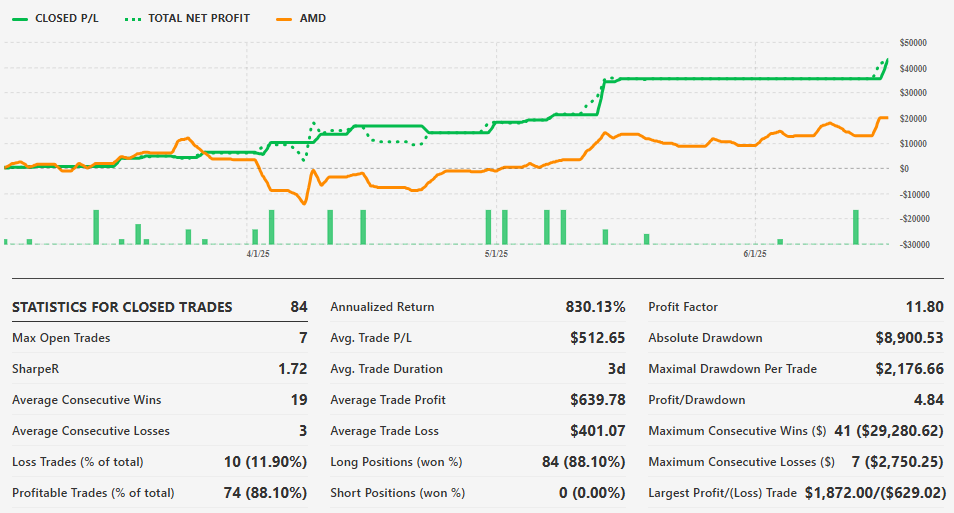
This agent executes a long position in AMD while simultaneously using AMDS, an inverse ETF of AMD, as a hedge.
- AMD: A top-tier semiconductor firm with a diversified portfolio in CPUs, GPUs, gaming consoles, and data centers.
- AMDS: An inverse ETF designed to deliver -100% daily returns relative to AMD’s performance.
Why It Works:
This double agent utilizes high-frequency 15-minute chart analysis, supported by FLM filtering and ML optimization. The swing strategy with daily timeframe confirmations allows for both agility and directional conviction. With automated risk capping and real-time analytics, it combines powerful entry signals with downside hedging.
15-Minute Trading Agent
Annualized Return: +576%
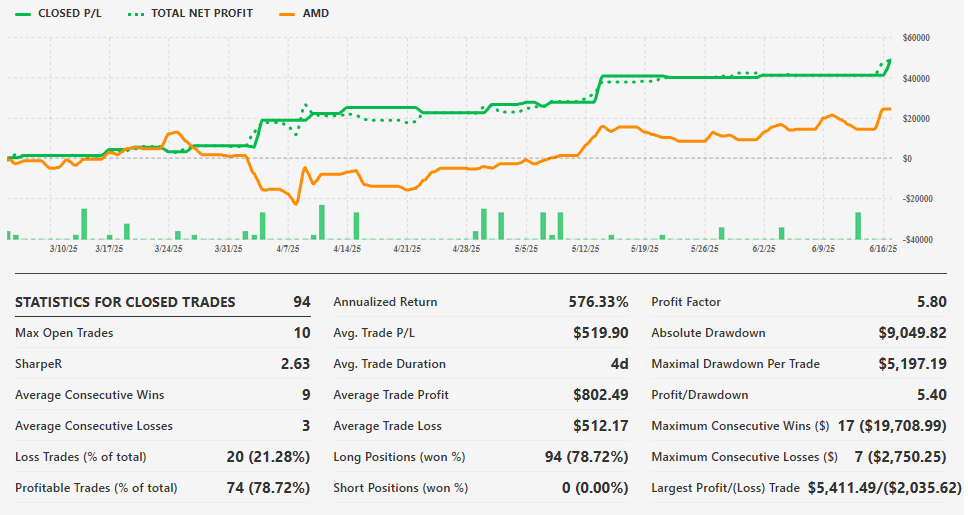
Paired with SOXS—a 3x leveraged inverse ETF of the semiconductor sector—this agent adds more aggressive downside exposure.
- SOXS: Designed to triple the inverse daily performance of the PHLX Semiconductor Sector Index.
- AMD: Core long position ensures tech growth exposure.
Strategic Edge:
SOXS amplifies the hedging effect, giving the agent robust dual-directional capabilities in volatile tech markets. Ideal for active traders, this strategy leverages rapid AI recalibration to stay aligned with intraday momentum.
5-Minute Trading Agent
Annualized Return: +478%
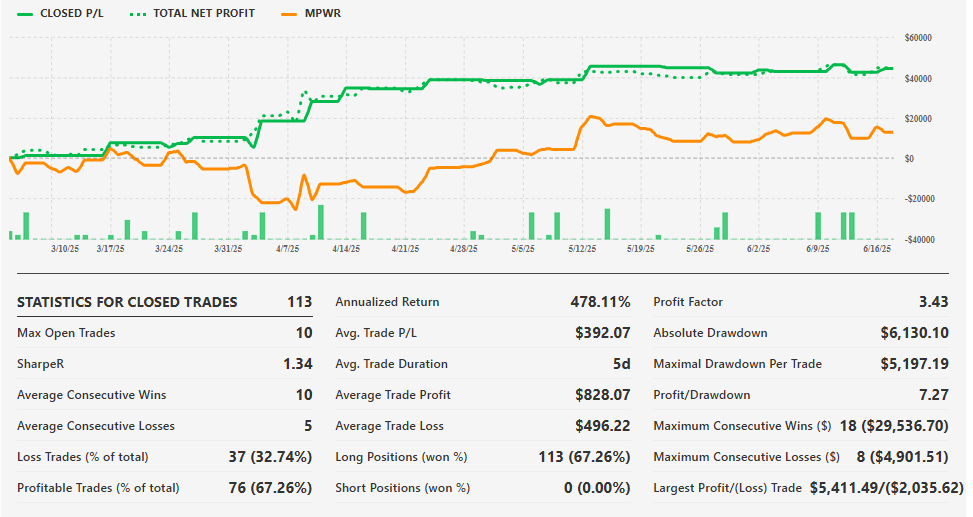
This high-frequency agent features a long position in MPWR and hedges with SOXS.
- MPWR: A fabless chip designer known for energy-efficient analog semiconductors used in automotive and industrial markets.
- SOXS: Serves again as the downside protection instrument.
Why 5 Minutes Matters:
Using 5-minute intervals, the agent captures micro-trends and reacts rapidly to intraday swings. Enhanced ML models detect repeatable patterns with shorter latency, improving timing precision and portfolio turnover without sacrificing risk control.
15-Minute Trading Agent
Annualized Return: +463%
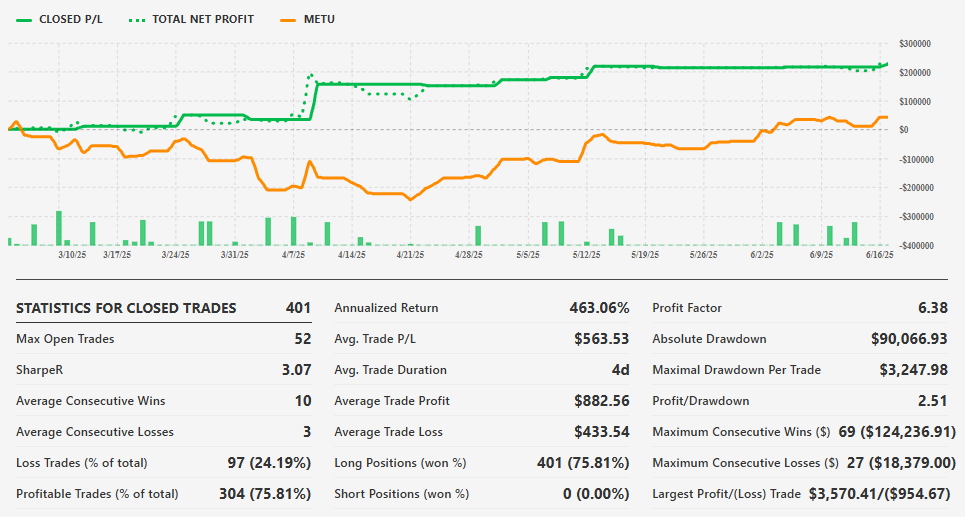
A single-instrument AI agent trading METU, a 2x leveraged fund tied to META (formerly Facebook).
- METU: Offers twice the daily return of META, suited for short-term aggressive growth plays.
Trading Philosophy:
This agent does not hedge but uses FLMs to strictly regulate entry points and trade exposure. The 15-minute chart allows it to capitalize on tech momentum swings, while risk is controlled through capped position limits and daily trend validation.
5-Minute Trading Agent
Annualized Return: +392%
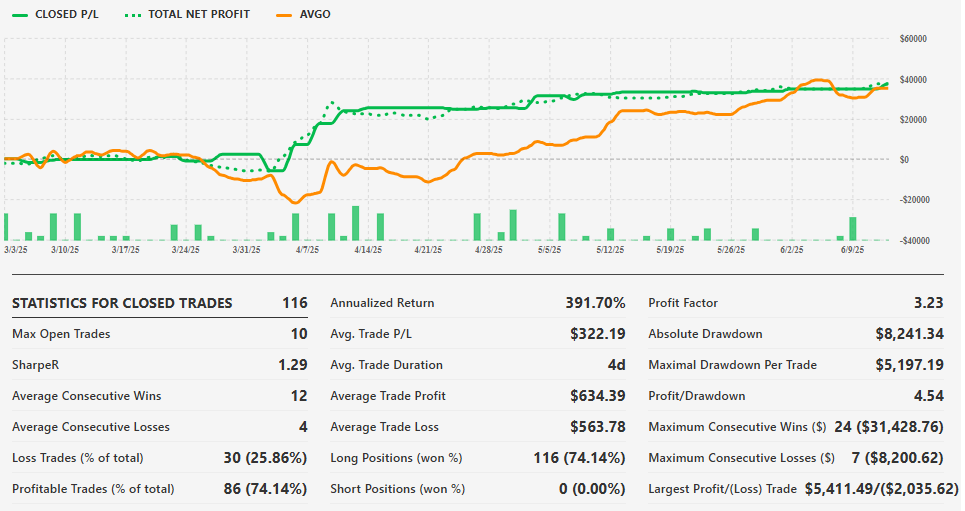
This strategy pairs AVGO (Broadcom) with SOXS for a semiconductor-focused long/short play.
- AVGO: A diversified semiconductor and enterprise software firm with strong revenue streams from Apple and global telecoms.
- SOXS: Complements Broadcom’s long exposure by shorting the broader semiconductor sector.
Performance Strengths:
With Broadcom's stability and SOXS’s leveraged bearish exposure, this agent provides balance in trending and corrective market conditions. The short 5-minute signals make it agile enough to respond to real-time developments while maintaining an edge in both bullish and bearish climates.
The Role of Inverse ETFs in Double Agent Strategies
Each Double Agent utilizes inverse ETFs like AMDS and SOXS for real-time hedging and speculative opportunities. While traditional investors use these instruments cautiously, the Tickeron AI framework ensures inverse ETF volatility is mitigated through smart position sizing, frequent signal reassessment, and daily compounding awareness.
Risk Control and Position Management: Built-in Safety Mechanisms
Across all agent types, Tickeron enforces robust limits:
- Position caps: Max 10 concurrent trades for double agents, 6 for single agents
- Daily trend validation: Ensures trades align with macro movement
- Real-time data feeds: Improve signal accuracy and reduce lag
- Emotion-free execution: Minimizes behavioral biases in trading
These measures ensure a stable experience for beginners while preserving the advanced analytics required by seasoned traders.
Tickeron: The Intelligence Behind the Bots
Tickeron, under the guidance of CEO Sergey Savastiouk, has cemented its position as a leader in AI-powered finance. Its FLMs represent a fusion of market intuition and machine precision, enabling users to leverage institutional-grade analytics in an accessible format.
The platform’s architecture provides:
- High-frequency signal generation
- Integrated inverse and long ETF strategies
- Customizable bots with dual perspective logic
- Onboarding support for all experience levels
This ecosystem allows for scalable participation in financial markets, democratizing access to AI trading tools that were once limited to hedge funds and proprietary desks.
Conclusion: AI Agents, FLMs, and the Future of Trading
The trading results from June 17, 2025, reflect the maturity of Tickeron's AI ecosystem. The top-performing agents—especially the AMD/AMDS double agent at +830% annualized return—demonstrate how intelligent design, real-time adaptation, and well-paired hedging instruments can deliver superior results in dynamic markets.
As Tickeron continues expanding its AI infrastructure, the evolution of Financial Learning Models and trading agents signals a paradigm shift: from reactive to predictive trading, where machines don’t just follow the market—they anticipate it.
Contributor
Serhii Bondarenko is an AI-focused trading strategist and financial markets analyst specializing in the development and application of AI trading bots and autonomous trading agents. His work combines technical analysis, fundamental analysis, and quantitative research to identify market patterns, forecast price movements, and analyze liquidity, volatility, and correlations across global stock markets. Serhii actively publishes market insights, forecasts, and trading frameworks on platforms such as Investing.com and Finextra, with a strong focus on AI-driven decision-making and next-generation algorithmic trading. His research aims to bridge the gap between traditional trading methodologies and advanced artificial intelligence, helping traders and investors navigate complex and rapidly evolving market conditions.
Aroon Indicator for AMD shows an upward move is likely
AMD's Aroon Indicator triggered a bullish signal on October 06, 2026. Tickeron's A.I.dvisor detected that the AroonUp green line is above 70 while the AroonDown red line is below 30. When the up indicator moves above 70 and the down indicator remains below 30, it is a sign that the stock could be setting up for a bullish move. Traders may want to buy the stock or look to buy calls options. A.I.dvisor looked at 261 similar instances where the Aroon Indicator showed a similar pattern. In 207 of the 261 cases, the stock moved higher in the days that followed. This puts the odds of a move higher at 79%.

Technical Analysis (Indicators)
Bullish Trend Analysis
The Momentum Indicator moved above the 0 level on September 04, 2026. You may want to consider a long position or call options on AMD as a result. In 57 of 75 past instances where the momentum indicator moved above 0, the stock continued to climb. The odds of a continued upward trend are 76%.
The Moving Average Convergence Divergence (MACD) for AMD just turned positive on September 04, 2026. Looking at past instances where AMD's MACD turned positive, the stock continued to rise in 30 of 42 cases over the following month. The odds of a continued upward trend are 71%.
AMD moved above its 50-day moving average on September 15, 2026 date and that indicates a change from a downward trend to an upward trend.
The 10-day moving average for AMD crossed bullishly above the 50-day moving average on September 17, 2026. This indicates that the trend has shifted higher and could be considered a buy signal. In 11 of 14 past instances when the 10-day crossed above the 50-day, the stock continued to move higher over the following month. The odds of a continued upward trend are 79%.
Following a +3.62% 3-day Advance, the price is estimated to grow further. Considering data from situations where AMD advanced for three days, in 244 of 319 cases, the price rose further within the following month. The odds of a continued upward trend are 76%.
Bearish Trend Analysis
The RSI Indicator has been in the overbought zone for 2 days. Expect a price pull-back in the near future.
The Stochastic Oscillator demonstrated that the ticker has stayed in the overbought zone for 19 days. The longer the ticker stays in the overbought zone, the sooner a price pull-back is expected.
Following a 3-day decline, the stock is projected to fall further. Considering past instances where AMD declined for three days, the price rose further in 50 of 62 cases within the following month. The odds of a continued downward trend are 76%.
AMD broke above its upper Bollinger Band on September 21, 2026. This could be a sign that the stock is set to drop as the stock moves back below the upper band and toward the middle band. You may want to consider selling the stock or exploring put options.
Fundamental Analysis (Ratings)
The Tickeron Price Growth Rating for this company is 4 (best 1 - 100 worst), indicating outstanding price growth. AMD’s price grows at a higher rate over the last 12 months as compared to S&P 500 index constituents.
The Tickeron Profit vs. Risk Rating rating for this company is 5 (best 1 - 100 worst), indicating low risk on high returns. The average Profit vs. Risk Rating rating for the industry is 70, placing this stock better than average.
The Tickeron PE Growth Rating for this company is 11 (best 1 - 100 worst), pointing to outstanding earnings growth. The PE Growth rating is based on a comparative analysis of stock PE ratio increase over the last 12 months compared against S&P 500 index constituents.
The Tickeron SMR rating for this company is 70 (best 1 - 100 worst), indicating slightly better than average sales and a considerably profitable business model. SMR (Sales, Margin, Return on Equity) rating is based on comparative analysis of weighted Sales, Income Margin and Return on Equity values compared against S&P 500 index constituents. The weighted SMR value is a proprietary formula developed by Tickeron and represents an overall profitability measure for a stock.
The Tickeron Seasonality Score of 85 (best 1 - 100 worst) indicates that the company is significantly overvalued in the industry. The Tickeron Seasonality score describes the variance of predictable price changes around the same period every calendar year. These changes can be tied to a specific month, quarter, holiday or vacation period, as well as a meteorological or growing season.
The Tickeron Valuation Rating of 86 (best 1 - 100 worst) indicates that the company is significantly overvalued in the industry. This rating compares market capitalization estimated by our proprietary formula with the current market capitalization. This rating is based on the following metrics, as compared to industry averages: P/B Ratio (14.771) is normal, around the industry mean (7.975). P/E Ratio (155.069) is within average values for comparable stocks, (165.532). Projected Growth (PEG Ratio) (0.619) is also within normal values, averaging (3.761). Dividend Yield (0.000) settles around the average of (0.007) among similar stocks. P/S Ratio (20.450) is also within normal values, averaging (45.794).
Notable companies
Industry description
Market Cap
High and low price notable news
Volume
Fundamental Analysis Ratings
The average fundamental analysis ratings, where 1 is best and 100 is worst, are as follows

Advertisement
General Information
a manufacturer of integrated circuits for semiconductors
Industry Semiconductors
Advertisement