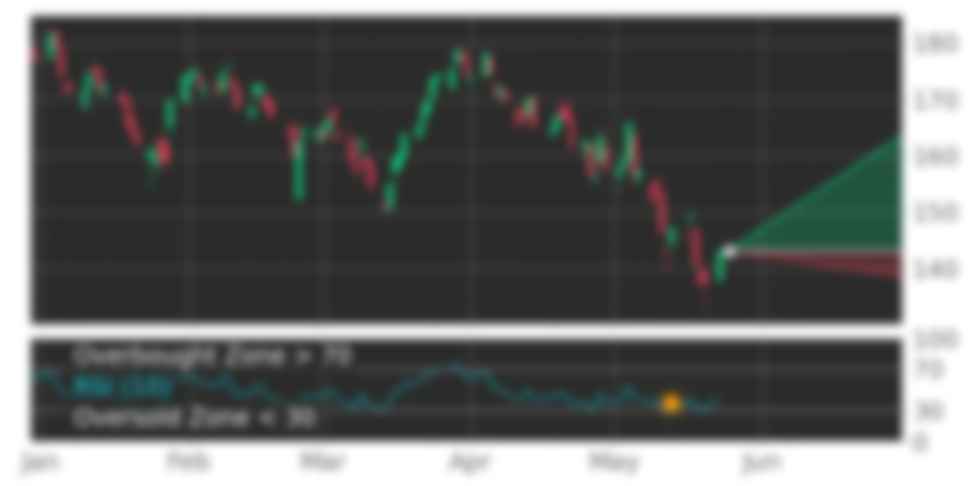
This is a Bearish indicator signaling DFAR's price could decline from here. Traders may explore shorting the stock or put options. A.I. dvisor identified 42 similar cases where DFAR's MACD histogram became negative, and of them led to successful outcomes. Odds of Success:
The 50-day moving average for DFAR moved below the 200-day moving average on October 30, 2026. This could be a long-term bearish signal for the stock as the stock shifts to an downward trend.
The 10-day RSI Indicator for DFAR moved out of overbought territory on November 05, 2026. This could be a bearish sign for the stock. Traders may want to consider selling the stock or buying put options. Tickeron's A.I.dvisor looked at 23 similar instances where the indicator moved out of overbought territory. In 19 of the 23 cases, the stock moved lower in the following days. This puts the odds of a move lower at 83%.
The Momentum Indicator moved below the 0 level on November 18, 2026. You may want to consider selling the stock, shorting the stock, or exploring put options on DFAR as a result. In 67 of 79 cases where the Momentum Indicator fell below 0, the stock fell further within the subsequent month. The odds of a continued downward trend are 85%.
The Moving Average Convergence Divergence Histogram (MACD) for DFAR turned negative on November 17, 2026. This could be a sign that the stock is set to turn lower in the coming weeks. Traders may want to sell the stock or buy put options. Tickeron's A.I.dvisor looked at 43 similar instances when the indicator turned negative. In 33 of the 43 cases the stock turned lower in the days that followed. This puts the odds of success at 77%.
Following a 3-day decline, the stock is projected to fall further. Considering past instances where DFAR declined for three days, the price rose further in 50 of 62 cases within the following month. The odds of a continued downward trend are 82%.
The Stochastic Oscillator demonstrated that the ticker has stayed in the oversold zone for 2 days, which means it's wise to expect a price bounce in the near future.
DFAR moved above its 50-day moving average on October 29, 2026 date and that indicates a change from a downward trend to an upward trend.
The 10-day moving average for DFAR crossed bullishly above the 50-day moving average on October 30, 2026. This indicates that the trend has shifted higher and could be considered a buy signal. In 13 of 15 past instances when the 10-day crossed above the 50-day, the stock continued to move higher over the following month. The odds of a continued upward trend are 87%.
Following a +3.04% 3-day Advance, the price is estimated to grow further. Considering data from situations where DFAR advanced for three days, in 236 of 285 cases, the price rose further within the following month. The odds of a continued upward trend are 83%.
DFAR may jump back above the lower band and head toward the middle band. Traders may consider buying the stock or exploring call options.
The Aroon Indicator entered an Uptrend today. In 222 of 282 cases where DFAR Aroon's Indicator entered an Uptrend, the price rose further within the following month. The odds of a continued Uptrend are 79%.
The Dimensional US Real Estate ETF (DFAR) seeks long-term capital appreciation by investing in U.S. companies whose principal activities involve the ownership, management, development, construction, or sale of residential, commercial, and industrial real estate. The fund is actively managed using a market-capitalization-weighted approach and concentrates heavily in REITs, alongside select real estate operating companies and residential construction firms.
The portfolio holds approximately 125 securities, with total assets under management (AUM) near $1.7 billion. Its largest positions include Welltower (WELL), Prologis (PLD), Equinix (EQIX), American Tower (AMT), Digital Realty (DLR), Simon Property Group (SPG), Realty Income (O), Public Storage (PSA), Equity Residential (EQR), and Ventas (VTR). By REIT industry, the fund is weighted toward specialized REITs (including data centers and towers), followed by retail, healthcare, residential, and industrial REITs, with a smaller office allocation.
The fund carries a competitive net expense ratio of 0.19% (management fee of 0.17%) and has operated since its inception in February 2022. Because it is a pure real-estate vehicle, its returns are driven primarily by sector fundamentals and interest-rate dynamics rather than broad equity-market beta.
U.S. real estate securities sit at the intersection of two dominant market themes: the interest-rate cycle and the digital-infrastructure buildout. Because REITs distribute a large share of earnings as dividends, their valuations are often compared against bond yields, making the sector acutely sensitive to shifts in monetary policy and inflation expectations. Periods of easing yields tend to compress real-estate capitalization rates and lift equity valuations, while persistent inflation or hawkish policy can pressure the group.
Beneath that macro overlay, the sector's internal growth has been highly uneven. Specialized REITs tied to data centers and communications towers have benefited from surging demand for cloud computing and artificial-intelligence workloads, driving leasing momentum and capital spending. Healthcare REITs focused on senior housing have drawn support from favorable demographics and an aging population. By contrast, the office segment continues to face structural headwinds from remote work and elevated vacancy, while retail and industrial REITs navigate a normalization following earlier pandemic-era booms.
DFAR's recent price action reflects this split between rate sensitivity and sector-specific demand. After climbing to a multi-month high in late July, the fund drifted lower through August and September, bottoming near the end of September before staging a sustained recovery. Over the trailing month, DFAR has gained approximately 9%, leaving it roughly flat over the trailing quarter.
The rebound coincided with an easing in long-term Treasury yields, which lowered the discount rate applied to future property cash flows and improved the relative appeal of REIT dividends. Within the portfolio, data-center and tower operators, along with healthcare REITs, were the clearest beneficiaries of structural demand trends, while rate-sensitive and higher-beta segments lagged. The fund's concentration in large-cap, investment-grade-style REITs has provided a degree of stability, though it also means the portfolio is closely tied to the performance of a handful of dominant names.
Tickeron's AI Screener is an AI-powered stock and ETF discovery platform that helps investors scan thousands of securities using technical indicators, fundamentals, volatility measures, AI-generated signals, market trends, price patterns, and customizable filters. The tool is designed to surface trending securities, breakout candidates, and emerging trading opportunities more efficiently than manual screening, while allowing users to filter by industry, sector, and performance characteristics. For investors monitoring the real estate sector or comparing DFAR against peers, the AI Screener offers a structured way to identify candidates aligned with a given thesis or risk profile.
Looking ahead, the most important variables for DFAR are the path of interest rates, inflation, and the durability of the data-center and digital-infrastructure cycle. A continuation of the AI-driven capital-spending buildout would likely support the fund's specialized-REIT exposure, while any cooling in cloud demand or an oversupply of new capacity could temper that leadership. Healthcare REITs tied to senior housing remain a demographic-driven story worth monitoring for occupancy and rent growth.
On the macro side, investors should watch the Federal Reserve's policy trajectory and long-term Treasury yields, which have the most direct influence on REIT valuations. Fund flows, sector rotation, and regulatory developments affecting data-center energy consumption and zoning also carry potential implications. As always, concentration in the real-estate industry and exposure to small- and mid-cap names introduce risks that warrant consideration alongside the fund's structural growth themes.
The information on this webpage is provided for general informational and educational purposes only and is not intended as investment advice, a recommendation to purchase or sell any security, or an offer or solicitation related to investments. It does not consider your personal financial situation, goals, or risk profile, and all investing carries inherent risks, including the possibility of losing your entire investment. For more details, please review our full disclaimer.