MENU
Go to the list of all blogs
published in Blogs
Jul 21, 2026
iShares Russell 2000 ETF (IWM) Delivers +20% in Q2 as Small Caps Lead the Market

iShares Russell 2000 ETF (IWM) Delivers +20% in Q2 as Small Caps Lead the Market

Key Takeaways

  • The iShares Russell 2000 ETF delivers diversified exposure to approximately 2,000 U.S. small-cap stocks across industrials, healthcare, financials, and information technology, with a competitive 0.19% expense ratio and roughly $83 billion in assets under management (AUM).
  • After surging more than 20% during the second quarter of 2026 — its strongest quarterly performance in years — IWM has entered a period of consolidation, moving roughly 1% lower over the past 30 days.
  • Small-cap stocks have broadly outperformed large-cap benchmarks year-to-date, driven by a combination of resilient economic growth, AI-driven demand filtering into smaller industrials and technology firms, and a Federal Reserve policy stance that has stabilized borrowing costs.
  • Approximately 30% of Russell 2000 debt carries floating interest rates, making the fund structurally more sensitive to Federal Reserve policy shifts than large-cap indexes.
  • Earnings growth for Russell 2000 constituents is projected near 19% for 2026, outpacing S&P 500 estimates and providing a fundamental underpinning for the small-cap rally.

Overview of the iShares Russell 2000 ETF (IWM)

The iShares Russell 2000 ETF, issued by BlackRock and launched in May 2000, seeks to track the investment results of the Russell 2000 Index — the most widely followed benchmark for U.S. small-capitalization equities. The index comprises approximately 2,000 of the smallest stocks within the broader Russell 3000 Index, representing roughly 7% of that index's total market capitalization.

IWM's portfolio spans roughly 2,000 holdings, with no single position exceeding 0.4% of the fund. Top holdings include Moog Inc, Cytokinetics, BrightSpring Health Services, UMB Financial, Viasat, JFrog, Krystal Biotech, Hut 8 Corp, and CareTrust REIT. Sector weights are led by industrials at approximately 19%, information technology near 18%, healthcare around 16%, and financials at roughly 16%, followed by consumer discretionary, energy, real estate, and materials. This balanced sector composition differentiates IWM from large-cap benchmarks that have grown increasingly concentrated in mega-cap technology stocks. When scanning for comparable names, I occasionally reference Tickeron’s AI tools to cross-check sector exposures.

The fund operates as a passive, market-cap-weighted vehicle with an expense ratio of 0.19%. Its deep liquidity and active options market make it a primary instrument for institutional investors executing small-cap allocation and hedging strategies.

The Small-Cap Landscape and Key Themes

Small-cap equities entered 2026 with significant tailwinds after years of relative underperformance versus large-cap peers. By late 2025, the valuation gap between the Russell 2000 and the S&P 500 had reached a multi-decade extreme, with small caps trading at approximately 18 times forward earnings versus 26 times for large caps. That discount, combined with a cooling inflation trajectory and three consecutive Federal Reserve rate cuts in late 2025, set the stage for a rotation into domestically oriented, interest-rate-sensitive companies.

Several structural themes now shape the small-cap landscape. Artificial intelligence (AI) investment has broadened beyond hyperscale cloud providers, creating demand for semiconductor supply-chain participants, data center infrastructure providers, and specialized software firms — many of which reside in the Russell 2000. In parallel, reshoring trends and domestic infrastructure spending have disproportionately benefited U.S.-focused small-cap industrials and manufacturers. Legislative changes, including the restoration of full R&D expensing and 100% bonus depreciation, have further improved cash flow for capital-intensive smaller firms.

However, risks remain pronounced. Roughly 30% of Russell 2000 constituent debt carries floating rates, compared to approximately 7% for the S&P 500. Interest expense now accounts for approximately 31% of EBITDA (earnings before interest, taxes, depreciation, and amortization) for Russell 2000 firms, a level that has more than doubled since 2020. Nearly 40% of Russell 2000 companies remain unprofitable. The June 2026 index reconstitution also halved the weight of AI infrastructure stocks within the benchmark, reducing a key performance driver from approximately 15% to 7%.

Recent Performance and Positioning

IWM delivered a standout second quarter, climbing approximately 20.4% from its April 1 closing level of $249.56 to $300.45 by June 30. That quarter represented the Russell 2000's strongest performance since the fourth quarter of 2020 and contributed to a year-to-date gain exceeding 19% through mid-July. For context, the S&P 500 advanced roughly 9-10% over the same period, underscoring the magnitude of the small-cap leadership rotation.

Over the most recent 30-day window, however, IWM has traded in a narrow range, edging roughly 1% lower as markets digested mixed signals. Oil prices spiked back above $80 per barrel amid renewed U.S.-Iran tensions, semiconductor stocks experienced a sharp pullback, and uncertainty surrounding the Federal Reserve's policy path under Chair Kevin Warsh kept risk appetite in check. The consolidation follows a powerful rally and reflects a market pausing to assess whether fundamental earnings growth can sustain small-cap valuations at current levels. One thing that stands out in the holdings is the performance of names like Moog Inc and Hut 8 Corp, which have each posted triple-digit gains over the past year.

The fund's top holdings reflect the breadth of the small-cap opportunity set. Moog Inc, a motion-control systems manufacturer, and Hut 8 Corp, a digital asset infrastructure company, have each posted triple-digit percentage gains over the past year, benefiting from industrial and crypto-related demand respectively. BrightSpring Health Services and Cytokinetics represent the healthcare segment, where clinical milestones and demographic trends continue to attract investor capital. The fund's granular composition — with no position exceeding 0.4% — means performance is driven by broad sector and macro trends rather than idiosyncratic single-stock moves.

Leveraging AI Tools in Small-Cap Research

Identifying opportunities across thousands of small-cap stocks can be resource-intensive, which is where Tickeron's AI Screener adds practical value. The platform applies artificial intelligence to scan equities and ETFs using a broad array of criteria, including technical indicators, fundamental metrics, volatility patterns, and AI-generated trading signals. Users can filter by sector, industry, market capitalization, and performance characteristics to surface securities that match specific investment criteria — whether seeking breakout candidates, momentum plays, or fundamentally sound names trading at attractive valuations. For investors navigating the expansive small-cap universe, the AI Screener offers an efficient way to narrow the field and identify actionable ideas aligned with evolving market conditions. I have found this approach helpful when building watchlists for names that fit the themes discussed above.

2026 Outlook and Factors to Watch

The trajectory of IWM through the remainder of 2026 will likely hinge on several interrelated factors. First among them is Federal Reserve policy: markets currently price a roughly 35-basis-point probability of tightening by year-end. Any rate increase would disproportionately pressure small caps given their higher floating-rate debt exposure. Conversely, if the Fed remains on hold and inflation continues to moderate, the rate environment could remain supportive for small-cap earnings.

Earnings execution represents the second critical variable. Russell 2000 constituents are projected to deliver approximately 19% year-over-year earnings growth for full-year 2026. If those estimates materialize — particularly in the industrials, financials, and healthcare segments that dominate the index — small caps could maintain their relative valuation advantage. At a forward price-to-earnings multiple near 17, the Russell 2000 continues to trade at a discount to the S&P 500's roughly 20 times earnings, suggesting room for further multiple expansion if earnings delivery remains on track. I'm watching earnings reports closely in the coming quarters to see how this plays out.

Geopolitical risks, including the trajectory of Middle East tensions and their impact on energy prices, add uncertainty to the inflation outlook. Sustained oil prices above $80 per barrel could complicate the Fed's policy calculus and disproportionately affect the transportation, manufacturing, and consumer-facing small-cap segments. Additionally, the post-reconstitution Russell 2000 — now carrying a reduced AI infrastructure weight — may see leadership rotate toward traditional cyclical sectors, regional banks, and biotech, altering the performance profile investors have grown accustomed to during the first half of 2026.

Capital flows into small-cap ETFs remain a critical signal. After years of investor capital concentrating in large-cap and thematic technology funds, the broadening of market participation in 2026 has driven renewed interest in small-cap strategies. Whether institutional and retail investors continue to allocate toward diversified small-cap vehicles like IWM — rather than narrower factor-based or active alternatives — will influence both fund flows and index-level momentum in the months ahead.

The information on this webpage is provided for general informational and educational purposes only and is not intended as investment advice, a recommendation to purchase or sell any security, or an offer or solicitation related to investments. It does not consider your personal financial situation, goals, or risk profile, and all investing carries inherent risks, including the possibility of losing your entire investment. For more details, please review our full disclaimer.

Disclaimers and Limitations

Related Ticker: IWM

Momentum Indicator for IWM turns negative, indicating new downward trend

IWM saw its Momentum Indicator move below the 0 level on July 23, 2026. This is an indication that the stock could be shifting in to a new downward move. Traders may want to consider selling the stock or exploring put options. Tickeron's A.I.dvisor looked at 95 similar instances where the indicator turned negative. In of the 95 cases, the stock moved further down in the following days. The odds of a decline are at .

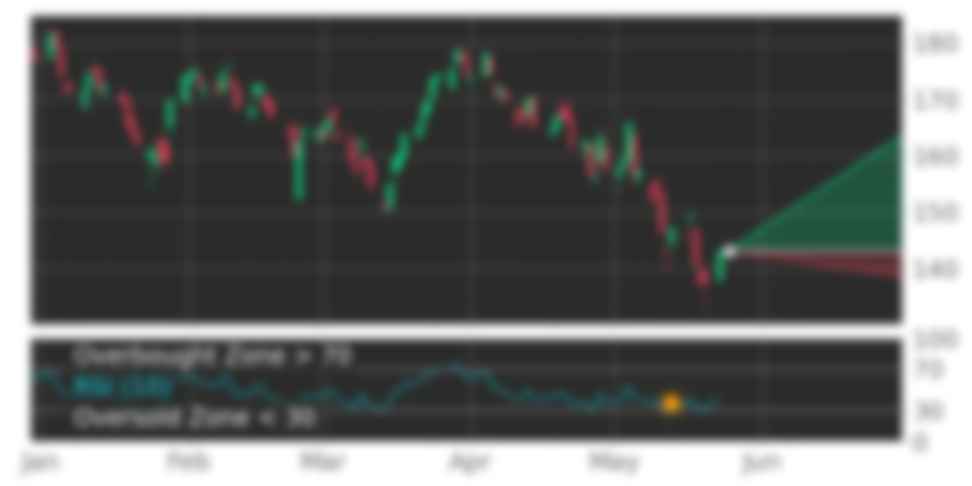
Price Prediction Chart

Technical Analysis (Indicators)

Bearish Trend Analysis

The Moving Average Convergence Divergence Histogram (MACD) for IWM turned negative on July 06, 2026. This could be a sign that the stock is set to turn lower in the coming weeks. Traders may want to sell the stock or buy put options. Tickeron's A.I.dvisor looked at 44 similar instances when the indicator turned negative. In of the 44 cases the stock turned lower in the days that followed. This puts the odds of success at .

Following a 3-day decline, the stock is projected to fall further. Considering past instances where IWM declined for three days, the price rose further in of 62 cases within the following month. The odds of a continued downward trend are .

Bullish Trend Analysis

The Stochastic Oscillator is in the oversold zone. Keep an eye out for a move up in the foreseeable future.

Following a 3-day Advance, the price is estimated to grow further. Considering data from situations where IWM advanced for three days, in of 322 cases, the price rose further within the following month. The odds of a continued upward trend are .

The Aroon Indicator entered an Uptrend today. In of 276 cases where IWM Aroon's Indicator entered an Uptrend, the price rose further within the following month. The odds of a continued Uptrend are .

Notable companies

The most notable companies in this group are Bloom Energy Corp (NYSE:BE), Guardant Health (NASDAQ:GH), Arrowhead Pharmaceuticals (NASDAQ:ARWR), Lumen Technologies (NYSE:LUMN), Transocean Ltd (NYSE:RIG), SSR Mining (NASDAQ:SSRM), Valaris Limited (NYSE:VAL), Tanger (NYSE:SKT), California Resources Corp (NYSE:CRC), Synaptics (NASDAQ:SYNA).

Industry description

The investment seeks to track the investment results of the Russell 2000® Index, which measures the performance of the small-capitalization sector of the U.S. equity market. The fund generally invests at least 80% of its assets in the component securities of its underlying index and in investments that have economic characteristics that are substantially identical to the component securities of its underlying index (i.e., depositary receipts representing securities of the underlying index) and may invest up to 20% of its assets in certain futures, options and swap contracts, cash and cash equivalents.

Market Cap

The average market capitalization across the iShares Russell 2000 ETF ETF is 2.53B. The market cap for tickers in the group ranges from 455.89K to 52.59B. BE holds the highest valuation in this group at 52.59B. The lowest valued company is ZSPC at 455.89K.

High and low price notable news

The average weekly price growth across all stocks in the iShares Russell 2000 ETF ETF was -1%. For the same ETF, the average monthly price growth was -2%, and the average quarterly price growth was 10%. WLFC experienced the highest price growth at 224%, while PRPL experienced the biggest fall at -96%.

Volume

The average weekly volume growth across all stocks in the iShares Russell 2000 ETF ETF was -11%. For the same stocks of the ETF, the average monthly volume growth was -39% and the average quarterly volume growth was -23%

Fundamental Analysis Ratings

The average fundamental analysis ratings, where 1 is best and 100 is worst, are as follows

Valuation Rating: 55
P/E Growth Rating: 56
Price Growth Rating: 51
SMR Rating: 75
Profit Risk Rating: 76
Seasonality Score: 14 (-100 ... +100)
View a ticker or compare two or three
IWM
Daily Signal:
Gain/Loss:
Interact to see
Advertisement
A.I.Advisor
published price charts
Last 5 trading days
A.I. Advisor
published General Information

General Information

Category SmallBlend

Profile
Details
Category
Small Blend
Address
iShares Trust400 Howard StreetSan Francisco
Phone
1-800-474-2737
Web
www.ishares.com