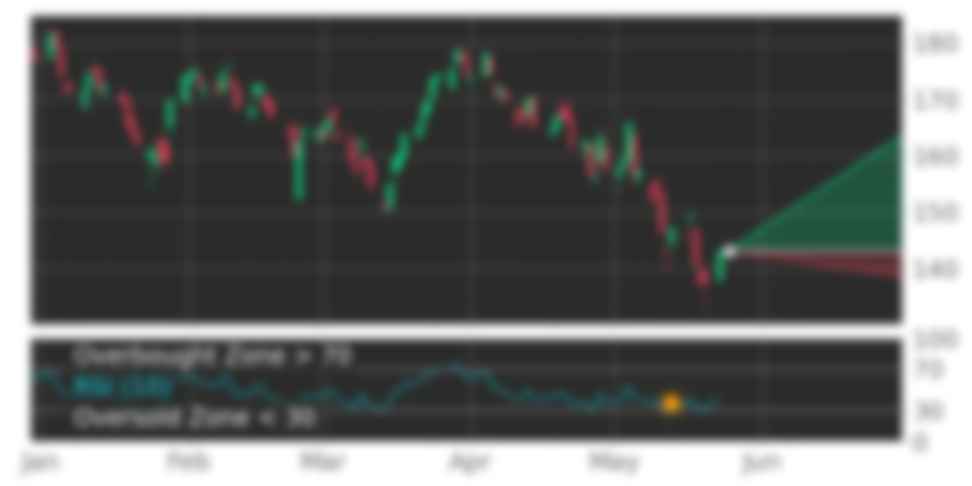
In recent weeks, Palladyne AI Corp. shares have reflected broader investor interest in AI-enabled defense and industrial technologies. The stock has experienced notable volatility consistent with small-cap growth names in the autonomy sector, influenced by earnings results, contract momentum, and sector sentiment. Trading activity has remained elevated as the company advances its vertically integrated platform, with market participants closely monitoring progress on backlog conversion and commercial deployments. Overall, the shares continue to trade within a range shaped by both near-term execution milestones and longer-term growth narratives in collaborative autonomy. I also checked this using Tickeron’s AI Screener to see how the stock compares to others in the industry.
Several key events over the past 30 days have shaped investor sentiment around Palladyne AI Corp. On May 5, 2026, the company released its first-quarter 2026 financial results, reporting revenue of $3.5 million, a 107% increase from $1.7 million in the prior-year period. This growth stemmed from expanded defense programs and the first full quarter of operations following the November 2025 acquisitions that positioned the firm as a vertically integrated defense and industrial AI company. Non-GAAP EPS came in at a loss of $0.23, wider than the year-ago period due to higher operating expenses tied to growth investments. Management reiterated full-year 2026 revenue guidance of $24 million to $27 million, representing substantial year-over-year expansion, with expectations for sequential quarterly growth accelerating in the second half as backlog converts.
The quarter also featured a backlog of approximately $17 million as of March 31, 2026, including roughly $7 million in new contract awards. Notable operational progress included demonstrations of collaborative autonomous swarming using the IntelliSwarm and SwarmOS platforms, follow-on orders for flight computer variants, and expanded partnerships such as with Draganfly for drone integration testing. Additional contracts secured through subsidiaries GuideTech and Palladyne Defense targeted space navigation support and a propulsion subsystem for a U.S. missile program, expected to contribute nearly $1 million in 2026 revenue. Intellectual property advancements featured a new U.S. patent on AI-driven swarming architectures and whitepapers outlining the company’s Decentralized Embodied Collaborative Autonomy framework.
Further bolstering defense positioning, on June 1, 2026, Palladyne AI appointed retired Lieutenant General Sean Bernabe and retired Brigadier General Gwyn Armfield to its Defense Advisory Board. Days later, the company announced participation in the Jefferies 2026 Defense Tech Summit. On May 22, 2026, it disclosed employee equity awards as part of standard compensation practices. These developments, combined with earlier analyst actions including rating initiations and modest price target adjustments, contributed to heightened trading interest and price fluctuations as investors weighed execution progress against ongoing cash burn and path-to-profitability considerations.
Looking ahead to 2026, Palladyne AI Corp. is positioned to capitalize on increasing defense spending on autonomous systems, collaborative swarming, and multi-domain operations. Key themes include backlog conversion from the current $17 million level, acceleration of commercial deployments for its Palladyne IQ platform, and continued expansion into space and industrial markets. Investors may watch progress on government contract awards, particularly in counter-UAS and precision fires programs, alongside the company’s ability to maintain liquidity amid guided quarterly cash usage of $8 million to $9 million.
Additional factors include execution on intellectual property monetization, regulatory developments in defense procurement, and competitive dynamics in the embodied AI space. Management has emphasized back-end weighted revenue expectations, with the second half of the year anticipated to drive the majority of growth. Monitoring quarterly operating results, new contract announcements, and strategic partnerships will provide insight into the company’s trajectory through the year. From what I see, the path to profitability remains a key focus area amid these growth investments.
One tool I often turn to when looking for data-driven trading ideas is Tickeron’s Trending AI Robots page. It showcases a curated selection of high-performing AI trading bots designed to navigate evolving market conditions. While Tickeron offers hundreds of AI trading bots that trade thousands of different tickers, only the strongest performers suited to current environments earn placement in this featured section. These bots span diverse trading styles, strategies, timeframes, performance metrics, and ticker sets, providing investors with data-driven options for automated trading. Performance statistics vary widely across the platform, with top bots demonstrating robust risk-adjusted returns in various market regimes. For more details on these tools, visit Trending AI Robots.
The information on this webpage is provided for general informational and educational purposes only and is not intended as investment advice, a recommendation to purchase or sell any security, or an offer or solicitation related to investments. It does not consider your personal financial situation, goals, or risk profile, and all investing carries inherent risks, including the possibility of losing your entire investment. For more details, please review our full disclaimer.
Moving higher for three straight days is viewed as a bullish sign. Keep an eye on this stock for future growth. Considering data from situations where PDYN advanced for three days, in of 219 cases, the price rose further within the following month. The odds of a continued upward trend are .
The Momentum Indicator moved above the 0 level on May 21, 2026. You may want to consider a long position or call options on PDYN as a result. In of 89 past instances where the momentum indicator moved above 0, the stock continued to climb. The odds of a continued upward trend are .
The Moving Average Convergence Divergence (MACD) for PDYN just turned positive on May 26, 2026. Looking at past instances where PDYN's MACD turned positive, the stock continued to rise in of 52 cases over the following month. The odds of a continued upward trend are .
PDYN moved above its 50-day moving average on May 22, 2026 date and that indicates a change from a downward trend to an upward trend.
The 10-day moving average for PDYN crossed bullishly above the 50-day moving average on May 26, 2026. This indicates that the trend has shifted higher and could be considered a buy signal. In of 14 past instances when the 10-day crossed above the 50-day, the stock continued to move higher over the following month. The odds of a continued upward trend are .
The Aroon Indicator entered an Uptrend today. In of 140 cases where PDYN Aroon's Indicator entered an Uptrend, the price rose further within the following month. The odds of a continued Uptrend are .
The 10-day RSI Indicator for PDYN moved out of overbought territory on June 03, 2026. This could be a bearish sign for the stock. Traders may want to consider selling the stock or buying put options. Tickeron's A.I.dvisor looked at 27 similar instances where the indicator moved out of overbought territory. In of the 27 cases, the stock moved lower in the following days. This puts the odds of a move lower at .
The Stochastic Oscillator may be shifting from an upward trend to a downward trend. In of 51 cases where PDYN's Stochastic Oscillator exited the overbought zone, the price fell further within the following month. The odds of a continued downward trend are .
Following a 3-day decline, the stock is projected to fall further. Considering past instances where PDYN declined for three days, the price rose further in of 62 cases within the following month. The odds of a continued downward trend are .
PDYN broke above its upper Bollinger Band on May 26, 2026. This could be a sign that the stock is set to drop as the stock moves back below the upper band and toward the middle band. You may want to consider selling the stock or exploring put options.
The Tickeron Valuation Rating of (best 1 - 100 worst) indicates that the company is fair valued in the industry. This rating compares market capitalization estimated by our proprietary formula with the current market capitalization. This rating is based on the following metrics, as compared to industry averages: P/B Ratio (4.643) is normal, around the industry mean (16.241). P/E Ratio (27.188) is within average values for comparable stocks, (70.069). Projected Growth (PEG Ratio) (0.000) is also within normal values, averaging (1.817). PDYN has a moderately low Dividend Yield (0.000) as compared to the industry average of (0.020). P/S Ratio (41.841) is also within normal values, averaging (151.187).
The Tickeron Price Growth Rating for this company is (best 1 - 100 worst), indicating steady price growth. PDYN’s price grows at a higher rate over the last 12 months as compared to S&P 500 index constituents.
The Tickeron PE Growth Rating for this company is (best 1 - 100 worst), pointing to worse than average earnings growth. The PE Growth rating is based on a comparative analysis of stock PE ratio increase over the last 12 months compared against S&P 500 index constituents.
The Tickeron SMR rating for this company is (best 1 - 100 worst), indicating weak sales and an unprofitable business model. SMR (Sales, Margin, Return on Equity) rating is based on comparative analysis of weighted Sales, Income Margin and Return on Equity values compared against S&P 500 index constituents. The weighted SMR value is a proprietary formula developed by Tickeron and represents an overall profitability measure for a stock.
The Tickeron Profit vs. Risk Rating rating for this company is (best 1 - 100 worst), indicating that the returns do not compensate for the risks. PDYN’s unstable profits reported over time resulted in significant Drawdowns within these last five years. A stable profit reduces stock drawdown and volatility. The average Profit vs. Risk Rating rating for the industry is 92, placing this stock worse than average.
The average fundamental analysis ratings, where 1 is best and 100 is worst, are as follows
Industry ComputerCommunications