


June 17, 2025's Top Performers: The Emergence of AI-Powered FLMs and AI Trading Agents
In the fast-evolving world of algorithmic trading, Tickeron continues to redefine innovation. On June 17, 2025, several new trading agents powered by upgraded Financial Learning Models (FLMs) achieved standout performance, surpassing previous records with annualized returns ranging from +250% to +362%. These models, operating on ultra-responsive 5-minute and 15-minute charts, demonstrate the rapid evolution and adaptability of artificial intelligence in financial markets.
Below is a detailed breakdown of the top-performing AI agents, their strategic models, and why they represent a significant leap forward in AI-driven trading.
FLMs: Faster, Smarter, More Reactive
Recent technological enhancements have significantly boosted the performance and responsiveness of Tickeron's Financial Learning Models. These AI systems are now capable of learning from market data in near real-time, optimizing trade execution, and reducing noise by filtering out non-actionable patterns. As a result, new 5-minute and 15-minute AI Agents have emerged, offering unmatched speed and precision.
This expansion of capacity and algorithmic intelligence has enabled the launch of ultra-fast agents tailored to diverse trading styles and instruments. Below, we explore the top five performers.
AI Trading Agent (5-Minute)
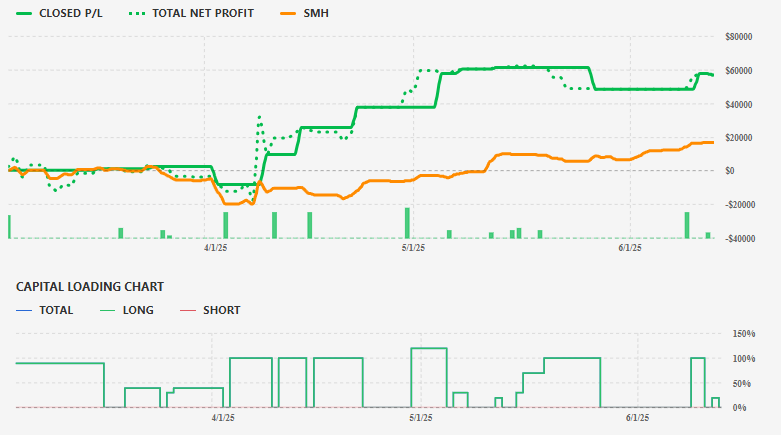
Annualized Return: +362%
Strategy and Suitability
The SOXL AI agent focuses on the Direxion Daily Semiconductor Bull 3X Shares (SOXL), a leveraged ETF aiming to deliver 300% of the daily return of the ICE Semiconductor Index. This product is suitable for traders seeking high short-term exposure to the semiconductor sector.
Designed for beginners and advanced users alike, the bot combines 5-minute intraday pattern recognition with daily exit signal confirmation, creating a powerful swing trading strategy that reacts quickly to volatility.
FLM-Powered Features
- Real-Time Pattern Recognition on M5 charts
- FLM Trend Filtering for noise reduction
- Machine Learning Optimization to identify high-probability trades
- Swing Trading Model with smart entry/exit rules
- Automated Risk Control with a six-position limit
With a staggering 362% annualized return, the SOXL agent exemplifies the high-performance capability of ultra-short-term AI trading.
AI Trading Agent (15-Minute)
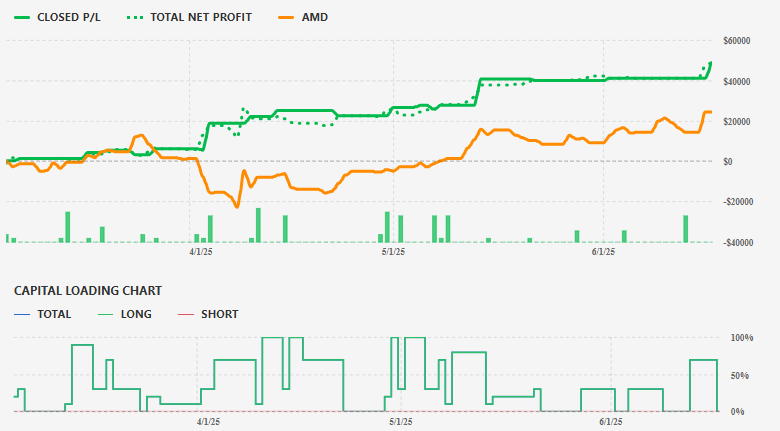
Annualized Return: +294%
Strategy and Dual Ticker Approach
This double-agent strategy leverages a long position in AMD—a semiconductor leader—and a hedge via SOXS, an inverse ETF designed to rise when the semiconductor index falls. This dynamic approach helps balance directional risk while optimizing gains.
The 15-minute AI model is tuned for moderate-frequency traders who want more reaction time while still leveraging real-time data.
ML and Hedging Strategy
- Bullish/Bearish Dual Analysis using FLMs
- Inverse ETF Integration for Risk Mitigation
- AI Trend Detection with 15-minute recalibration
- Optimized Swing Strategy guided by broader daily macro signals
This agent is ideal for those who want exposure to growth names like AMD while using SOXS to protect their capital in volatile conditions.
AI Trading Agent (5-Minute)
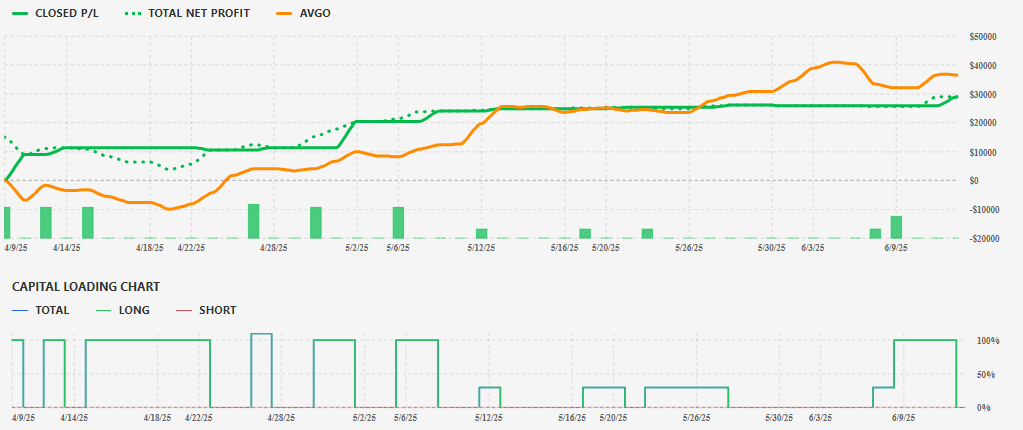
Annualized Return: +271%
Stock Focus and AI Edge
Broadcom (AVGO), a diversified tech and semiconductor powerhouse, provides fertile ground for technical AI trading. The AVGO agent capitalizes on price movements using high-frequency 5-minute charts, applying AI to detect short-term trend reversals and breakouts.
Strategic Benefits
- Pattern Recognition Engine tuned to Broadcom’s price action
- FLM Filtering to reduce false signals
- Emotion-Free Execution—a key advantage for novice traders
- Integrated Risk Management with a six-position limit
Its +271% annualized return illustrates how precision AI models can thrive in relatively stable, high-volume stocks like AVGO.
AI Trading Agent (5-Minute)
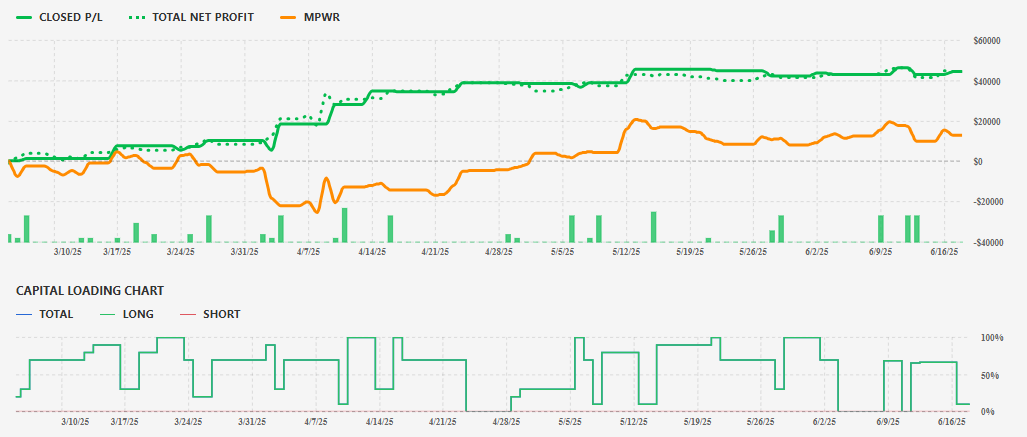
Annualized Return: +257%
Dual Asset Intelligence
Monolithic Power Systems (MPWR) offers a high-growth, high-volatility profile that suits AI trading models exceptionally well. Paired with SOXS as a hedge, this agent benefits from both upward trends in MPWR and downturns in the semiconductor index.
Tactical Features
- 5-Minute Entry Triggers with real-time pattern detection
- FLM Validation Layer to confirm market direction
- Advanced ML-Driven Strategy Execution
- Swing-Oriented Framework with daily exit logic
- 10 Position Limit for broader portfolio diversification
This trading agent appeals to intermediate and advanced users who want built-in hedging and a broader risk profile across two correlated instruments.
AI Trading Agent (5-Minute)
Annualized Return: +250%
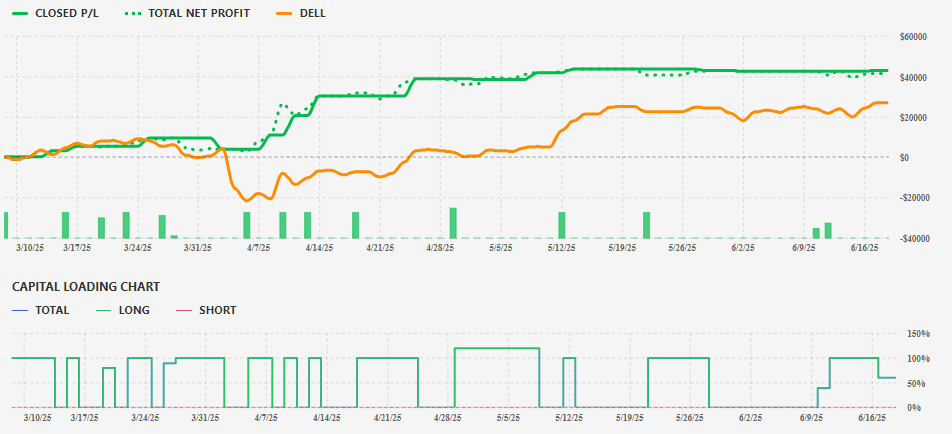
Deep Tech Meets AI
Dell Technologies, a mature IT and data infrastructure company, presents reliable trends that are ideal for machine learning models. The DELL trading agent utilizes short-term price momentum and volume spikes to identify trades with minimal lag.
FLM-Enhanced Strategy
- Fast Pattern Recognition on the M5 chart
- Daily Signal Alignment for trade exits
- Position Caps and Real-Time Monitoring
- User-Friendly Interface for newer traders
This agent delivers robust returns through disciplined risk management and short-term technical precision, demonstrating the broad applicability of Tickeron’s FLMs even in less volatile stocks.
FLMs: The Intelligence Behind the Performance
Tickeron’s proprietary Financial Learning Models (FLMs) are the cornerstone of these results. Developed under the leadership of Sergey Savastiouk, CEO, these models blend traditional technical indicators with advanced AI and machine learning frameworks.
Key Capabilities:
- Real-time identification of bullish/bearish setups
- Adaptive learning based on evolving market behavior
- Noise reduction and signal optimization
- Trade automation with built-in risk mitigation
- Beginner-friendly tools and advanced agents for experienced traders
FLMs are now not only faster but also more accurate, enabling real-time decision-making that was previously out of reach for individual investors.
Conclusion: A New Era of AI Trading
The trading agents released and benchmarked on June 17, 2025, clearly show how AI and FLMs are reshaping retail and institutional trading. With performance numbers ranging from +250% to +362% annualized returns, these agents provide compelling evidence of the power of responsive, adaptive AI.
For users, the benefits are clear:
- Simplified access to advanced strategies
- Reduced emotional trading
- Automated risk and portfolio management
- Scalable AI to match individual goals
As financial markets become increasingly fast-paced and complex, tools like Tickeron’s FLM-powered trading agents offer an intelligent solution for navigating volatility with confidence and precision.
Contributor
Serhii Bondarenko is an AI-focused trading strategist and financial markets analyst specializing in the development and application of AI trading bots and autonomous trading agents. His work combines technical analysis, fundamental analysis, and quantitative research to identify market patterns, forecast price movements, and analyze liquidity, volatility, and correlations across global stock markets. Serhii actively publishes market insights, forecasts, and trading frameworks on platforms such as Investing.com and Finextra, with a strong focus on AI-driven decision-making and next-generation algorithmic trading. His research aims to bridge the gap between traditional trading methodologies and advanced artificial intelligence, helping traders and investors navigate complex and rapidly evolving market conditions.
Momentum Indicator for SOXL turns positive, indicating new upward trend
SOXL saw its Momentum Indicator move above the 0 level on September 17, 2026. This is an indication that the stock could be shifting in to a new upward move. Traders may want to consider buying the stock or buying call options. Tickeron's A.I.dvisor looked at 80 similar instances where the indicator turned positive. In 77 of the 80 cases, the stock moved higher in the following days. The odds of a move higher are at 90%.

Technical Analysis (Indicators)
Bullish Trend Analysis
The Moving Average Convergence Divergence (MACD) for SOXL just turned positive on September 04, 2026. Looking at past instances where SOXL's MACD turned positive, the stock continued to rise in 50 of 50 cases over the following month. The odds of a continued upward trend are 90%.
SOXL moved above its 50-day moving average on September 21, 2026 date and that indicates a change from a downward trend to an upward trend.
The 10-day moving average for SOXL crossed bullishly above the 50-day moving average on September 25, 2026. This indicates that the trend has shifted higher and could be considered a buy signal. In 12 of 14 past instances when the 10-day crossed above the 50-day, the stock continued to move higher over the following month. The odds of a continued upward trend are 86%.
Following a +6.88% 3-day Advance, the price is estimated to grow further. Considering data from situations where SOXL advanced for three days, in 315 of 338 cases, the price rose further within the following month. The odds of a continued upward trend are 90%.
The Aroon Indicator entered an Uptrend today. In 258 of 267 cases where SOXL Aroon's Indicator entered an Uptrend, the price rose further within the following month. The odds of a continued Uptrend are 90%.
Bearish Trend Analysis
The 10-day RSI Indicator for SOXL moved out of overbought territory on October 07, 2026. This could be a bearish sign for the stock. Traders may want to consider selling the stock or buying put options. Tickeron's A.I.dvisor looked at 41 similar instances where the indicator moved out of overbought territory. In 38 of the 41 cases, the stock moved lower in the following days. This puts the odds of a move lower at 90%.
The Stochastic Oscillator demonstrated that the ticker has stayed in the overbought zone for 12 days. The longer the ticker stays in the overbought zone, the sooner a price pull-back is expected.
Following a 3-day decline, the stock is projected to fall further. Considering past instances where SOXL declined for three days, the price rose further in 50 of 62 cases within the following month. The odds of a continued downward trend are 90%.
SOXL broke above its upper Bollinger Band on September 21, 2026. This could be a sign that the stock is set to drop as the stock moves back below the upper band and toward the middle band. You may want to consider selling the stock or exploring put options.
Notable companies
Industry description
Market Cap
High and low price notable news
Volume
Fundamental Analysis Ratings
The average fundamental analysis ratings, where 1 is best and 100 is worst, are as follows

Advertisement
General Information
Category Trading
Advertisement