MENU
Go to the list of all blogs
Sergey Savastiouk's Avatar
published in Blogs
Apr 07, 2026

American Express (AXP): Neutral Technicals Amid Consolidation Near Key Support

Key Takeaways

  • Neutral overall technical rating with mixed signals across timeframes: short-term buy indications from oscillators and MAs, longer-term sell from key MAs.
  • Price consolidating near $300-$306 around a major weekly upward-sloping trendline support from October 2023 (third touch), with prior bounces.
  • RSI (14) at 48.17 (neutral); weekly RSI near 38 showing bullish divergence with higher lows.
  • MACD (12,26) at -5.89 (buy signal) amid daily/weekly divergences suggesting potential momentum shift.
  • Key support at $291-$292 (S1), pivot $302; resistance at $313 (R1), $323 (R2).
  • Below 50-day SMA ($324), 200-day SMA ($335), confirming downtrend from 52-week high of $387.
  • Traders watching $310-$315 breakout for targets toward $340+.

Understanding the Trend in AXP

From what I see on the chart of AXP, there's a neutral short-term trend playing out within a broader downtrend that's developed over the past quarter. Shares have fallen about -17% year-to-date from a 52-week high near $387, and now they're trading around $305-$306 in a consolidation phase over the last 30 days, posting a modest 1.7% gain. The price action is forming higher lows in what looks like an impulsive structure, but the inability to reclaim longer-term moving averages points to ongoing bearish pressure. One thing that stands out is the key upward-sloping weekly trendline from October 2023, which has acted as support on three occasions now—the current test near $300 is something I'm watching closely for potential bounces, as we've seen before.

Critical Support and Resistance Levels

Pivot analysis puts the classic pivot right at $302, which lines up neatly with the recent consolidation range. Immediate support is at S1 $291.48, with deeper levels down at S2 $280 and S3 $259. On the resistance side, it starts at R1 $312.97, then R2 $323.46, and R3 $345. These align well with the zones traders are focused on: $300 as that critical trendline support, and $310-$315 as a potential breakout area. In my view, a sustained move above $313 could open up targets around $340, while a break below $291 might quicken the pace toward those lower supports.

Momentum Indicators: Signs of Divergence

Momentum indicators are holding a balanced stance right now, but there are hints of bullish divergence emerging. The daily RSI (14) sits at 48.17, firmly neutral and steering clear of overbought or oversold territory. On the weekly chart, RSI is near 38—edging toward oversold—while forming higher lows relative to price, which is a classic bullish signal. The MACD (12,26) at -5.89 is flashing a buy signal, bolstered by divergences on both daily and weekly timeframes where momentum isn't keeping pace with the price declines. Stochastic %K (14,3,3) at 70.54 remains neutral, and CCI (20) at 80.93 indicates there's still room to the upside before hitting overbought levels.

Moving Averages: Short-Term Buy, Long-Term Sell

The shorter-term moving averages are leaning bullish: EMA(10) at $300.93 (buy), SMA(20) at $300.14 (buy), and VWMA(20) at $300.04 (buy). That said, price is still trading below the longer-term averages—SMA(50) at $324.19 (sell), SMA(100) at $346.01 (sell), and SMA(200) at $335.39 (sell). This bearish setup across the key 50-, 100-, and 200-day MAs confirms the intermediate downtrend. I also checked this using Tickeron’s AI Screener to see how AXP stacks up against peers, and a crossover above the 50-day SMA would be a pivotal signal for any reversal.

Volume Profile and Market Activity

Volume lately has been running below average, around 780K shares compared to the typical 3.8M, which fits with the subdued action during this consolidation. I've noticed demand picking up on those trendline tests, and volume spikes would be key to watch on any breakouts. With a beta of 1.30, AXP shows higher volatility than the broader market, which is typical for financial sector names.

AI Daily Buy/Sell Signals

In my own research, I turn to Tickeron’s AI Daily Buy/Sell Signals to analyze stocks like AXP. This tool uses artificial intelligence to dig through massive amounts of market data, technical indicators, and price patterns, delivering actionable buy or sell signals. It pulls from trend recognition, historical pattern matching, and momentum analysis to help spot entry and exit points, confirm trends, and support trading decisions—especially useful in volatile stretches. I find it reliable for validating chart setups and sharpening timing. If you're looking for real-time insights tied to the current market, checking out the AI Daily Buy/Sell Signals is part of my routine.

Technical Outlook: Levels I'm Monitoring

Overall, I'm keeping an eye on whether AXP holds above that $300 trendline support for any bullish continuation—a weekly close above $310-$315 could push toward $340-$360, and maybe even extensions to $380. On the flip side, a drop below $291 might test those deeper supports at $280. Key things to monitor include sustained bullish divergence in RSI, MACD crossovers, and volume pickup on moves toward R1 at $313. The short-term MAs could offer dynamic support, but reclaiming the 50-day SMA at $324 is crucial for any real trend shift.

Disclaimer

The information on this webpage is provided for general informational and educational purposes only and is not intended as investment advice, a recommendation to purchase or sell any security, or an offer or solicitation related to investments. It does not consider your personal financial situation, goals, or risk profile, and all investing carries inherent risks, including the possibility of losing your entire investment. For more details, please review our full Disclaimers and Limitations.

Related Ticker: AXP

AXP in +1.26% Uptrend, rising for three consecutive days on May 29, 2026

Moving higher for three straight days is viewed as a bullish sign. Keep an eye on this stock for future growth. Considering data from situations where AXP advanced for three days, in of 329 cases, the price rose further within the following month. The odds of a continued upward trend are .

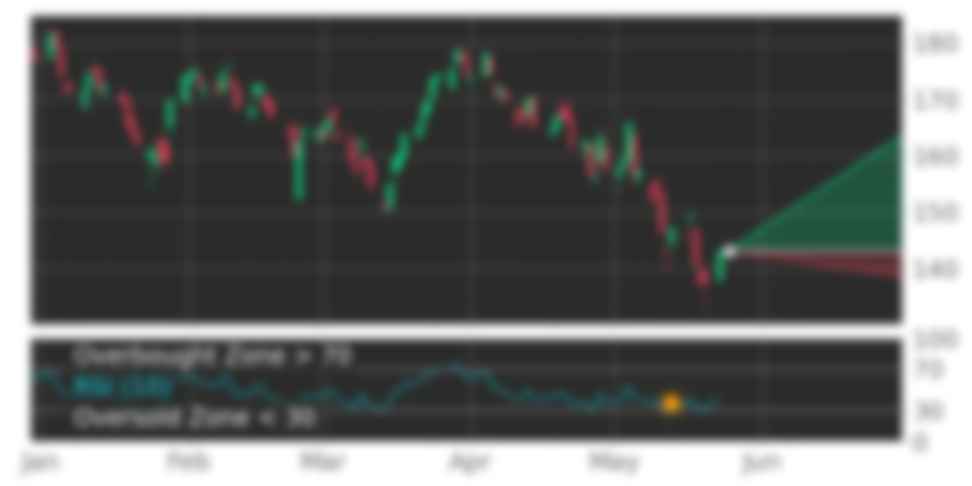
Price Prediction Chart

Technical Analysis (Indicators)

Bullish Trend Analysis

The Moving Average Convergence Divergence (MACD) for AXP just turned positive on May 29, 2026. Looking at past instances where AXP's MACD turned positive, the stock continued to rise in of 47 cases over the following month. The odds of a continued upward trend are .

Bearish Trend Analysis

The Stochastic Oscillator may be shifting from an upward trend to a downward trend. In of 69 cases where AXP's Stochastic Oscillator exited the overbought zone, the price fell further within the following month. The odds of a continued downward trend are .

The Momentum Indicator moved below the 0 level on June 02, 2026. You may want to consider selling the stock, shorting the stock, or exploring put options on AXP as a result. In of 80 cases where the Momentum Indicator fell below 0, the stock fell further within the subsequent month. The odds of a continued downward trend are .

AXP moved below its 50-day moving average on June 02, 2026 date and that indicates a change from an upward trend to a downward trend.

The 10-day moving average for AXP crossed bearishly below the 50-day moving average on May 22, 2026. This indicates that the trend has shifted lower and could be considered a sell signal. In of 14 past instances when the 10-day crossed below the 50-day, the stock continued to move higher over the following month. The odds of a continued downward trend are .

Following a 3-day decline, the stock is projected to fall further. Considering past instances where AXP declined for three days, the price rose further in of 62 cases within the following month. The odds of a continued downward trend are .

AXP broke above its upper Bollinger Band on May 29, 2026. This could be a sign that the stock is set to drop as the stock moves back below the upper band and toward the middle band. You may want to consider selling the stock or exploring put options.

The Aroon Indicator for AXP entered a downward trend on June 01, 2026. This could indicate a strong downward move is ahead for the stock. Traders may want to consider selling the stock or buying put options.

Fundamental Analysis (Ratings)

The Tickeron SMR rating for this company is (best 1 - 100 worst), indicating very strong sales and a profitable business model. SMR (Sales, Margin, Return on Equity) rating is based on comparative analysis of weighted Sales, Income Margin and Return on Equity values compared against S&P 500 index constituents. The weighted SMR value is a proprietary formula developed by Tickeron and represents an overall profitability measure for a stock.

The Tickeron Profit vs. Risk Rating rating for this company is (best 1 - 100 worst), indicating low risk on high returns. The average Profit vs. Risk Rating rating for the industry is 79, placing this stock better than average.

The Tickeron Seasonality Score of (best 1 - 100 worst) indicates that the company is slightly undervalued in the industry. The Tickeron Seasonality score describes the variance of predictable price changes around the same period every calendar year. These changes can be tied to a specific month, quarter, holiday or vacation period, as well as a meteorological or growing season.

The Tickeron PE Growth Rating for this company is (best 1 - 100 worst), pointing to consistent earnings growth. The PE Growth rating is based on a comparative analysis of stock PE ratio increase over the last 12 months compared against S&P 500 index constituents.

The Tickeron Price Growth Rating for this company is (best 1 - 100 worst), indicating fairly steady price growth. AXP’s price grows at a lower rate over the last 12 months as compared to S&P 500 index constituents.

The Tickeron Valuation Rating of (best 1 - 100 worst) indicates that the company is significantly overvalued in the industry. This rating compares market capitalization estimated by our proprietary formula with the current market capitalization. This rating is based on the following metrics, as compared to industry averages: P/B Ratio (6.242) is normal, around the industry mean (3.939). P/E Ratio (19.411) is within average values for comparable stocks, (18.573). Projected Growth (PEG Ratio) (1.530) is also within normal values, averaging (1.054). Dividend Yield (0.011) settles around the average of (0.066) among similar stocks. P/S Ratio (2.901) is also within normal values, averaging (6.685).

Notable companies

The most notable companies in this group are VISA (NYSE:V), Mastercard (NYSE:MA), American Express Company (NYSE:AXP), Capital One Financial (NYSE:COF), PayPal Holdings (NASDAQ:PYPL), Synchrony Financial (NYSE:SYF), SLM Corp (NASDAQ:SLM), Bread Financial Holdings (NYSE:BFH), LexinFintech Holdings Ltd (NASDAQ:LX).

Industry description

A savings bank primary function is to take deposits and paying interest on those deposits. Originating in Europe during the 18th century, these banks were generally introduced to incentivize people of all stripes to save money and park them with banks. By the 1990s, the internet ushered in online savings banks that allowed savers to deposit/transact with banks digitally, without requiring to visit a branch office. Savings banks have potentially encouraged lower-income population to save and have access to a financial institution to earn interest on their money. New York Community Bancorp, Inc, Webster Financial Corporation, Washington Federal, Inc. are examples of savings banks.

Market Cap

The average market capitalization across the Savings Banks Industry is 29.81B. The market cap for tickers in the group ranges from 1.61M to 603.46B. V holds the highest valuation in this group at 603.46B. The lowest valued company is DXF at 1.61M.

High and low price notable news

The average weekly price growth across all stocks in the Savings Banks Industry was -5%. For the same Industry, the average monthly price growth was -3%, and the average quarterly price growth was -7%. QFIN experienced the highest price growth at 32%, while DXF experienced the biggest fall at -23%.

Volume

The average weekly volume growth across all stocks in the Savings Banks Industry was -6%. For the same stocks of the Industry, the average monthly volume growth was 10% and the average quarterly volume growth was 16%

Fundamental Analysis Ratings

The average fundamental analysis ratings, where 1 is best and 100 is worst, are as follows

Valuation Rating: 57
P/E Growth Rating: 65
Price Growth Rating: 55
SMR Rating: 50
Profit Risk Rating: 79
Seasonality Score: 12 (-100 ... +100)
View a ticker or compare two or three
AXP
Daily Signal:
Gain/Loss:
Interact to see
Advertisement
A.I.Advisor
published price charts
Last 5 trading days
A.I. Advisor
published General Information

General Information

a financial conglomerate

Industry SavingsBanks

Profile
Details
Industry
Financial Conglomerates
Address
200 Vesey Street
Phone
+1 212 640-2000
Employees
74600
Web
https://www.americanexpress.com