


From 35% to 198%: The Power of Shorter ML Timeframes in AI Trading
As artificial intelligence continues to reshape the financial markets, one thing is becoming clear: speed and adaptability win. Tickeron’s evolution of its proprietary Financial Learning Models (FLMs)—which integrate AI and machine learning into algorithmic trading—offers a compelling case for the advantages of shorter machine learning (ML) time frames and strategic use of inverse ETFs.
The evidence? A staggering jump in performance—from 35% to 198% annualized return—when comparing two of Tickeron’s AI trading agents: one using 60-minute ML intervals and the other operating on 15-minute ML cycles with expanded hedging strategies.
AI Agent #1: 15-Minute ML with Top 5 Companies + Inverse ETFs
Annualized Return: 198%
9-Ticker AI Agent (15 min)
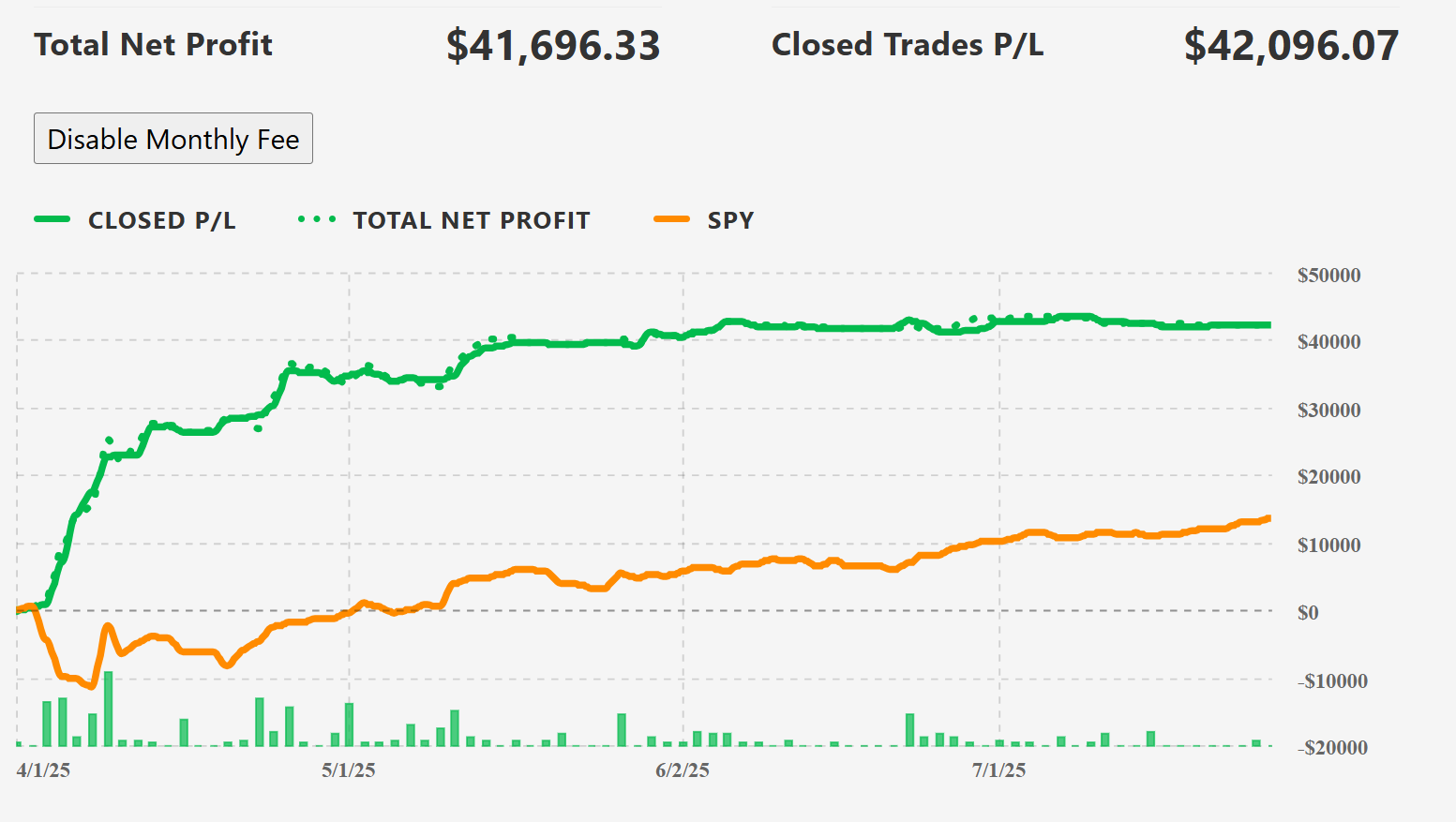
In contrast to its predecessor, this high-frequency trading agent operates across nine tickers, including five mega-cap tech stocks—AAPL, GOOG, NVDA, TSLA, and MSFT—and four leveraged ETFs: SOXL, SOXS, QID, and QLD. The strategy leverages 15-minute ML cycles, offering rapid entry/exit signals and the ability to trade both long and short positions.
Buy Long & Hedge Short
The inclusion of inverse ETFs provides robust hedging capability and enables profitability in down markets, something long-only strategies struggle with.
Strategic Features
- Breakout Acceleration Engine: Identifies volume-driven price breakouts
- High-Frequency Execution: Places multiple trades per session
- Micro-Floating Stop-Loss System: Tight risk control without premature exits
- Dynamic Profit Capture: Targets gains of +4% to +7% per trade
- Volatility Optimization: Focuses on earnings events, macro news, and high-beta stocks
This AI bot is designed for active, momentum-based intraday traders, not passive investors. It thrives in environments characterized by fast-moving news cycles, volatile sentiment, and sharp directional shifts.
AI Agent #2: 60-Minute ML with Top 10 Companies
Annualized Return: 35%
Swing Trader: Top 10 Giants (60 min)
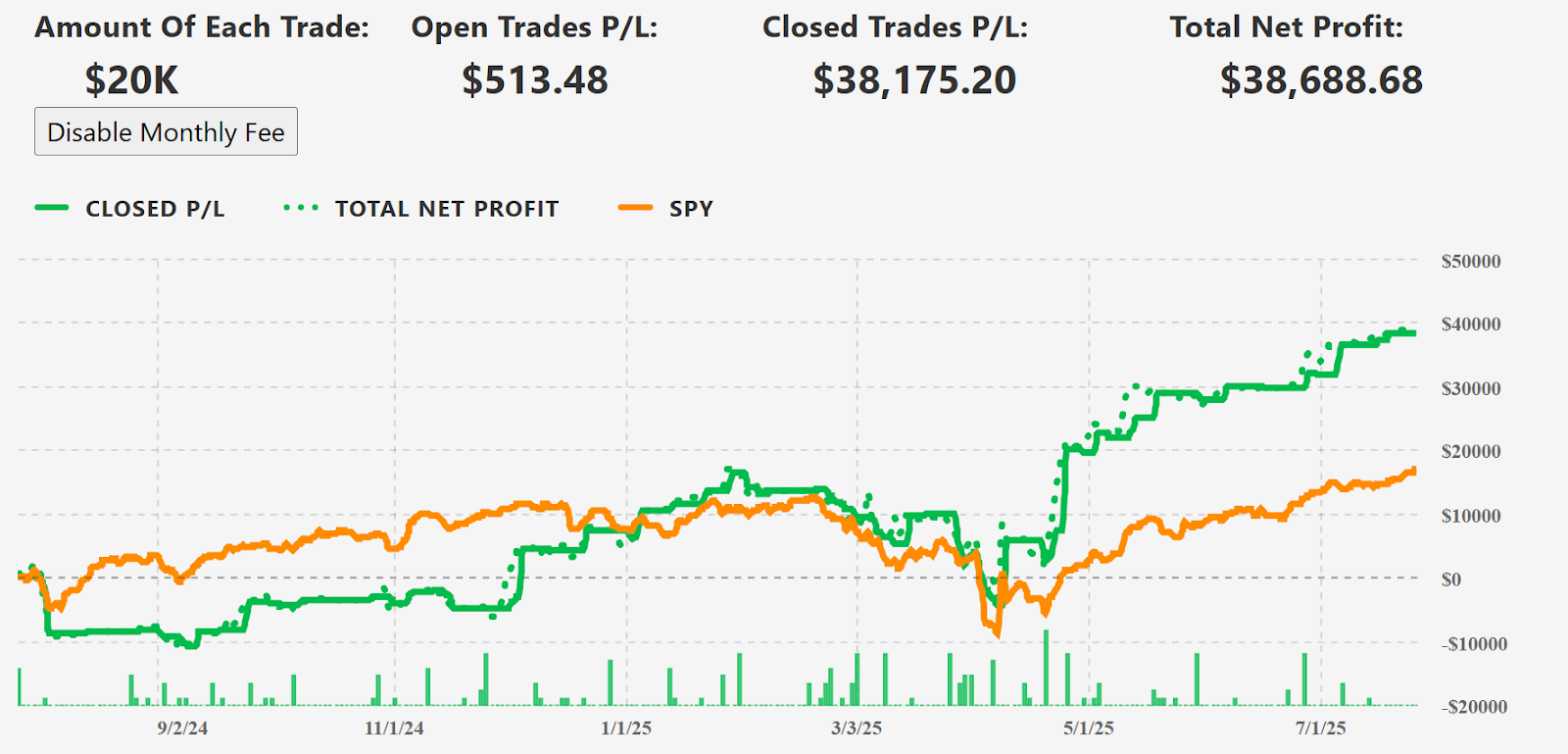
This agent is designed for traders seeking long-only exposure to the top 10 S&P 500 companies by market cap, such as Apple, Microsoft, and Alphabet. It provides a stable, large-cap focused strategy using Tickeron’s 60-minute ML timeframes.
Overview and Suitability
Built for traders of all experience levels, this AI agent navigates the financial markets like a seasoned sailor steering through well-known currents. By focusing on market giants, it minimizes volatility and maximizes stability. Ideal for long-only investors, it avoids frequent trading and targets mean-reversion opportunities—entering positions shortly before market close after a confirmed dip and rebound signal.
Technical Design
The bot uses a blend of hourly (H1) and four-hour (H4) charts, while incorporating daily timeframe filters to validate trend signals. It identifies optimal pullback entries during intraday sell-offs, positioning itself to ride the recovery phase. The trading logic executes conservatively, managing up to six positions at a time.
While the 60-minute ML model performs reliably in calmer markets, its slower cycle means it often misses shorter bursts of volatility or abrupt market reversals. This is where the 15-minute model shines.
Why 15-Minute Time Frames Outperform
The key advantage of the 15-minute ML model is speed and granularity. It allows the AI to process and respond to market changes more frequently, capturing opportunities that longer intervals miss. While the 60-minute model might catch one or two trades a day, the 15-minute model can execute multiple high-probability trades during a single market session.
Benefits of Shorter ML Time Frames
- Faster Reaction Time to market swings
- Greater entry precision, improving risk/reward ratios
- More frequent signals, increasing opportunity volume
- Adaptive learning, responding to real-time volatility
- Better hedging integration, through inverse ETF strategies
By trading both sides of the market and using more granular signals, the 15-minute agent demonstrates higher capital efficiency and stronger return potential.
The Role of Tickeron’s Financial Learning Models (FLMs)
At the core of both agents are Tickeron’s FLMs—sophisticated algorithms trained on massive financial datasets. These models are engineered to:
- Detect patterns invisible to the human eye
- Continuously adapt through machine learning
- Validate trades using multi-timeframe signals
- Integrate technical indicators with real-time sentiment
The 15-minute FLMs take these capabilities to the next level, providing higher-frequency insights, which are critical in today’s fast-paced trading environment.
Performance Summary
Feature
60-Minute Agent (Top 10)
15-Minute Agent (Top 5 + ETFs)
Annualized Return
35%
198%
Timeframe
60 minutes
15 minutes
Instruments
Top 10 S&P 500 stocks
Top 5 Tech + Leveraged ETFs
Trade Frequency
Low
High
Hedge Capabilities
None
Yes (via inverse ETFs)
Volatility Suitability
Medium
High
Max Positions
6
10
Conclusion: The Future Belongs to Faster, Smarter AI
Tickeron’s 15-minute ML strategy proves that shorter learning cycles, strategic diversification, and AI-driven hedging are not just theoretical improvements—they deliver real performance gains. With an annualized return of 198%, this next-generation agent significantly outpaces its 60-minute counterpart.
For traders seeking higher returns, smarter risk controls, and dynamic exposure to both bullish and bearish trends, 15-minute ML AI agents are the future.
Explore AI Agents today at Tickeron.com
Contributor
Sergey Savastiouk, Ph.D. has a degree in Applied Mathematics from Moscow University and has extensive experience as an entrepreneur, investor, manager, and mathematician. His professional expertise is in applied mathematics, mathematical modeling, system and pattern analysis, and software and hardware system integration. He has served as the CEO of several hi-tech start-up companies and nonprofit organizations, which has given him proven capabilities in business strategy for high-tech start-up companies, market assessment, company formation, team building, product development, marketing, and sales. He has published numerous articles in journals and magazines on related fields. As a retail investor, he spent 15 years developing his proprietary trading and quantitative algorithms (now Tickeron’s A.I.), which brought him significant returns in trading the stock market. His current work and goal in founding Tickeron is to bring professional, sophisticated stock market analysis capabilities to retail investors via an easy-to-use interface.
AAPL in +1.08% Uptrend, advancing for three consecutive days on September 22, 2026
Moving higher for three straight days is viewed as a bullish sign. Keep an eye on this stock for future growth. Considering data from situations where AAPL advanced for three days, in 233 of 353 cases, the price rose further within the following month. The odds of a continued upward trend are 66%.

Technical Analysis (Indicators)
Bullish Trend Analysis
The Stochastic Oscillator suggests the stock price trend may be in a reversal from a downward trend to an upward trend. 35 of 56 cases where AAPL's Stochastic Oscillator exited the oversold zone resulted in an increase in price. Tickeron's analysis proposes that the odds of a continued upward trend are 62%.
AAPL moved above its 50-day moving average on September 10, 2026 date and that indicates a change from a downward trend to an upward trend.
The 10-day moving average for AAPL crossed bullishly above the 50-day moving average on August 28, 2026. This indicates that the trend has shifted higher and could be considered a buy signal. In 10 of 18 past instances when the 10-day crossed above the 50-day, the stock continued to move higher over the following month. The odds of a continued upward trend are 56%.
The Aroon Indicator entered an Uptrend today. In 188 of 299 cases where AAPL Aroon's Indicator entered an Uptrend, the price rose further within the following month. The odds of a continued Uptrend are 63%.
Bearish Trend Analysis
The 10-day RSI Indicator for AAPL moved out of overbought territory on September 23, 2026. This could be a bearish sign for the stock. Traders may want to consider selling the stock or buying put options. Tickeron's A.I.dvisor looked at 47 similar instances where the indicator moved out of overbought territory. In 25 of the 47 cases, the stock moved lower in the following days. This puts the odds of a move lower at 53%.
The Momentum Indicator moved below the 0 level on October 01, 2026. You may want to consider selling the stock, shorting the stock, or exploring put options on AAPL as a result. In 37 of 65 cases where the Momentum Indicator fell below 0, the stock fell further within the subsequent month. The odds of a continued downward trend are 57%.
The Moving Average Convergence Divergence Histogram (MACD) for AAPL turned negative on September 29, 2026. This could be a sign that the stock is set to turn lower in the coming weeks. Traders may want to sell the stock or buy put options. Tickeron's A.I.dvisor looked at 46 similar instances when the indicator turned negative. In 21 of the 46 cases the stock turned lower in the days that followed. This puts the odds of success at 46%.
Following a 3-day decline, the stock is projected to fall further. Considering past instances where AAPL declined for three days, the price rose further in 50 of 62 cases within the following month. The odds of a continued downward trend are 56%.
AAPL broke above its upper Bollinger Band on September 01, 2026. This could be a sign that the stock is set to drop as the stock moves back below the upper band and toward the middle band. You may want to consider selling the stock or exploring put options.
Fundamental Analysis (Ratings)
The Tickeron SMR rating for this company is 11 (best 1 - 100 worst), indicating very strong sales and a profitable business model. SMR (Sales, Margin, Return on Equity) rating is based on comparative analysis of weighted Sales, Income Margin and Return on Equity values compared against S&P 500 index constituents. The weighted SMR value is a proprietary formula developed by Tickeron and represents an overall profitability measure for a stock.
The Tickeron Profit vs. Risk Rating rating for this company is 19 (best 1 - 100 worst), indicating low risk on high returns. The average Profit vs. Risk Rating rating for the industry is 94, placing this stock better than average.
The Tickeron PE Growth Rating for this company is 37 (best 1 - 100 worst), pointing to consistent earnings growth. The PE Growth rating is based on a comparative analysis of stock PE ratio increase over the last 12 months compared against S&P 500 index constituents.
The Tickeron Price Growth Rating for this company is 47 (best 1 - 100 worst), indicating steady price growth. AAPL’s price grows at a higher rate over the last 12 months as compared to S&P 500 index constituents.
The Tickeron Seasonality Score of 50 (best 1 - 100 worst) indicates that the company is fair valued in the industry. The Tickeron Seasonality score describes the variance of predictable price changes around the same period every calendar year. These changes can be tied to a specific month, quarter, holiday or vacation period, as well as a meteorological or growing season.
The Tickeron Valuation Rating of 90 (best 1 - 100 worst) indicates that the company is significantly overvalued in the industry. This rating compares market capitalization estimated by our proprietary formula with the current market capitalization. This rating is based on the following metrics, as compared to industry averages: AAPL's P/B Ratio (45.872) is very high in comparison to the industry average of (5.935). P/E Ratio (38.807) is within average values for comparable stocks, (102.284). Projected Growth (PEG Ratio) (2.709) is also within normal values, averaging (4.647). Dividend Yield (0.003) settles around the average of (1.004) among similar stocks. P/S Ratio (10.526) is also within normal values, averaging (4.260).
Notable companies
Industry description
Market Cap
High and low price notable news
Volume
Fundamental Analysis Ratings
The average fundamental analysis ratings, where 1 is best and 100 is worst, are as follows

Advertisement
General Information
a manufacturer of mobile communication, media devices, personal computers, and portable digital music players
Industry ComputerPeripherals
Can Blockchains Reduce Fraud and Failed Payments?
What is the U.S. Dollar (USD) and Why Does It Dominate the Global Economy?
Best Human Capital Stock: A Financial Analysis of the Personnel Services Industry
What a New Iran War Could Mean for Stocks, USO, and XLE This Week
BHP, PANW, HD, MDT, TOL, KEYS, TJX, LOW, ADI, TGT, BIDU, EL, FUTU, GES | Q2 2025 Earnings Preview: August 18-20, 2025
Advertisement