Go to the list of all blogs
Serhii Bondarenko's Avatar
published in Blogs
Mar 08, 2025

Week (March 3 - 7) in Review: Financial Leaders

The week was marked by significant financial events that influenced global markets. Notably, the FTSE 100 Index reached an all-time high, closing at 8,871.31 on March 3, 2025, surpassing its previous records. This surge was driven by strong performances in sectors such as mining and banking. Conversely, the U.S. stock markets faced volatility due to uncertainties surrounding trade policies and economic data, leading to declines in major indices.
Global Overview

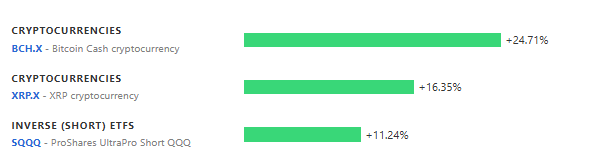
The global financial landscape experienced notable fluctuations this week. Cryptocurrencies like Bitcoin Cash (BCH) and XRP saw significant gains of 24.96% and 16.64%, respectively, reflecting increased investor interest. However, traditional commodities such as the United States Oil Fund (USO) declined by 4.35%, indicating potential shifts in energy markets. Major indexes, including the iShares Russell 2000 ETF (IWM), decreased by 4.36%, highlighting broader market apprehensions.​

Sector Overview

Sector-specific performances varied throughout the week. The financial sector, represented by the iShares MSCI Europe Financials ETF (EUFN), rose by 5.36%, possibly due to positive earnings reports from European banks. The materials sector also performed well, with ETFs like VanEck Rare Earth & Strategic Metals (REMX) and iShares MSCI Global Metals & Mining Producers (PICK gaining 4.72% and 3.26%, respectively, driven by increased demand for industrial metals. In contrast, the technology sector faced challenges; the First Trust Cloud Computing ETF (SKYY) dropped by 7.37%, and the Invesco S&P SmallCap Consumer Discretionary ETF (PSCD) fell by 8.27%, suggesting investor caution in these areas.​

International Overview

International markets displayed mixed results. European ETFs, such as the iShares MSCI Eurozone ETF (EZU) and the JPMorgan BetaBuilders Europe ETF (BBEU), experienced gains of 5.15% and 3.49%, respectively, indicating optimism in the European economy. Latin American markets also showed strength, with the First Trust Brazil AlphaDEX® ETF (FBZ) increasing by 4.04%. Conversely, North American ETFs like the iShares Core S&P 500 ETF (IVV) and the Vanguard Total Stock Market ETF (VTI) declined by over 4%, reflecting investor concerns about the U.S. economic outlook.​

Summary

This week underscored the dynamic nature of global financial markets. While certain sectors and regions experienced growth, others faced declines due to various economic and geopolitical factors. Investors are advised to remain vigilant and consider diversification to navigate the evolving financial landscape effectively.

Disclaimers and Limitations


Related Ticker: USO, BCH, XRP.X, EUFN, REMX, PICK, SKYY, PSCD, BBEU, EZU, FBZ, IVV, VTI

Contributor

Serhii Bondarenko is an AI-focused trading strategist and financial markets analyst specializing in the development and application of AI trading bots and autonomous trading agents. His work combines technical analysis, fundamental analysis, and quantitative research to identify market patterns, forecast price movements, and analyze liquidity, volatility, and correlations across global stock markets. Serhii actively publishes market insights, forecasts, and trading frameworks on platforms such as Investing.com and Finextra, with a strong focus on AI-driven decision-making and next-generation algorithmic trading. His research aims to bridge the gap between traditional trading methodologies and advanced artificial intelligence, helping traders and investors navigate complex and rapidly evolving market conditions.


USO in downward trend: price may decline as a result of having broken its higher Bollinger Band on September 10, 2026

USO broke above its upper Bollinger Band on September 10, 2026. This could be a sign that the stock is set to drop as the stock moves back below the upper band and toward the middle band. You may want to consider selling the stock or exploring put options. The A.I.dvisor looked at 46 similar instances where the stock broke above the upper band. In 43 of the 46 cases the stock fell afterwards. This puts the odds of success at 90%.

Price Prediction Chart

Technical Analysis (Indicators)

Bearish Trend Analysis

The 10-day RSI Indicator for USO moved out of overbought territory on September 16, 2026. This could be a bearish sign for the stock. Traders may want to consider selling the stock or buying put options. Tickeron's A.I.dvisor looked at 36 similar instances where the indicator moved out of overbought territory. In 28 of the 36 cases, the stock moved lower in the following days. This puts the odds of a move lower at 78%.

The Momentum Indicator moved below the 0 level on September 22, 2026. You may want to consider selling the stock, shorting the stock, or exploring put options on USO as a result. In 70 of 87 cases where the Momentum Indicator fell below 0, the stock fell further within the subsequent month. The odds of a continued downward trend are 80%.

The Moving Average Convergence Divergence Histogram (MACD) for USO turned negative on September 21, 2026. This could be a sign that the stock is set to turn lower in the coming weeks. Traders may want to sell the stock or buy put options. Tickeron's A.I.dvisor looked at 54 similar instances when the indicator turned negative. In 44 of the 54 cases the stock turned lower in the days that followed. This puts the odds of success at 81%.

Following a 3-day decline, the stock is projected to fall further. Considering past instances where USO declined for three days, the price rose further in 50 of 62 cases within the following month. The odds of a continued downward trend are 85%.

Bullish Trend Analysis

The Stochastic Oscillator suggests the stock price trend may be in a reversal from a downward trend to an upward trend. 62 of 70 cases where USO's Stochastic Oscillator exited the oversold zone resulted in an increase in price. Tickeron's analysis proposes that the odds of a continued upward trend are 89%.

Following a +4.65% 3-day Advance, the price is estimated to grow further. Considering data from situations where USO advanced for three days, in 301 of 333 cases, the price rose further within the following month. The odds of a continued upward trend are 90%.

The Aroon Indicator entered an Uptrend today. In 224 of 247 cases where USO Aroon's Indicator entered an Uptrend, the price rose further within the following month. The odds of a continued Uptrend are 90%.

Industry description

The investment seeks the daily changes in percentage terms of its shares’ per share NAV to reflect the daily changes in percentage terms of the spot price of light, sweet crude oil delivered to Cushing, Oklahoma, as measured by the daily changes in the price of a specified short-term futures contract on light, sweet crude oil called the “Benchmark Oil Futures Contract,” plus interest earned on USO’s collateral holdings, less USO’s expenses. USO seeks to achieve its investment objective by investing primarily in futures contracts for light, sweet crude oil, other types of crude oil, diesel-heating oil, gasoline, natural gas, and other petroleum-based fuels.
View a ticker or compare two or three
USO
Daily Signal:
Gain/Loss:
Interact to see
Advertisement
A.I.Advisor
published price charts
A.I. Advisor
published General Information

General Information

Category CommoditiesBroadBasket

Category
Commodities Focused
Address
1320 Harbor Bay ParkwaySuite 145Almadeda
Phone
403-233-9366
Web
www.unitedstatesoilfund.com
Interact to see
Advertisement
UBXG stock surged +79% over the last 30 days, driven by heightened trading volume and positive market sentiment amid broader technology sector trends. Over the past quarter, the stock rose +61%, reflecting recovery from earlier lows near its 52-week bottom.
CVGI stock surged approximately +89% over the last 30 days, driven by strong Q4 2025 earnings beat on revenue and positive 2026 guidance. Over the past quarter, shares rose about +126%, reflecting improved profitability, debt reduction, and a key partnership announcement.
SAFX stock surged +104% over the past 30 days, driven by positive updates on a $10 million capital raise and merger progress. Over the past quarter, the stock rose +44%, reflecting recovery from lows amid renewable energy sector interest and strategic developments.
LONA stock surged +80% over the past 30 days, driven by positive analyst upgrades, executive appointments, and full-year financial updates highlighting pipeline progress. Over the past quarter, shares rose +48%, reflecting improved investor sentiment in biotech amid clinical advancements.
Lifetime Brands (LCUT) stock surged +77% over the last 30 days, driven by a strong Q4 earnings beat and a Zacks Rank #1 (Strong Buy) upgrade that reflects an improved earnings outlook. Over the past quarter, shares rose +48%, supported by profitability gains despite softer sales, with adjusted EBITDA reaching $50.8 million for full-year 2025.
CURV stock surged approximately +73% over the last 30 days, driven primarily by a positive reaction to Q4 and fiscal 2025 earnings that beat expectations on EPS and revenue. Over the past quarter, the stock is up around +55%, reflecting recovery from lows near $1 amid ongoing store optimization and sub-brand launches
Blaize Holdings, Inc. (BZAI) focuses on artificial intelligence (AI)-enabled edge computing solutions, offering programmable AI processors and platforms for verticals such as smart cities, defense, retail, and enterprise markets. The company's core revolves around hardware like the Graph Streaming Processor (GSP) AI accelerator, compute cards, and software tools including Blaize AI Studio—a no-code/low-code environment for deploying AI models without source code expertise. Based in El Dorado Hills, California, and founded in 2010, it went public through a merger in early 2025.
Comstock Holding Companies, Inc. (CHCI) operates as an asset manager, developer, and operator of mixed-use and transit-oriented properties, mainly in the greater Washington, D.C. metropolitan area. The company targets high-growth urban and suburban markets, overseeing a portfolio that spans residential, commercial, hospitality, and parking assets near key metro stations. Its asset-light, fee-based model delivers recurring revenue through property management, leasing, development services, and asset recapitalization for institutional investors, family offices, and governments.
From what I see, Home Depot (HD) remains the world's largest home improvement retailer, operating over 2,300 stores across North America with a broad selection of products for construction, renovation, and maintenance. The company blends big-box retail with an expanding e-commerce platform and tailored services for professional contractors, drawing revenue from both do-it-yourself (DIY) consumers and do-it-for-me (DIFM) pros. In a competitive landscape against players like Lowe's, HD maintains dominance through its scale, efficient supply chain, and strong loyalty programs. Much of its performance ties directly to the housing market—home sales, remodeling, and repairs—which explains the recent pressure on the stock from subdued activity and high mortgage rates limiting turnover and major projects.
GE Aerospace (GE) stock declined -12% over the past 30 days, falling from around $333 to $293, amid profit-taking after record highs near $348. Over the past quarter, the stock is down -8%, reflecting post-earnings selloff despite strong Q4 2025 results with 20% revenue growth.
Toyota Motor Corporation (TM) stands as the world's largest automaker by volume, designing, manufacturing, and selling a wide range of vehicles—from sedans and trucks to SUVs and electrified models like hybrids—under brands including Toyota, Lexus, and Daihatsu. The company's business model centers on a robust global supply chain, vertical integration in components like engines and transmissions, and a multi-pathway approach that prioritizes hybrids alongside EVs and hydrogen technology. In the highly competitive automotive sector, Toyota maintains a strong position, particularly with its dominant hybrid market share, though it faces mounting pressure from EV frontrunners such as BYD in China and Tesla worldwide. From what I see, these core strengths explain much of the recent stock action: the resilience from hybrids offers some stability, but the slower EV rollout and heavy China exposure heighten sales volatility in a shifting market.
ARM stock surged +26% over the past 30 days, driven by announcements of in-house chip production and strong analyst upgrades amid AI enthusiasm. Over the past quarter, the stock climbed +38%, reflecting robust Q3 earnings beat with 26% revenue growth and data center royalty doubling.
Sable Offshore Corp. (SOC) is an independent oil and gas company focused on offshore operations in federal waters off California. The company owns and operates three platforms in the Santa Ynez Unit (SYU), spanning 16 federal leases across approximately 76,000 acres, along with subsea pipelines for crude oil, natural gas, and produced water transport to onshore facilities. Its core business model centers on restarting and developing prolific fields like the SYU, which had been idle due to regulatory and legal hurdles following a 2015 pipeline spill.
Sable Offshore Corp. (SOC) shares fell 7.40% in the most recent completed session, closing at $16.52 versus a prior close of $17.84. The pullback followed a volatile stretch in which SOC traded between $15.76 and $19.21 over just two sessions, reflecting profit‑taking after a strong run in March.
NBR stock rose approximately +12% over the last 30 days, driven by positive momentum in the oil and gas drilling sector and strong Q4 earnings beat. Over the past quarter, the stock surged +58%, fueled by robust YTD performance, debt reduction efforts, and improved operational results in international drilling.
Patterson-UTI Energy, Inc. (PTEN) stands out as a leading provider of drilling and completion services to oil and natural gas exploration and production companies, primarily in the United States and select international markets. The company operates through three main segments: Drilling Services, which includes contract drilling rigs and directional drilling; Completion Services, encompassing hydraulic fracturing, wireline, and pumping; and Drilling Products, offering specialized drill bits globally, including in the Middle East.
As a provider of onshore drilling and completion services, Patterson-UTI Energy (PTEN) is gearing up for a key Q1 2026 earnings report against the backdrop of fluctuating oil prices and steady U.S. rig demand. The company's integrated approach across Drilling Services, Completion Services, and Drilling Products gives it a solid footing in North American shale plays. In my view, recent quarters like Q4 2025, where revenue exceeded estimates despite a net loss, highlight its resilience. This upcoming report will offer insights into activity levels, margin trends, and capital discipline amid supply growth and geopolitical tensions. With strong free cash flow and recent dividend increases, PTEN's focus on shareholders stands out, making this a critical gauge for the 2026 outlook in the cyclical oilfield services sector.
When geopolitical turmoil sends markets into chaos, most retail traders freeze — but Tickeron's Energy (OXY, EOG, DVN, FANG, APA, MTDR) AI Trading Agent is built to thrive in exactly these conditions. This 15-minute and 60-minute AI-powered robot has delivered a +76.22% annualized return with a 64.21% win rate and a Profit Factor of 2.70 — trading six of the most volatile and opportunity-rich energy tickers on the market.
The global energy sector is on fire — literally and figuratively. With crude oil prices swinging 20–30% in response to geopolitical flashpoints, OPEC+ production cuts, and escalating conflicts in Eastern Europe and the Middle East, traders who aren't using AI-powered tools are flying blind. Enter Tickeron's Energy (Oil & Gas – E&P) AI Trading Agent — a 60-minute signal robot built exclusively around five high-impact Exploration & Production tickers, now posting a staggering +49% Annualized Return and +1,251% 30-Day Annualized Return, with $14,703 in closed-trade P&L on a $30,000 simulated balance.
From what I see, Cheniere Energy Partners (CQP) holds a commanding position through its ownership and operation of the Sabine Pass LNG terminal in Louisiana, the largest LNG production facility in the U.S. with approximately 30 million tonnes per annum (mtpa) capacity across six trains, alongside the connected Creole Trail Pipeline. This setup makes CQP a leader in U.S. LNG exports, which have accounted for about 11% of global supply in recent years. The company's ~80% contracted production through long-term sale and purchase agreements (SPAs) provides revenue stability, with weighted average remaining lives of around 13 years.