
 GET DAILY SIGNALS
Analyze 39 Chart Patterns with AI — Start Free Today
Tickeron, a leader in AI-powered financial analytics, proudly introduces its upgraded Pattern Search Engine (PSE) — an intelligent screener designed to detect chart patterns across stocks, ETFs, penny stocks, crypto, and forex with ease and precision.
With a simple workflow — set criteria, receive patterns, bookmark, and track performance — users gain instant access to actionable trade setups.
Start your free 14-day trial, then continue for just $30/month at Tickeron.com — click “Try Now.”
“TRY NOW”.

Screener for Stock Chart Patterns ᐉ Pattern Search Engine (PSE)
Simplified Workflow for Smarter Pattern Trading
The enhanced PSE turns complex pattern analysis into a streamlined, intuitive process:
-
Choose your criteria — asset class, price range, confidence level, and pattern types.
-
Monitor your feed — receive automatically identified chart patterns.
-
Bookmark key setups — track breakout, target, and live status.
-
Stay informed — get notifications via email or push alerts.
It’s truly “set-and-receive” intelligence — no complicated setup required, just focused insights powered by AI.
Screener for Stock Chart Patterns ᐉ Pattern Search Engine (PSE)
Sophisticated Pattern Trading Meets AI
Trading chart patterns remains one of the most advanced strategies in equities and derivatives markets because it exploits the psychology of market participants and combines it with structural insights. The new PSE uses artificial intelligence to uncover these hidden dynamics and deliver them in a usable feed.
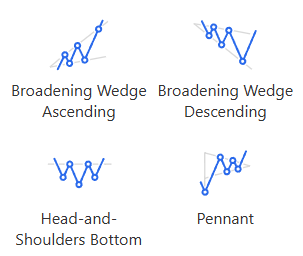
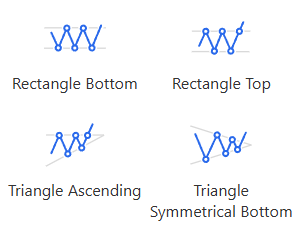
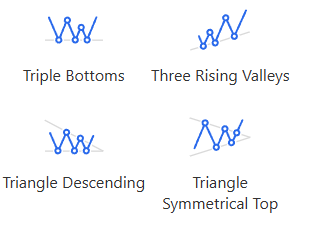
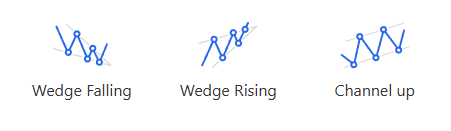
By leveraging the PSE, users are taught by AI to recognize classic patterns and their likely entry and exit points. Every day, the PSE scans thousands of symbols — stocks, ETFs, penny stocks, crypto, forex — for 39 distinct pattern types, including:
Screener for Stock Chart Patterns ᐉ Pattern Search Engine (PSE)
- Broadening Bottom, Broadening Top
- Broadening Wedge Ascending/Descending
- Cup-and-Handle, Flag
- Head-and-Shoulders Bottom, Pennant
- Rectangle Bottom/Top
- Triple Bottoms, Three Rising Valleys
- Triangle Ascending, Symmetrical Bottom, Triangle Descending, Symmetrical Top
- Wedge Falling/Rising, Channel Up
…and many more.
Screener for Stock Chart Patterns ᐉ Pattern Search Engine (PSE)
You can filter by asset class (Stocks, Penny Stocks, ETFs, Forex) and by confidence level, price range, and other custom settings. The more filters you apply, the fewer but higher-quality trade ideas you receive.
Why the Pattern Search Engine Stands Out
-
Covers 39 pattern types across multiple asset classes
-
AI-generated confidence, breakout, and target metrics
-
Fully customizable filters — price range, asset class, and confidence level
-
Real-time notifications and bookmarking features
-
Free 14-day trial, then just $30/month
-
Powered by Tickeron’s proprietary AI/ML infrastructure and Financial Learning Models (FLMs)
Screener for Stock Chart Patterns ᐉ Pattern Search Engine (PSE)
Product Ecosystem: From Patterns to Real-Time Agents
Tickeron offers a full suite of AI-powered trading tools. Key products include:
- AI Trend Prediction Engine — tickeron.com/stock-tpe/
- AI Pattern Search Engine (PSE) — tickeron.com/stock-pattern-screener/
- AI Real Time Patterns — tickeron.com/stock-pattern-scanner/
- AI Screener — tickeron.com/screener/
- Time Machine in AI Screener — tickeron.com/time-machine/
- Daily Buy/Sell Signals — tickeron.com/buy-sell-signals/
Beyond tools, Tickeron offers automated trading and copy-trading via its AI Robots and trading Agents:
- Bot trading and copy-trading: tickeron.com/bot-trading/
- Copy-Trading: tickeron.com/copy-trading/
- AI-Stock-Trading: tickeron.com/ai-stock-trading/
- AI Agents: tickeron.com/ai-agents/
- Virtual Agents: tickeron.com/bot-trading/virtualagents/all/
- Signal Agents: tickeron.com/bot-trading/signals/all/
- Real-Money Bots: tickeron.com/bot-trading/realmoney/all/
Tickeron’s AI Agents are advanced trading entities that leverage proprietary FLMs and machine-learning intervals (5-, 15- and 60-minute cycles) to deliver precision entries and exits across asset classes. Users can choose from Signal Agents (for alerts), Virtual Agents (simulated portfolios) and Brokerage Agents (live trade integration). With these agents, the company bridges institutional-grade execution with retail accessibility.
Recent Market Context & News
Today’s market is micro-shifting rapidly, and PSE is optimally positioned to capture those changes. For example:
- AMD surged ~31.66% in one week on an OpenAI partnership announcement, with an average daily volume of ~6 million shares. PSE found that in 30 of 37 past instances when AMD’s 50-day moving average was breached, a further rise occurred (~81% odds) via Tickeron’s back-tests. tickeron.com
- According to Tickeron’s blog, AI Robots achieved annualized returns up to +54% on 15-minute models during a recent market rally. tickeron.com
- AI Trading Bots delivered up to +strong performance in volatile markets, showcasing the power of shorter ML intervals of 5 and 15 minutes. tickeron.com
These market movements emphasize the importance of pattern recognition and AI-driven timing — exactly the problem PSE is designed to address.
Pricing and Free Trial
Start your free 14-day trial today at Tickeron.com.
Continue afterward for just $30/month — simple pricing for advanced AI capabilities.
Empowering Traders with AI-Driven Simplicity
The Pattern Search Engine gives traders an elegant yet powerful workflow: continuous scanning, AI-calculated breakout and target levels, confidence metrics, and instant alerts.
Whether trading stocks, ETFs, penny stocks, crypto, or forex, users receive institutional-level pattern insights at retail cost.
By filtering by pattern type, confidence, price range, or asset class, traders focus only on the highest-probability setups — not the noise.
Powered by Financial Learning Models (FLMs)
At the core of PSE lies Tickeron’s Financial Learning Models (FLMs) and Machine Learning Models (MLMs), trained on massive datasets across multiple timeframes (5, 15, and 60 minutes).
These models analyze price action, volume, sentiment, and macro data to detect emerging structures and forecast breakout potential.
Internal tests confirm that shorter ML cycles improve timing accuracy by 20–30%, significantly boosting signal quality.
About Tickeron
Tickeron is a leading AI financial technology company developing intelligent tools for traders and investors.
Powered by proprietary Financial Learning Models (FLMs), Tickeron delivers real-time analytics, pattern recognition, and predictive trading insights across multiple asset classes.
Visit tickeron.com and follow us on Twitter/X at @Tickeron for updates.
Screener for Stock Chart Patterns ᐉ Pattern Search Engine (PSE)
Contributor
Serhii Bondarenko is an AI-focused trading strategist and financial markets analyst specializing in the development and application of AI trading bots and autonomous trading agents. His work combines technical analysis, fundamental analysis, and quantitative research to identify market patterns, forecast price movements, and analyze liquidity, volatility, and correlations across global stock markets. Serhii actively publishes market insights, forecasts, and trading frameworks on platforms such as Investing.com and Finextra, with a strong focus on AI-driven decision-making and next-generation algorithmic trading. His research aims to bridge the gap between traditional trading methodologies and advanced artificial intelligence, helping traders and investors navigate complex and rapidly evolving market conditions.
TSLA in +5.00% Uptrend, rising for three consecutive days on October 21, 2026
Moving higher for three straight days is viewed as a bullish sign. Keep an eye on this stock for future growth. Considering data from situations where TSLA advanced for three days, in 257 of 325 cases, the price rose further within the following month. The odds of a continued upward trend are 79%.

Technical Analysis (Indicators)
Bullish Trend Analysis
The Momentum Indicator moved above the 0 level on October 26, 2026. You may want to consider a long position or call options on TSLA as a result. In 63 of 86 past instances where the momentum indicator moved above 0, the stock continued to climb. The odds of a continued upward trend are 73%.
The Moving Average Convergence Divergence (MACD) for TSLA just turned positive on October 26, 2026. Looking at past instances where TSLA's MACD turned positive, the stock continued to rise in 33 of 46 cases over the following month. The odds of a continued upward trend are 72%.
TSLA moved above its 50-day moving average on October 19, 2026 date and that indicates a change from a downward trend to an upward trend.
The Aroon Indicator entered an Uptrend today. In 156 of 234 cases where TSLA Aroon's Indicator entered an Uptrend, the price rose further within the following month. The odds of a continued Uptrend are 67%.
Bearish Trend Analysis
The Stochastic Oscillator may be shifting from an upward trend to a downward trend. In 50 of 64 cases where TSLA's Stochastic Oscillator exited the overbought zone, the price fell further within the following month. The odds of a continued downward trend are 78%.
Following a 3-day decline, the stock is projected to fall further. Considering past instances where TSLA declined for three days, the price rose further in 50 of 62 cases within the following month. The odds of a continued downward trend are 78%.
Fundamental Analysis (Ratings)
The Tickeron PE Growth Rating for this company is 31 (best 1 - 100 worst), pointing to outstanding earnings growth. The PE Growth rating is based on a comparative analysis of stock PE ratio increase over the last 12 months compared against S&P 500 index constituents.
The Tickeron Price Growth Rating for this company is 49 (best 1 - 100 worst), indicating steady price growth. TSLA’s price grows at a higher rate over the last 12 months as compared to S&P 500 index constituents.
The Tickeron Seasonality Score of 50 (best 1 - 100 worst) indicates that the company is fair valued in the industry. The Tickeron Seasonality score describes the variance of predictable price changes around the same period every calendar year. These changes can be tied to a specific month, quarter, holiday or vacation period, as well as a meteorological or growing season.
The Tickeron Profit vs. Risk Rating rating for this company is 70 (best 1 - 100 worst), indicating that the returns do not compensate for the risks. TSLA’s unstable profits reported over time resulted in significant Drawdowns within these last five years. A stable profit reduces stock drawdown and volatility. The average Profit vs. Risk Rating rating for the industry is 93, placing this stock better than average.
The Tickeron SMR rating for this company is 84 (best 1 - 100 worst), indicating slightly better than average sales and a considerably profitable business model. SMR (Sales, Margin, Return on Equity) rating is based on comparative analysis of weighted Sales, Income Margin and Return on Equity values compared against S&P 500 index constituents. The weighted SMR value is a proprietary formula developed by Tickeron and represents an overall profitability measure for a stock.
The Tickeron Valuation Rating of 100 (best 1 - 100 worst) indicates that the company is significantly overvalued in the industry. This rating compares market capitalization estimated by our proprietary formula with the current market capitalization. This rating is based on the following metrics, as compared to industry averages: TSLA's P/B Ratio (17.807) is very high in comparison to the industry average of (1.893). TSLA's P/E Ratio (331.881) is considerably higher than the industry average of (14.173). Projected Growth (PEG Ratio) (4.273) is also within normal values, averaging (2.450). Dividend Yield (0.000) settles around the average of (0.160) among similar stocks. TSLA's P/S Ratio (12.225) is slightly higher than the industry average of (2.648).
Notable companies
Industry description
Market Cap
High and low price notable news
Volume
Fundamental Analysis Ratings
The average fundamental analysis ratings, where 1 is best and 100 is worst, are as follows

Advertisement
General Information
a manufacturer of electric sports cars
Industry MotorVehicles
Advertisement